

Content and Marketing are no longer about winning short bursts of attention. They are about earning durable confidence—from users, algorithms, and ecosystems that increasingly penalize inconsistency. Over the last few years, founders and CMOs have watched reliable tactics decay: rankings vanish despite quality content, traffic fluctuates without warning, and AI-generated sameness floods every channel. The common explanation is “algorithm updates.” The more accurate diagnosis is trust failure.
Modern growth is no longer driven by tactical cleverness. It is driven by whether your content, data, and digital footprint behave like a trustworthy system. Brands that understand this are compounding growth quietly. Those that don’t are burning budgets trying to fix symptoms instead of structures.
The Shift Decision-Makers Feel but Can’t Always Name
Most leadership teams sense that something fundamental has changed. Campaigns that once delivered predictable ROI now feel fragile. SEO dashboards look healthy one quarter and collapse the next. Content volumes increase, yet authority plateaus.
This is not because Content and Marketing stopped working. It’s because fragmented execution no longer maps to how trust is evaluated today.
Search engines, buyers, and even AI-driven discovery tools are converging on one principle: coherence. They reward brands that demonstrate consistency across expertise, intent, behavior, and data integrity. Tactics still matter—but only inside a larger trust architecture.
When trust is absent, optimization becomes noise.
What Everyone Is Saying About Trust (and Why It’s Incomplete)
The industry conversation around trust is loud—but shallow.
You’ll hear:
- “Focus on authenticity.”
- “Build EEAT-compliant content.”
- “Stop manipulative SEO tactics.”
- “Tell better brand stories.”
These points are directionally correct, but operationally weak. They frame trust as a message to broadcast rather than a system to engineer.
Most brands respond by polishing tone, adding author bios, or publishing more “thought leadership.” Meanwhile, the underlying signals—entity consistency, data accuracy, behavioral alignment—remain fragmented. The result is cognitive dissonance: content says one thing, signals say another.
Trust cannot be declared. It has to be verified repeatedly by machines and humans alike.
Trust Is a System, Not a Statement
The core mistake in modern Content and Marketing is treating trust as a creative outcome instead of an operational discipline.
Trust behaves more like infrastructure than messaging. It emerges when multiple systems reinforce the same truth over time:
- Your content aligns with your actual expertise.
- Your brand entities are consistent across platforms.
- Your data sources don’t contradict each other.
- Your user behavior validates your claims.
When one element breaks, trust decays quietly. Rankings slip. Conversion rates flatten. AI summaries stop citing you.
This is why brands with similar content quality experience wildly different outcomes. One has a trust system. The other has content assets.
At IInfotanks, this distinction is foundational. Content is never treated as an isolated output; it’s mapped into a broader Content and Marketing system designed to withstand algorithm volatility, AI interpretation, and compliance scrutiny.
The New SEO Trust Signals Most Brands Ignore
Backlinks still matter—but they are no longer sufficient proxies for trust.
Modern SEO evaluates layered signals that many teams don’t actively manage:
- Entity consistency: Are your brand, authors, products, and topics represented uniformly across the web?
- Behavioral validation: Do users engage, return, and convert in ways that support your authority claims?
- Content integrity: Is your information accurate, current, and internally consistent across pages?
- Governance signals: Do updates, corrections, and authorship reflect accountability?
These are not “optimizations” you apply retroactively. They are outcomes of disciplined Content and Marketing operations.
Without governance, even high-quality content becomes a liability. Errors compound. AI tools remix inaccuracies. Search engines quietly downgrade confidence.
Trust erosion is rarely dramatic. It’s slow, silent, and expensive.
Why “Good Content” Still Loses Rankings
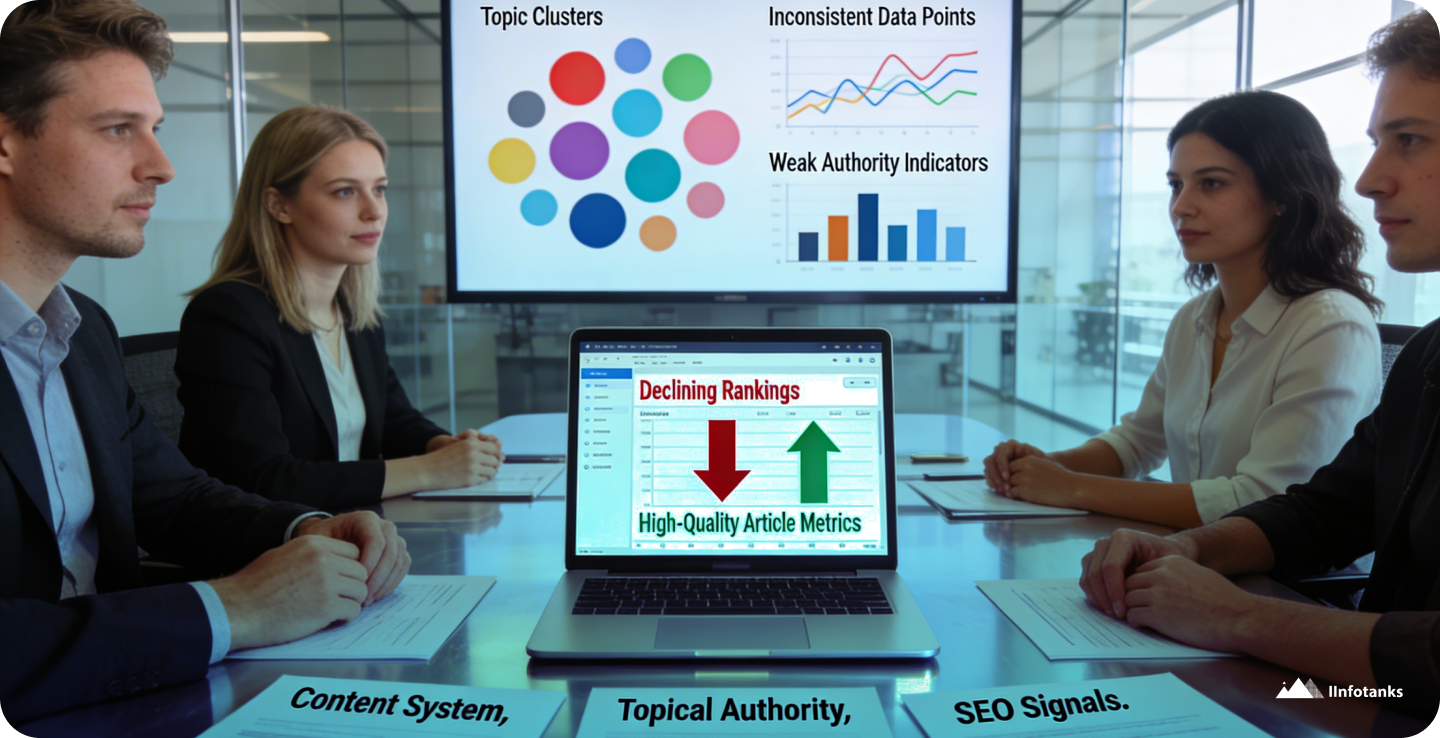
This is the question most executives ask in private.
The uncomfortable answer: content quality is no longer evaluated page by page. It’s evaluated system by system.
A strong article cannot compensate for:
- Conflicting expertise signals across your site
- Misaligned topical focus
- Inconsistent data claims
- AI-generated scale without human validation
In other words, “good content” fails when it’s unsupported by a trust framework.
Brands that retain visibility through algorithm shifts don’t publish more—they align better. Their Content and Marketing efforts behave like a single, intelligent organism rather than a collection of campaigns.
This is where strategic partners outperform vendors. Execution alone cannot solve structural trust gaps.
Content and Marketing as a Compounding Trust Engine
When Content and Marketing are designed as a trust system, growth stops being linear. It compounds.
A compounding trust engine has four interconnected layers:
| Layer | What It Solves | Why It Matters |
|---|---|---|
| Strategic Intent | Topic focus, audience clarity, expertise boundaries | Prevents dilution and algorithmic confusion |
| Content Architecture | Pillars, entities, internal logic | Signals authority beyond individual pages |
| Data Integrity | Accuracy, sourcing, updates, compliance | Reduces silent trust decay |
| Behavioral Reinforcement | Engagement, return visits, conversions | Validates relevance at scale |
Most brands operate only at the second layer—publishing content—while neglecting the others. That imbalance creates friction. Algorithms hesitate. Users skim but don’t commit. AI systems paraphrase competitors instead.
A trust engine works differently. Each piece of content strengthens the next. Historical accuracy improves future rankings. Behavioral signals reinforce topical authority. Updates don’t reset performance; they stabilize it.
This is why organizations that invest early in structured Content and Marketing systems find themselves insulated from volatility. They don’t chase updates. They absorb them.
The Hidden Cost of Fragmented Tactics
Loss aversion matters here. Not because of dramatic penalties, but because of what quietly slips away.
Without a trust-led system, brands risk:
- Losing historical authority after algorithm shifts
- Becoming interchangeable in AI-generated summaries
- Publishing content that contradicts earlier positions
- Accumulating technical and editorial debt that’s expensive to unwind
These losses don’t appear as line items on a budget. They appear as opportunity costs: deals that don’t close, rankings that never recover, content libraries that stop performing.
Fragmented tactics feel productive. They create motion. But motion without coherence increases cognitive load—for users, search engines, and internal teams. Over time, complexity erodes confidence.
Trust, by contrast, reduces friction. It makes decisions easier—both for buyers and for algorithms trying to decide who deserves visibility.
Authority Is No Longer Claimed—It’s Inferred
One of the most under-discussed shifts in modern SEO is how authority is determined.
Authority used to be signaled explicitly: credentials, backlinks, keywords. Today, it’s inferred from patterns:
- How consistently you cover a topic over time
- Whether your insights evolve accurately
- If your data aligns with known realities
- How other systems reference you implicitly
This inference-based evaluation favors brands that behave predictably, responsibly, and coherently. It penalizes those that optimize for short-term wins without long-term alignment.
In this environment, Content and Marketing leaders are less like publishers and more like system architects. Their role isn’t just to produce—it’s to maintain credibility at scale.
This is where strategic allies matter. Partners who understand governance, compliance, and AI-era trust signals don’t just help you grow faster; they help you avoid decay.
Why Strategic Partnerships Outperform Tactical Execution

The most resilient brands don’t outsource thinking. They collaborate on systems.
A true Content and Marketing partnership focuses on:
- Aligning expertise with searchable demand
- Building entity-level authority, not just traffic
- Creating feedback loops between data, content, and performance
- Designing content to remain accurate, useful, and trusted over time
This is subtly different from execution-centric models. It prioritizes continuity over campaigns, intelligence over volume, and trust over tricks.
IInfotanks operates from this philosophy. As Content and Marketing Partners, the work isn’t about shipping assets—it’s about building structures that hold up under pressure: AI saturation, algorithm shifts, regulatory scrutiny, and changing buyer behavior.
The brands that win next aren’t louder. They’re clearer, calmer, and more credible.
Conclusion: Growth Now Belongs to the Trusted
The era of tactical dominance is closing. Content and Marketing are no longer arenas for clever manipulation; they are systems of proof.
Trust has become the primary growth driver—not because it sounds virtuous, but because every modern gatekeeper relies on it. Search engines infer it. Buyers feel it. AI systems replicate it.
Brands that invest in trust-led systems gain compounding returns. Those that don’t experience slow erosion masked as “market changes.”
The choice isn’t between creativity and compliance, or human insight and data accuracy. The future belongs to organizations that integrate all of them—deliberately, strategically, and with the right partners beside them.
