
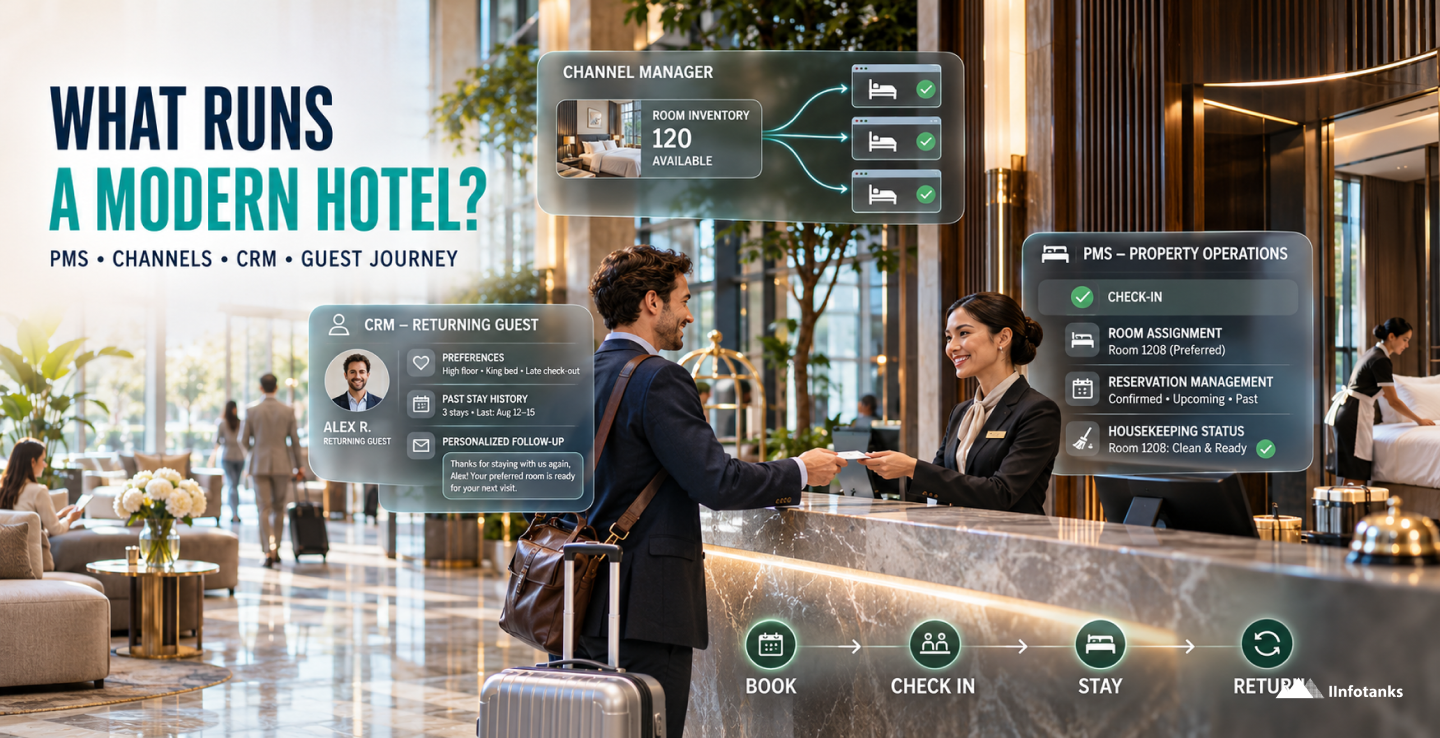
Walk into a hotel and you’ll see a front desk, a key card reader on every door and a website that takes bookings. Behind all of it sits a stack of software that guests never think about. If you run a small hotel, plan to open one or build tools for people who do, you may have typed “what software do hotels use” into a search bar and found long product lists with no sense of where to begin. If you sell software to hotels, you also need to know who makes the buying decisions, and a hotels and motels email list covers the general managers and purchasing contacts at those properties.
Here’s the short answer. A property management system, or PMS, holds your reservations, room status and guest bills. A channel manager sends your rooms and rates to booking sites like Booking.com and Expedia, then pulls the bookings back. A booking engine takes reservations on your own website, and a payment gateway handles the card. A CRM keeps the guest relationship going after checkout. Pricing tools, housekeeping apps, door locks and messaging come later.
Hotels sell in more than one place, so these tools have to keep several channels in step with the same room count. The website that takes direct bookings only works well when it connects cleanly to the PMS behind it. The same goes for every other tool on the list. A system that can’t share data with the rest forces your team to retype it, and retyping is where wrong rates and double bookings start.
Some tools are close to essential from day one, and the PMS is the clearest case. Others, like a CRM or a revenue management system, can wait until a real need shows up. Costs and the effort of switching systems later both depend on which pieces you pick first, and a 15-room guesthouse needs a very different setup from a 200-room property. Sorting tools by the job they do, rather than by brand, makes the choice much easier.
What Software Do Hotels Use? The Stack in One View
Hotels run on four core tools and a few optional ones. The core tools do most of the daily work.
- Property management system: reservations, room status and guest bills.
- Channel manager: rates and availability for third-party booking sites.
- Booking engine: direct reservations on the hotel’s own website.
- Payment gateway: card capture and settlement.
Optional layers include a CRM, a revenue management system, housekeeping tools, door locks and guest messaging. Most of them only pay off once the core tools work together. The PMS sits in the middle, and every other tool connects to it.
How much each channel matters differs from hotel to hotel. The HOTREC European hotel distribution study, summarized by the Austrian Chamber of Commerce, covers 2,713 hotels in 28 countries. It puts direct bookings at 51.3% for 2025 and online travel agencies, or OTAs, at 29.9%, with Booking Holdings and Expedia together holding 85.4% of European OTA bookings. Most hotels sell directly and through those big names, which is why the channel tools carry so much weight.
What Does a Hotel Property Management System Do?
A hotel property management system is the system of record. Every reservation, room and bill lives there first. It’s the screen your front desk team keeps open all day. Other tools read from it or write to it, so when the PMS is wrong, everything downstream is wrong too.
- Reservations and room inventory: who’s booked, which room, which dates and at what rate.
- Front desk: check-in, check-out, room moves and guest notes.
- Guest folios and billing: room charges, restaurant postings, taxes and final invoices. In India, this is where GST-ready invoices come from.
- Housekeeping status: clean, dirty or inspected, updated as rooms turn over.
- Reports: occupancy, average daily rate and revenue by channel.
Many PMS products bundle a channel manager and a booking engine. Some don’t, so check before you buy. Reports from the PMS also drive decisions about rates and staffing, which is why clean data matters here.
How Does a Hotel Channel Manager Keep Rates in Sync?
A hotel channel manager sits between your PMS and the booking sites that sell your rooms. You change something once, and it updates everywhere. Here’s one booking, start to finish:
- You change a rate or close a room in your PMS or channel manager.
- The channel manager sends the update to every connected booking site.
- A guest books a room on one of those sites.
- The booking flows back into your PMS.
- The channel manager pushes the lower availability to all the other sites.
Overbooking happens when step 5 runs late. Two sites sell the last room before either one hears about the other. A fast connection closes that gap, and a good channel manager flags any update that fails. Ask whether the tool keeps a log of every update sent, so you can see what reached which site. A hotel listed on just one site can manage it by hand. Past two sites, the retyping starts to cost real time.
Channel managers connect to booking sites such as Booking.com and Expedia, and many also push rates to Google’s hotel listings. Booking.com publishes technical documentation for the software that connects to it, which is why hotels use approved connections instead of building their own.
Where Do the Booking Engine, Payment Gateway and POS Fit?
These three tools handle money, so they sit close to the PMS.
Tool | What it handles |
|---|---|
Booking engine | Direct bookings on your own website, with live rates and availability |
Payment gateway | Card capture, deposits, refunds and settlement |
POS | Restaurant, bar and shop charges that post to the guest’s room bill |
The booking engine is the one guests actually see, so its design affects how many visitors finish a reservation. How many steps it takes and how it looks on a phone are UI and UX design questions as much as software ones.
Ask each vendor whether the gateway and POS post to the PMS automatically. If they don’t, someone re-keys every charge.
What Does a Hotel CRM Store, and Does Every Hotel Need One?
A hotel CRM stores what you know about people: who they are, what they like and how they’ve dealt with you. The PMS records stays. The CRM remembers the relationship. A guest who always asks for a quiet room gets one without asking, and a guest who complained last time has a note on file before arrival.
Data | Example | Use |
|---|---|---|
Contact details | Email, phone, country | Confirmations and promotions |
Stay history | Three stays, the last in March | Recognizing repeat guests |
Preferences | High floor, late checkout | Preparing the room before arrival |
Communication log | Pre-arrival email, a complaint and its reply | Nobody asks the same question twice |
Not every hotel needs one at the start. Many small hotels begin with the guest profiles inside their PMS, which already record stay history. A CRM earns its place when you want to market to past guests or when several teams need the same guest record.
General-purpose platforms such as Salesforce CRM can also serve as a hotel CRM. Whichever route you take, settle one question first: which system is the source of truth for each guest? Pick that, then connect everything else to it.
Which Optional Tools Do Hotels Add Next?
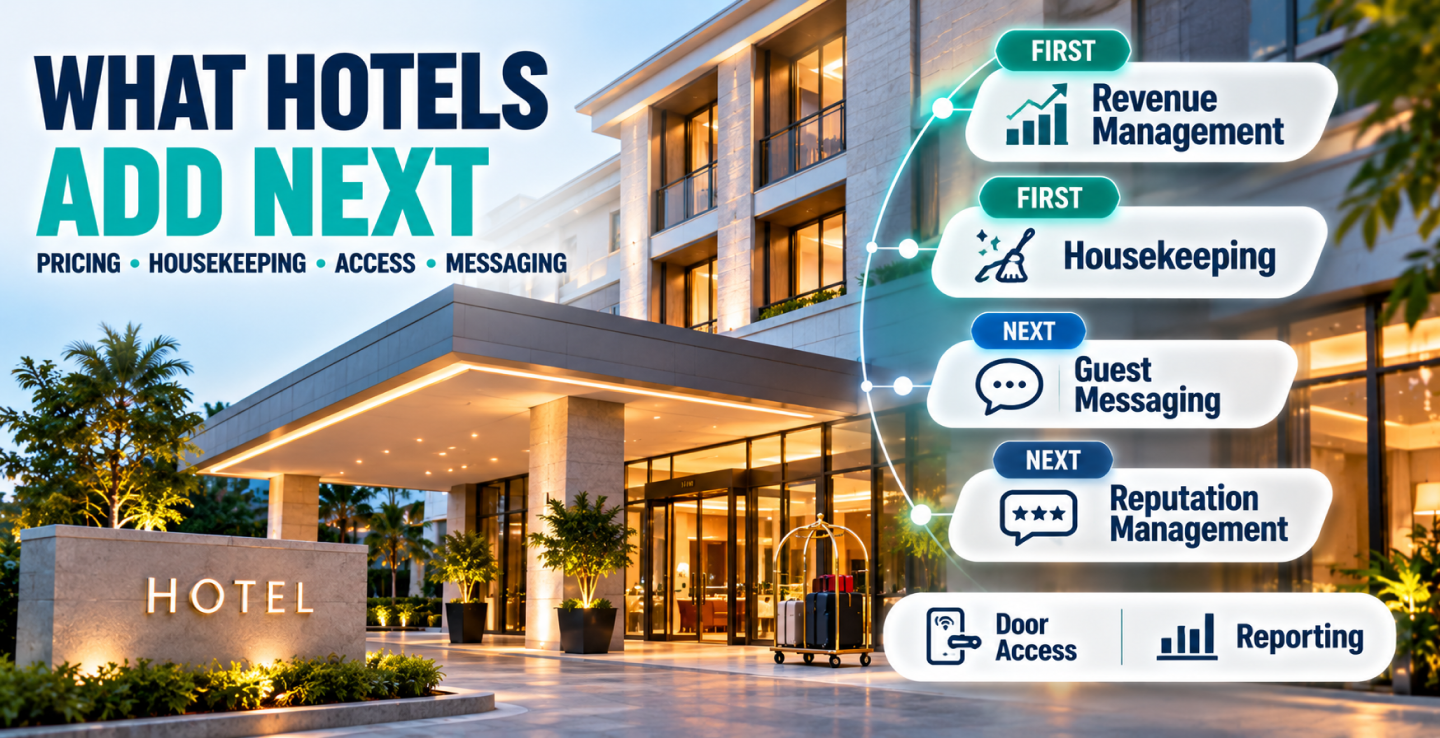
Once the core is stable, hotels tend to add tools for pricing, cleaning, access and communication.
- Revenue management system: forecasts demand and suggests rates.
- Housekeeping app: assigns rooms to cleaners and updates room status as work finishes.
- Electronic door locks: issue key cards or phone keys and link back to the front desk.
- Guest messaging: texts or chats with guests before and during the stay.
- Reputation management: collects reviews in one place so you can reply faster.
- Reporting tools: combine data from several systems into one view.
Add them one at a time, and only when a real problem asks for it. Revenue management and housekeeping usually come first, because they save time every day, followed by messaging and reputation tools.
How Do These Systems Connect Behind the Scenes?
Most hotel tools talk to each other through APIs, which are agreed ways for one program to send data to another. Shared message standards make that easier. OpenTravel is the best-known hospitality example, and it defines a common format so two systems read the same booking the same way.
Booking.com shows how strict the rules get. According to its connectivity documentation, a new booking on the OTA XML route keeps coming back to your system until you confirm you’ve processed it, so your software has to avoid creating duplicates. If a booking isn’t confirmed within 30 minutes, Booking.com emails it to the property. With Google’s hotel feed, you push rates and availability whenever a price changes.
When a connection is missing, someone retypes the data, and every retype is a chance for a wrong rate or a double booking. Guest data needs the same care. Duplicate profiles across the PMS and CRM are a CRM data management problem, and they’re easier to fix before they spread. When you talk to a vendor, ask four plain questions. Is the connection two-way? How often does it sync? What happens when an update fails? Who fixes it, you or the vendor?
PMS vs. Channel Manager vs. Booking Engine vs. CRM: What Is the Difference?
Four tools, four jobs. This table keeps them apart.
Tool | Main job | Used daily by | Data it holds |
|---|---|---|---|
PMS | Runs hotel operations | Front desk and housekeeping | Reservations, rooms and bills |
Channel manager | Sends rates and availability to booking sites | Revenue or reservations manager | Rates, availability and channel mappings |
Booking engine | Sells rooms on your own website | Guests and the marketing team | Live rates, offers and booking details |
CRM | Manages guest relationships | Marketing and guest relations | Contact details, preferences and history |
Some data lives in two tools. The PMS and channel manager both touch rates and availability, and the PMS and CRM both hold guest details. Pick one tool as the source of truth for each, and let the other copy it.
When two tools disagree, a few habits settle it. Treat the PMS as the final word on rooms and bills, treat the channel manager as the final word on what each booking site shows, and check the sync log before changing either record by hand.
All-in-One Platform or Best-of-Breed Stack?
All-in-one platforms bundle the PMS, channel manager and booking engine. Best-of-breed means picking the strongest tool for each job and connecting them yourself. All-in-one gives you one login, one contract and one support line, though one module may be weaker than a specialist tool. Best-of-breed lets you choose the best fit for each job, though you maintain more connections.
The 2026 Hotel Technology Outlook from NYU’s Tisch Center, published in November 2025, surveyed more than 300 hotel professionals. Among hotels with 100 rooms or fewer, 54% used all-in-one platforms. Among independents with 101 to 250+ rooms, 68% used best-of-breed. Of all respondents, 38% named integration a top pain point, and 51% planned to replace or upgrade their stack within 12 to 24 months. Stayntouch and IDeaS, two software vendors, sponsored the study.
Pick all-in-one when you have a small team, a single property and little time to manage connections. Pick best-of-breed when one function, such as revenue management or CRM, matters enough to justify the extra upkeep.
Which Software Setup Fits Your Hotel Size?
Room count shapes the stack. These bands are a rough guide, not survey results.
Rooms | Starting stack | First priority |
|---|---|---|
Up to 20 | One PMS with a built-in channel manager and booking engine | Stop double bookings |
21 to 100 | PMS, channel manager and booking engine, plus reporting | Keep rates consistent and see revenue by channel |
101 and above | A best-of-breed PMS with a CRM and revenue management added | Data that moves between teams |
At any size, a simple landing page design for direct offers gives the booking engine somewhere to send visitors. Revisit the stack whenever a manual task eats more than a few hours a week.
The bands have soft edges. A 15-room hotel that sells on five booking sites needs a strong channel manager early, and a 120-room hotel with one dominant corporate client may need a CRM before anything else.
How Much Does Hotel Software Cost?
Hotel software prices vary a lot, so an average from a random article won’t tell you much. What you can compare is how vendors charge.
- Per room, per month: the bill grows with the hotel.
- Flat monthly fee: the same price within a tier, whatever the room count.
- Percentage per booking: common for booking engines and some channel managers.
- Quote only: typical for chains and larger hotels.
- Payment processing: usually billed separately, per transaction.
- Onboarding: a one-time fee, sometimes optional.
Beds24 publishes its prices, so it makes a useful example. According to its public pricing page, it charges €14.90 a month for the account, €3.00 per room and €0.65 per channel link. A link is one room type connected to one channel. The PMS and booking engine are listed as included, with no booking commissions and no setup fee. Personal onboarding is optional and starts at €79, paid once. Vendor prices change, so confirm current pricing before you rely on it. This is one vendor’s price list, which shows how the pieces add up. When you compare quotes, ask what’s billed separately: channel connections, extra users, payment fees and support.
Run the numbers for 12 months, not one. A low monthly fee with a large setup charge, or a cheap PMS that needs a paid connection for every booking site, can cost more than a higher sticker price that includes everything.
A Worked Example: Software Fees vs. OTA Commission
Software fees are small next to commission, and a quick calculation shows by how much.
Monthly OTA commission = rooms × 30 days × occupancy × average daily rate × OTA share × commission rate
Input | Value | Source |
|---|---|---|
Rooms | 20 | Assumed |
Occupancy | 70% | Assumed |
Average daily rate | €100 | Assumed |
OTA share of bookings | 29.9% | European average from the HOTREC study, applied to revenue for simplicity |
Commission rate | 15% | Placeholder, replace with your contract rate |
That’s 420 room nights and €42,000 in monthly room revenue. About €12,558 of it comes through OTAs, which at 15% means roughly €1,884 in commission. On the Beds24 price structure with six channel links, the software costs €14.90 + 20 × €3.00 + 6 × €0.65 = €78.80 a month. The commission line is roughly 24 times the software fee. Moving even a small share of bookings to your own site changes the bill more than switching tools does. Raising direct bookings comes down to conversion rate optimization, meaning how many visitors to your site finish a booking. Commission rates vary by contract and your OTA share may differ, so rerun the numbers with yours.
What Security and Compliance Rules Apply to Hotel Software?
Hotel software holds card numbers, passport details and contact information, so several rules apply, and some depend on where you operate.
- PCI DSS v4.0.1 is the current card security standard. It added no new requirements when it was published in June 2024.
- PCI DSS v4.0 was retired on Dec. 31, 2024, and the newer requirements took effect on March 31, 2025.
- Keep card numbers out of email, spreadsheets and chat, because those places sit outside the controls your payment provider maintains.
- A series of breaches at Starwood and Marriott affected more than 344 million customers worldwide. The U.S. Federal Trade Commission took action in October 2024 and required a 20-year security program.
- In India, GST on hotel rooms priced up to ₹7,500 per unit per day dropped from 12% with input tax credit to 5% without it on Sept. 22, 2025. The rate depends on the room tariff, so your PMS has to apply the right one for each room. Confirm the details with your tax advisor.
- India’s Digital Personal Data Protection Rules were notified in November 2025 and phase in over 18 months. Plan how your software handles guest consent and requests inside that window, and confirm current dates with a legal advisor.
How to Choose and Switch Hotel Software Without Losing Bookings
Most switching problems come from rushing the data move, so plan the move before you pick the tool.
- List every system the new tool must connect to, including payments, POS and door locks.
- Check that the channel list covers every booking site you sell on.
- Ask how the vendor handles failed updates and duplicate bookings.
- Export guest profiles, open reservations, rate plans and invoices.
- Retire old rate plans before you move them.
- Run test bookings on every channel before go-live.
- Train staff on real scenarios, then schedule extra hands for go-live day.
- Keep the old system available in read-only form for a few weeks, so staff can check a past reservation or invoice without guessing.
Two mistakes come up again and again. One is moving messy data, which carries every old error into the new system. Clean duplicate guest profiles and expired rate plans before the move, not after. The other is leaving the booking website and its connections unwatched once you’re live. Regular website maintenance covers that, and a check of rates, availability and test bookings every few weeks catches the quiet failures.
FAQs
What software do hotels use every day?
Most hotels use a PMS for check-in and billing, a channel manager for booking sites, a booking engine for direct reservations and a payment gateway for cards. Larger hotels add a CRM, revenue management and housekeeping tools.
What is the difference between a PMS and a channel manager?
A PMS runs daily operations like reservations, check-ins, housekeeping and bills. A channel manager sends rates and availability to booking sites and brings the bookings back. They overlap around reservations, so the connection between them matters.
Do small hotels need a channel manager if they already have a PMS?
If you sell on more than one booking site, yes. It can be built into the PMS or bought separately. A single listing can be updated by hand, but each extra site adds retyping and the risk of a double booking.
What CRM software do hotels use?
Hotels use hospitality CRMs and general platforms such as Salesforce. Check which options connect to your PMS first, and confirm which system holds the master guest record before you load any data.
How does a hotel send rates and availability to Google?
Partners push rates, availability and property data to Google whenever pricing changes, and only the changes need sending. Google’s hotel ARI guide notes that an HTTP 200 reply can still hide errors, so check the response body.
Is a booking engine the same as a channel manager?
No. A booking engine sells rooms on your own website. A channel manager sends your rooms and rates to third-party booking sites. Many platforms include both, but they do different jobs.
What is a central reservation system, and when is it needed?
A central reservation system stores rates and availability for every hotel in a chain. A single independent hotel usually doesn’t need one, because its PMS and channel manager already cover its own rooms.
Can one platform replace the PMS, channel manager and CRM?
Many all-in-one platforms bundle the PMS, channel manager and booking engine. CRM depth varies a lot, so test it against what you need, such as guest history, segments and email campaigns, before you drop a separate tool.
Should a hotel pick cloud or on-premise software?
Cloud software runs on the vendor’s servers and you use it through a browser. On-premise software runs on your own server, which puts updates, backups and security on your staff.
How does a channel manager prevent overbooking?
It updates availability on every connected site as soon as a room sells. The connection also needs safeguards. Booking.com keeps resending a booking until you acknowledge it and emails the property after 30 minutes, per its connectivity documentation.
Does hotel software need to be PCI compliant?
Card data falls under PCI DSS, and v4.0.1 is the current version. The PCI Security Standards Council published it in June 2024 with no new requirements. Ask your payment provider and PMS vendor how they meet it.
How does GST affect hotel billing software in India?
The Press Information Bureau confirmed GST on rooms priced up to ₹7,500 per unit per day fell from 12% to 5% without input tax credit from Sept. 22, 2025. Your PMS has to apply the right rate by tariff. Confirm details with your tax advisor.
What should a hotel back up before switching its PMS?
Export guest profiles, open and future reservations, rate plans, guest bills and invoices, and tax settings. Keep the old system’s reports somewhere safe, and run test bookings before go-live.
Does a small hotel need a revenue management system?
Usually not at the start. A revenue management system forecasts demand and suggests rates, and it pays off when setting prices by hand takes more time than the tool costs. Begin with the PMS, channel manager and booking engine.
How do India’s DPDP rules affect guest data?
The Digital Personal Data Protection Rules were notified in November 2025 with an 18-month phased timeline, per the Press Information Bureau. Guest contact details and ID copies are personal data, so ask your software vendors how consent, access and deletion requests will be handled.