
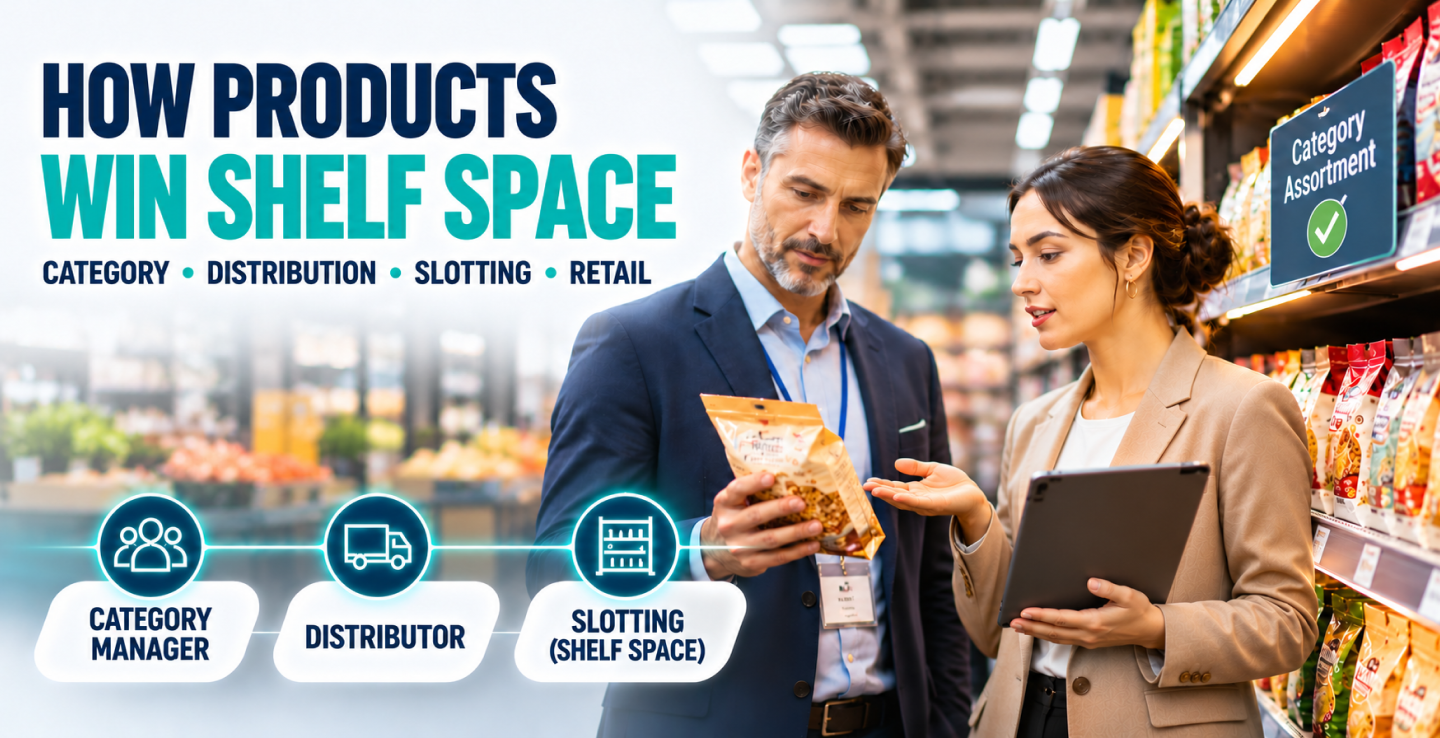
If you want to sell to grocery stores, expect one surprise early: a buyer can say yes to your product, and the deal can still lose you money. The Federal Trade Commission’s 2003 study of the grocery industry found that slotting fees, the one-time payments some retailers charge for initial shelf placement, averaged $2,313 to $21,768 per item, per retailer, per metro area.
Who you talk to shapes everything that follows. A buyer or category manager decides what gets shelf space, and each one has a long line of products asking for it, so your pitch has to show why yours belongs on the shelf. Finding the right buyer comes first, and B2B lead generation covers that step: finding likely buyers and running targeted campaigns to reach them.
Before that first meeting, a barcode, a compliant label, insurance and a sell sheet should be ready, because those items come up in every supplier setup. Insurance minimums at the big chains run from $2 million to $5 million per occurrence, and Publix, for one, asks suppliers to request an appointment at least two weeks before a category review starts. From there you choose a route. You can pitch the chain directly, work through a distributor such as UNFI, KeHE or C&S, deliver the product yourself or hire a broker, and each route changes what you keep from every sale. After the first order, a second round of costs shows up: free product, deductions and the pressure to keep selling at the pace the buyer expects.
Who Decides What Reaches a Grocery Shelf?
A buyer or category manager at the retailer makes the call. According to the FTC, that person negotiates with the supplier’s representative over whether slotting gets paid and how much. Category management means the retailer runs each category, such as snacks or frozen, as its own business unit, so your product has to earn its spot against what the category already holds.
- Buyer or category manager: the retailer’s decision maker for one category. The buyer is the person you pitch.
- Category captain: a supplier that advises the retailer on a category. The retailer keeps the final say.
- New item submission process: some chains send new suppliers through a formal submission. Sprouts says a submission “shall be deemed an offer to Sprouts, not a commitment by Sprouts.”
Chains label these jobs differently. A supermarkets and grocery stores email list, for example, sorts contacts under titles such as category buyer and merchandising director.
Are You Ready to Sell to Grocery Stores? A Pre-Pitch Checklist
Seven things need to be in place before you try to get your product into grocery stores, because each one comes up again during supplier setup.
- A GS1 US barcode: company prefixes start at $250 to join and $50 a year, according to GS1 US. The cost table below has the full range.
- Your nutrition label status: the FDA’s small business nutrition labeling exemption covers a product when the business has fewer than 100 full-time-equivalent employees, sells fewer than 100,000 units of that product in the U.S. a year and files an annual notice. Any nutrition claim disqualifies the product.
- Allergen labeling: the FDA lists nine major food allergens: milk, eggs, fish, crustacean shellfish, tree nuts, peanuts, wheat, soybeans and sesame. Sesame has been on the list since Jan. 1, 2023.
- A licensed commercial kitchen: Minnesota’s extension service says cottage food producers can’t sell to businesses that resell, such as grocery stores. Other states have their own rules.
- Insurance: retailers set their own minimum limits, and the cost table below lists several.
- Food safety certification, if the retailer asks: Publix, for example, requires GFSI certification only from its Publix Brand suppliers.
- Samples and sales figures: bring both to the pitch, and expect the sample requirements to differ by category.
Direct, Distributor, DSD or Broker: Which Route Gets Your Product Into Grocery Stores?
Pick the route by how many stores you want and who can deliver: submit directly to a retailer, sell through a distributor, deliver the product yourself or hire a broker to open doors.
Route | Who Delivers | What It Costs | Works Best When |
|---|---|---|---|
Direct to retailer | You or the retailer’s warehouse | No distributor markup; slotting may apply | The chain takes supplier submissions, as Sprouts and Publix do |
Distributor | The distributor | Markups of 10% to 35% of the wholesale price, according to Oregon State University Extension | You want many stores without running your own trucks |
DSD, or direct store delivery | You | Your delivery cost; five of seven FTC retailers said slotting was less likely for DSD items | Your stores sit close enough to serve yourself |
Broker | You or a distributor | A 3% to 5% commission on average, according to Oregon State University Extension | You need introductions to buyers |
A broker never owns your product. The broker sells it and takes a commission, while a distributor buys it and resells it. Oregon State’s figures come from a December 2006 extension guide for new food manufacturers, so use them as a starting point and ask each distributor for current terms. For the wholesaler side, a wholesale email list gives you names to call.
The Grocery Distributors Worth Knowing: UNFI, KeHE and C&S
Three grocery distributors sit between a large number of brands and a large number of stores, and each one runs its supplier relationships differently.
- UNFI: its fiscal 2026 annual report lists over 30,000 customer locations, over 200,000 products and 46 distribution centers and warehouses. Gross profit was 13.5% of net sales, up from 13.3% a year earlier. The gross profit figure covers everything UNFI sells, so it says nothing about the cut on a single item. The same filing lists support for the introduction of new products among the funds vendors provide.
- KeHE: SPS Commerce, which hosts KeHE’s supplier guides, shows a Nov. 1, 2025, version of the supplier policies and a newer one effective July 1, 2026. KeHE has also required electronic data interchange, or EDI, from all suppliers since July 1, 2026, so read the current version before you agree to terms.
- C&S: C&S Wholesale Grocers completed its acquisition of SpartanNash on Sept. 22, 2025. C&S’s release says the combined company operates almost 60 distribution centers across the U.S. and serves close to 10,000 independent retail locations.
How to Get Accepted by a Distributor, Step by Step
Getting accepted by grocery distributors takes five steps, and the first is asking the retailer’s buyer which distributor serves their stores.
- Ask the buyer which distributor they use. The answer tells you where to apply.
- Put your GTIN, case pack and cost per case on one sheet so you can answer any setup form quickly.
- Send samples. Sprouts asks for two retail-ready samples of each new grocery item. For dairy and frozen it wants two empty packages of your top two or three SKUs, and for produce it wants pictures only.
- Read the distributor’s current supplier policy. Policies get reissued, so check the date on the version you have.
- Have the item stocked at the distributor two weeks before the retailer’s test set. Sprouts sets that deadline, and the test set is the date it tests a reset in the store.
What Are Slotting Fees, and What Did the FTC Find?
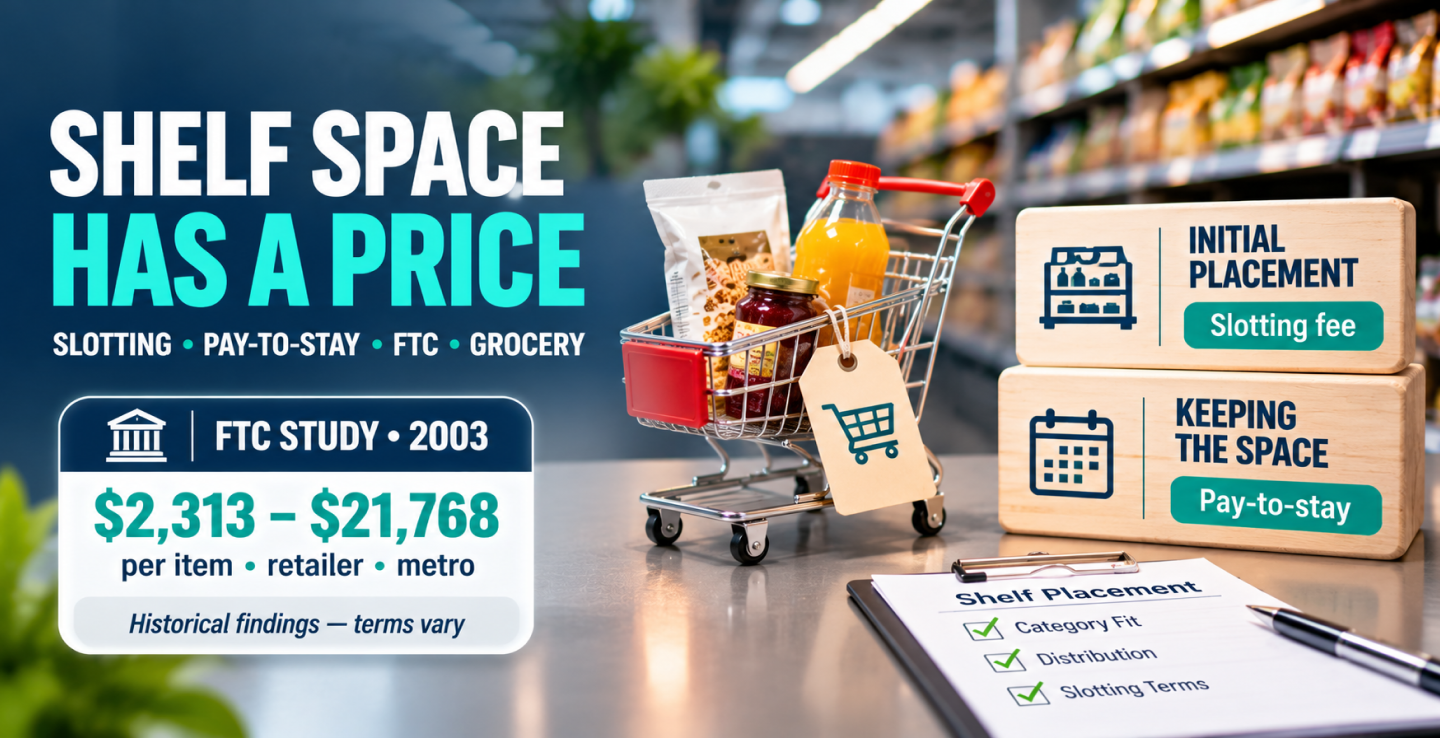
Slotting fees are one-time payments a supplier makes for initial shelf placement, and pay-to-stay payments keep an item on the shelf afterward. The FTC’s 2003 report put the average at $2,313 to $21,768 per item, per retailer, per metro area.
- Retailers estimated slotting on 50% to 90% of new product introductions.
- Five of seven retailers said slotting was less likely for DSD items and, where it existed, more likely to be lower.
- Seven of nine retailers supplied data for the study.
- The FTC called its findings “suggestive, not probative.”
The data is more than 20 years old, and the buyer negotiates terms, so the number you’re quoted can differ from these averages. The FTC slotting allowances report explains how the agency collected its numbers.
What It Costs to Get on the Shelf: A First-Launch Cost Table
Your fixed costs before the first order are a barcode, insurance and a food safety audit, and the figures below come from each organization’s own documents.
Cost | Amount | Source |
|---|---|---|
GS1 US company prefix | $250 to $10,500 to start and $50 to $2,100 a year, depending on how many products you register | GS1 US |
Kroger insurance minimum | $3 million per occurrence and $3 million general aggregate | Kroger requirements, revised Dec. 12, 2023 |
Publix insurance minimum | $3 million per occurrence | Publix supplier policies, July 24, 2026 |
Walmart category I food and drink insurance | $2 million per occurrence and $4 million aggregate | Walmart requirements, Feb. 18, 2025 |
Walmart category II food and drink insurance | $5 million per occurrence and $10 million aggregate | Walmart requirements, Feb. 18, 2025 |
Food safety audit | Request quotes; the price depends on the certification you choose | Certification bodies |
Slotting and free fills | See the slotting and price model sections | FTC and Sprouts |
GS1 US also sells middle tiers at $750 and $150 a year for up to 100 products, $2,500 and $500 for up to 1,000 and $6,500 and $1,300 for up to 10,000. The insurance figures are coverage limits, and your premium depends on your insurer. Kroger also asks for carriers rated A- or higher by A.M. Best and says it may require higher limits than its minimums. Walmart assigns each product to a category, so check which one applies to yours.
We Ran the Numbers: What a Brand Keeps From a $5.00 Shelf Price
In our illustrative model, a brand keeps between 48% and 67% of a $5.00 shelf price, depending on the route and how much trade spend it funds. Trade spend is the discount money a brand pays retailers or distributors to promote a product, and COGS is cost of goods sold, what it costs you to make one unit. The model uses the markups from Oregon State University Extension’s worked example: retailer 35%, distributor 15% and a broker commission of 5%. At those markups the retailer pays $3.70 for a $5.00 shelf item. The trade spend percentages are assumptions, and all figures use unrounded prices. Scenarios A through C change only trade spend, and scenario D removes the distributor and the broker.
Scenario | Brand List Price | Broker | Trade Spend | Brand Nets | Share of Shelf Price | Max COGS at a 30% Margin |
|---|---|---|---|---|---|---|
A: distributor and broker, no trade spend | $3.22 | $0.16 | $0.00 | $3.06 | 61.2% | $2.14 |
B: 10% trade spend | $3.22 | $0.16 | $0.32 | $2.74 | 54.8% | $1.92 |
C: 20% trade spend | $3.22 | $0.16 | $0.64 | $2.42 | 48.3% | $1.69 |
D: direct, no broker, 10% trade spend | $3.70 | $0.00 | $0.37 | $3.33 | 66.7% | $2.33 |
Two formulas turn those numbers into decisions. Free fill cost equals COGS per unit times units per case times cases per store times stores. Units needed to recover a slotting payment equal the payment divided by profit per unit, and profit per unit is the net price minus COGS. Take a $1.50 COGS, one case of 12 units and 100 stores: that free fill costs $1,800.
In scenario B, profit per unit is about $1.24, so a $2,313 slotting payment takes about 1,870 units to earn back. A $10,000 payment takes about 8,080 units, and a $21,768 payment takes about 17,590. Compare scenarios A and C: 20% trade spend cuts what the brand keeps from 61.2% to 48.3% of the shelf price. Scenario D keeps the most because no distributor or broker takes a cut, and the brand carries the delivery and selling work itself. The model leaves out spoilage and freight, so real numbers will run tighter.
How to Pitch a Category Manager: What to Bring and What to Say
To get your product into grocery stores, bring the answers a category manager has to defend internally: who buys your product, what makes it different, what it replaces and what it will sell. Publix publishes its category review cycles each year and asks suppliers to complete an appointment request form, linked from its Publix retail product supplier page, at least two weeks before a review starts. Publix’s supplier policy, dated July 24, 2026, lists what a pitch should cover: target demographic, differentiating characteristics, expected cannibalization, projected sales and household penetration.
Publix also says the majority of products presented outside the published schedule don’t qualify for an off-cycle addition, so timing your pitch to a review matters. Suppliers can drop samples at the Publix corporate office or mail them to the buyer, and the page says using a broker or distributor is optional.
- A one-page sell sheet with GTIN, case pack, cost and a suggested shelf price
- Your sales data, even if it comes from farmers markets or one regional chain
- A direct answer on cannibalization: which existing item loses sales to yours
- A support plan, such as demos, social posts or coupons
- Samples in retail-ready packaging
- A delivery plan that names your distributor or your DSD route
Going after a short list of named buyers is called account-based marketing, and it suits a pitch aimed at one category manager at a time.
Programs and Events That Opened the Door in 2026
Three programs gave small brands a direct line to large retailers in 2026, and each one runs on its own schedule.
- Whole Foods Market: the company announced its 2026 Local and Emerging Accelerator Program cohort on Sept. 24, with 10 brands chosen from more than 2,000 applications. Participants may qualify for a $25,000 equity investment, and the program runs 12 weeks.
- Walmart Open Call: Walmart held the 2026 event on Oct. 7 at its home office campus in Bentonville, Arkansas, and Talk Business reported roughly 125 companies from 35 states and Puerto Rico. The event is about sourcing more U.S.-made products.
- H-E-B Quest for Texas Best: H-E-B’s 13th annual contest for small Texas food, beverage and general merchandise suppliers ended with finalist pitches on Oct. 8 and a $50,000 grand prize that includes shelf placement.
Each program publishes its own schedule, so check its page for the next round before you plan around it.
After the Yes: Free Fills, Deductions and Payment Terms
A placement brings a second set of costs: free product and deductions, then the pressure to sell through. Sprouts’ vendor policy requires a free fill of each SKU for each new point of distribution.
For grocery, dairy, frozen and bulk items, the number of SKUs covered by the free fill is negotiated. For items sold through KeHE or UNFI, Sprouts deducts the wholesale value of that free fill, while DSD items come out of open billing statements. SKUs subject to a free fill get guaranteed placement for at least six months after implementation. Policies change, so confirm the current version before you sign. Publix’s supplier policy sets DSD invoice terms at 30 days.
Keeping Your Spot: Velocity and the Myth of 90% Failure
NielsenIQ says a new product’s success is generally determined by its velocity, which is sales per distribution point. A product is three times more likely to succeed if its velocity is in the top 40% of its category, according to NielsenIQ’s 2022 analysis of small CPG brands, which draws on its retail measurement and BASES research. Ask the buyer what sales pace the item needs to keep its spot, because that target comes from the retailer.
The popular claim that 90% of new products fail has less behind it than it sounds. A 2022 literature review by Ireneusz Rutkowski, published in the Journal of Marketing and Consumer Behaviour in Emerging Markets, looks at the evidence on new product failure rates. The paper says the 90% belief isn’t supported by empirical evidence.
Holiday Ice: Building a Food Industry Decision-Maker Database
Holiday Ice worked with IInfotanks on a custom U.S. food industry email list of 20,829 decision makers across three segments: produce with 9,615 contacts, poultry with 6,497 and seafood and marinas with 4,717. Each record includes company name, website, contact name, job title, postal address, phone and email, and the data was verified to a 90% or better email deliverability standard. The list was delivered within five to seven business days under an unlimited-use license, with a three-month replacement window for qualifying inaccurate or hard-bounced records.
Key takeaway: Splitting a large food industry audience into labeled segments lets a team plan outreach by vertical and measure results for each one.
Read the full case study: How We Built Holiday Ice: A 20,829 Contact Decision Maker Database Across Seafood, Poultry and Produce
FAQs
How Do I Get My Product Into Grocery Stores?
Prepare your barcode, labels and insurance, then pick a route: submit directly to a retailer, go through a distributor or enter a retailer program. Sprouts and Publix take supplier submissions, and Walmart holds an Open Call event for U.S.-made products.
Who Do I Contact First, the Store or the Category Manager?
Start with the category manager or the retailer’s supplier submission page. Publix, for example, tells suppliers to send any communication to the buyer as the primary point of contact. Accurate buyer data cuts the research time, as this post on shortening B2B sales cycles with data explains.
What Does a Grocery Category Manager Do?
A category manager runs one category, such as snacks or frozen, as its own business unit. The FTC says that person negotiates with supplier representatives over terms, including whether slotting is paid and how much.
What Are Slotting Fees?
Slotting fees are one-time payments a supplier makes for initial shelf placement. Pay-to-stay payments keep an item on the shelf afterward. The FTC’s 2003 study found averages from $2,313 to $21,768 per item, per retailer, per metro area.
Do I Need a Nutrition Facts Label to Sell Food in Grocery Stores?
Usually yes, but a business with fewer than 100 full-time-equivalent employees can skip it for a product that sells fewer than 100,000 units a year in the U.S., as long as it files an annual notice with the FDA and makes no nutrition claims on the package.
Do All Grocery Stores Charge Slotting Fees?
No. Retailers in the FTC study estimated slotting on 50% to 90% of new product introductions, and five of seven said it was less likely for DSD items. Terms differ by retailer, so ask early in the conversation.
What Is a Free Fill?
A free fill is product you give a retailer at no charge to stock a new item. Sprouts requires one for each SKU at each new point of distribution, and it deducts the wholesale value on items sold through KeHE or UNFI.
Do I Need a Distributor to Sell to Grocery Stores?
Not always. Sprouts and Publix accept supplier submissions, so a direct route exists. A distributor helps when you want many stores without delivering yourself, and Oregon State University Extension puts distributor markups at 10% to 35% of the wholesale price.
What Is the Difference Between a Broker and a Distributor?
A broker sells your product to buyers for a commission, 3% to 5% on average according to Oregon State University Extension, and never owns it. A distributor buys your product, stores it and resells it to retailers at a markup.
Do I Need a UPC Barcode, and What Does It Cost?
Yes, grocery items carry a UPC barcode. GS1 US company prefixes cost $250 to join and $50 a year for up to 10 products, rising to $10,500 and $2,100 a year for up to 100,000 products.
What Insurance Do Grocery Stores Require?
Limits differ by retailer. Kroger and Publix each list $3 million per occurrence, and Walmart lists $2 million to $5 million per occurrence depending on the product category. Retailers update these requirements, so check each current document before you buy a policy.
Do I Need GFSI or SQF Certification?
The answer depends on the retailer. Publix requires GFSI certification from its Publix Brand suppliers and may give preference to other suppliers who hold it. Enforcement of the FDA’s FSMA 204 traceability rule is barred until July 20, 2028.
Can I Sell Cottage Food to Grocery Stores?
Usually not. Minnesota’s extension service says cottage food producers can’t sell to businesses that resell, such as grocery stores. Other states have their own rules, so check yours before you plan on a licensed commercial kitchen.
How Long Does It Take to Get on Grocery Shelves?
No public average exists, and timing depends on each retailer’s review cycle. Publix asks for at least 60 days’ notice before a first ship date, and Sprouts wants the item at the distributor two weeks before its test set.
What Happens if My Product Doesn’t Sell?
The retailer can drop it, so velocity is the number to watch. NielsenIQ says a product with top 40% velocity is three times more likely to succeed. Sprouts guarantees placement for six months on free-fill SKUs.