

Buying nephrologist contact information sounds simple until you open a file and find names without NPIs, unclear practice locations, or email addresses that may no longer work. A dialysis technology company and a healthcare marketing team might target the same specialty, but they need different fields to reach the right physicians and avoid wasted outreach.
Start with the basics: who is the nephrologist, where do they practice, and how can your team contact them professionally? A well-structured nephrologist email list should make those details easy to review, alongside specialty identifiers, practice affiliations, and the date each contact field was last checked.
This guide breaks down the main data fields, which ones come from public sources, and which require additional research or verification. You’ll also learn how to check a sample, compare vendor claims, and separate unique US physicians from broader contact totals. The goal is to help you choose data your campaign can actually use.
TL;DR
8 field groups, 1 job each: Nephrologist contact information covers identity, credentials, practice, location, phone, email, context and a date stamp. Each group answers a different buyer question: who is this person, are they qualified, where do they work and how do you reach them at work?
Public records stop at email: Federal files supply names, NPIs, taxonomy codes, addresses and practice phones. The CMS clinician file has no email field. Nephrologist email addresses come from a vendor’s own research, so email is the field to question hardest and to date before you rely on it.
Test 20 rows before you pay: Ask for a 20-row sample, check NPIs and certificates against public registries, and count how many rows fill each field. Compare the total with the published estimate of about 12,600 nephrologists, then ask the vendor to explain any gap in writing before you buy.
What Counts as Nephrologist Contact Information?
Short answer: Nephrologist contact information is the professional record of a kidney specialist: who they are, what they’re certified in, where they work and how to reach them at work. It never includes patient details.
The NUCC taxonomy describes the specialty as an internist who treats kidney disorders, high blood pressure, and fluid and mineral balance. That’s the person your file should describe.
Search the phrase and you’ll find hospital contact pages. When we searched it on 18 November 2026, most results were health system, university and practice pages written for patients and referring doctors. This guide is for the other reader, the person building or buying nephrologist contact data for a campaign.
What to do: Write down who you need to reach in 1 sentence before you read any vendor page.
The 8 Field Groups at a Glance
Short answer: A usable record holds 8 groups of fields. Public records cover most of the first 5, and a vendor supplies the rest.
|
Field group |
What it holds |
Usual source |
What it tells you |
|---|---|---|---|
|
Identity |
Name, credential (MD or DO), NPI, license number and state |
NPPES, CMS clinician file |
Who this is, and whether the record matches a real provider |
|
Specialty and certification |
Taxonomy code, primary and secondary specialty, board certification |
NPPES, CMS file, ABIM |
Whether they’re a nephrologist, and how sure you can be |
|
Practice and affiliation |
Group name, group size, hospital affiliations, practice type |
CMS file, vendor research |
Who employs them and who else sits in the account |
|
Location |
Practice address, other locations, mailing address |
NPPES, CMS file |
Where they work and which territory they belong to |
|
Phone and fax |
Practice line, direct line, fax |
NPPES, CMS file, vendor research |
A channel that doesn’t depend on email |
|
|
Work email, email type, date checked |
Vendor research |
The channel most campaigns run on |
|
Context |
Years in practice, practice size band, website |
Derived or vendor research |
Segmentation |
|
Source and date |
An as-of date on each field |
Vendor |
How much to trust everything above |
Read the first 5 rows as the foundation. The email and context rows are where files differ most.
What to do: Copy this table into your brief and mark the 4 groups your campaign can’t run without.
Identity: Name, NPI and License
Short answer: Identity fields are the cheapest to check, because public records hold them. Start here before you judge anything else.
- Name and credential. The CMS Doctors and Clinicians data dictionary lists first, middle and last name, suffix and a credential such as MD or DO. It’s the edition for Performance Year 2019, so confirm the current layout.
- Nephrologist NPI number. The same dictionary describes the NPI as the unique clinician ID assigned by NPPES. CMS publishes NPPES data through a daily-updated NPI Registry and downloadable files, with a monthly full file, weekly updates and a deactivation list.
- License number and state. The NPPES file layout carries license numbers with their state codes. Vendor pages often show only “licensed states.”
The NPI is the best key for matching a file to your CRM. In November 2026 we read 5 public pages selling nephrologist files, and none named an NPI field on the page. Our guide to adding NPI, specialty and affiliation to provider records covers how those fields get added to a record.
What to do: Put the NPI on your must-have list, then ask each vendor how often they check it against the registry.
Specialty and Credentials: Where Nephrology Gets Specific
Short answer: 2 things show you’ve found a nephrologist: a taxonomy code and a board certificate. The code finds candidates and the certificate confirms them.
The taxonomy code. Under the NUCC taxonomy, Nephrology is 207RN0300X, an Internal Medicine specialization, and Pediatric Nephrology is 2080P0210X, a Pediatrics specialization. NUCC’s current code set is version 26.1, effective 1 July 2026. The NPPES layout lets a provider list several codes and mark 1 as primary, so a nephrology taxonomy code on a record is a lead that still needs proof (our read).
Pediatric nephrologists sit under a different code, so a file filtered on 207RN0300X misses them. They need their own pull, and our pediatric nephrologists email list page treats them as a separate audience.
The certificate. ABIM’s nephrology requirements set 3 conditions: a prior ABIM certificate in internal medicine, at least 24 months of fellowship training with 12 or more clinical months, and a passing score on the Nephrology Certification Examination. A board-certified nephrologist has all 3. The ABIM site also links to a public certification check, so you can test a name before you trust a field.
The sub-focus. Dialysis, transplant and interventional work don’t have a public field in the files we read. The vendor pages we read show sub-focus only as a job title, such as Transplant Nephrologist, so ask how it’s assigned.
What to do: Request the taxonomy code, a primary flag and a certification field with a date.
Practice and Affiliation: Who They Work For
Short answer: These fields show the account around the person: the group, its size and the hospitals it touches.
- Group name and size. The CMS clinician file carries the group’s legal name, a group PAC ID and the number of group members.
- Hospital affiliations. The same file holds up to 5 hospital affiliations, each with a hospital CCN (CMS Certification Number) and a hospital name.
- Practice type. Private group, hospital-employed, academic or dialysis organization. We found no public field for this in the files we read, so a vendor adds it (our read).
The CMS file comes from Medicare data, so a nephrologist who doesn’t bill Medicare may be missing (our read). Treat the group and affiliation fields as strong where present and silent where not.
What to do: Decide whether you sell to the person, the group or the facility, then ask which of these fields come filled on every row.
Location: Where Nephrologists Actually Practice


Short answer: A single address per person hides where they work. The public files hold a primary practice location and a mailing address, and CMS adds a reference file for other locations.
NPPES carries a mailing address and a practice location address, each with a phone and fax number. Since 18 June 2018, the NPPES download has also included a reference file for non-primary practice locations. That’s the field to ask about when a nephrologist splits time between a clinic, a hospital and a dialysis unit (our read).
Mailing and practice addresses can differ. A mailing address can be a billing office, so check which one a vendor means by nephrologist practice address (our read).
Geography matters more for this specialty than most. A Migration Policy Institute report cites an ASN analysis of AMA data showing that 72% of US counties lacked a nephrologist in 2023. Filter by state or metro area, because most county filters will come back empty.
What to do: Ask how the file treats a person with 2 or more sites: 1 record with 2 addresses, or 2 records.
Phone, Fax and Email: The Reach Fields
Short answer: Phone and fax often come from public records. Email doesn’t. Of everything in nephrologist contact information, it’s the field to test hardest.
- Phone. NPPES and the CMS file both carry practice phone numbers. The CMS dictionary says a phone is listed only when 1 number is available for the address. So nephrologist phone numbers from public records are practice lines. Direct dials and mobiles come from a vendor (our read).
- Fax. NPPES carries a fax number for both address types.
- Email. The CMS clinician dictionary has no email field, and the NPPES layout we checked has none either. Nephrologist email addresses come from a vendor’s own research.
The pages we read in November 2026 differ widely here. 1 page said phone numbers aren’t included, and another quoted 84% accuracy for cell phone numbers and 92% precision for personal emails, with no test method.
Ask 5 things about the email field: how it was found, whether it’s a named work address or a shared inbox, when it was last verified, what happens when it bounces, and whether it sits on the practice domain.
What to do: Ask the vendor for the verification date on the email field, then run your own check on 20 rows.
Context Fields That Help You Segment
Short answer: These fields don’t identify anyone. They help you pick the right people first.
- Years in practice. Few public files state it. A vendor derives it. Our physicians email list page lists 18 fields per record, including years in practice, and says it estimates tenure from graduation year and licensure date. The CMS file carries a medical school graduation year, which you can use the same way.
- Practice size. CMS gives a group member count. Vendors often add size bands.
- Website. It confirms the practice and helps you match an email domain.
What to do: Choose 2 context fields you’ll segment on and ignore the rest.
What Should Never Come With It
Short answer: Patient information. Nephrologist contact information is a professional record.
Dialysis patient names, diagnoses, treatment details and lab results don’t belong in it. The same goes for home addresses and personal profiles you can’t tie to a business reason.
If you can’t say what a field does for your campaign, don’t pay for it. Ask why it’s there.
What to do: Put “no patient data” in your vendor brief as a written line.
Which Fields Each Buyer Needs First
Short answer: Your product decides which part of nephrologist contact information matters most. No public source maps products to fields, so every row below is our read. Test each one.
|
If you sell |
Start with |
Why |
|---|---|---|
|
Dialysis equipment or supplies |
Practice and hospital affiliation, location, practice type |
The buying decision often sits with the group or facility |
|
A kidney drug |
Taxonomy code, certification, location |
Prescribers come first, then reach |
|
Health IT or EHR software |
Group name and size, hospital affiliation, website |
You sell to the practice, so the person is a way in |
|
Staffing or recruiting |
Certification, license states, years in practice |
Credentials decide who can be placed |
|
Education or events |
Specialty, location, work email |
Relevance and reach |
Many products fit 2 rows. In that case run 2 small tests with 2 first lines and compare replies.
What to do: Pick your row, then list the 4 fields it names and ask a vendor to show them filled in.
How Many Records Should a File Hold?
Short answer: No exact public headcount exists, but a published estimate puts the US at about 12,600 nephrologists in 2024. A file should explain any gap from that number.
The same Migration Policy Institute report cites AAMC data, built on the AMA Physician Professional Data, and says the count rose 67% from about 7,600 in 2008. It also puts international medical graduates at 54% of practicing nephrologists in 2024.
Vendor counts look nothing like that. In November 2026 the nephrology file pages we read showed 1,034 contacts on 1 page and 2,721 on another.
They count different things. The first counts nephrologist job titles with a verified work email. In the second, 666 of the 2,721 contacts, about 24%, carry the “Nephrologist” title, and the rest include nurses, social workers and fellows.
So count what’s in each field of the nephrologist contact information you’re sold. Ask for rows with an NPI, rows with taxonomy code 207RN0300X and rows with a verified work email. Count pediatric nephrologists separately.
What to do: Compare any total with the 12,600 estimate and ask for the reason behind a large gap in writing.
Check a Sample Before You Pay: 6 Checks
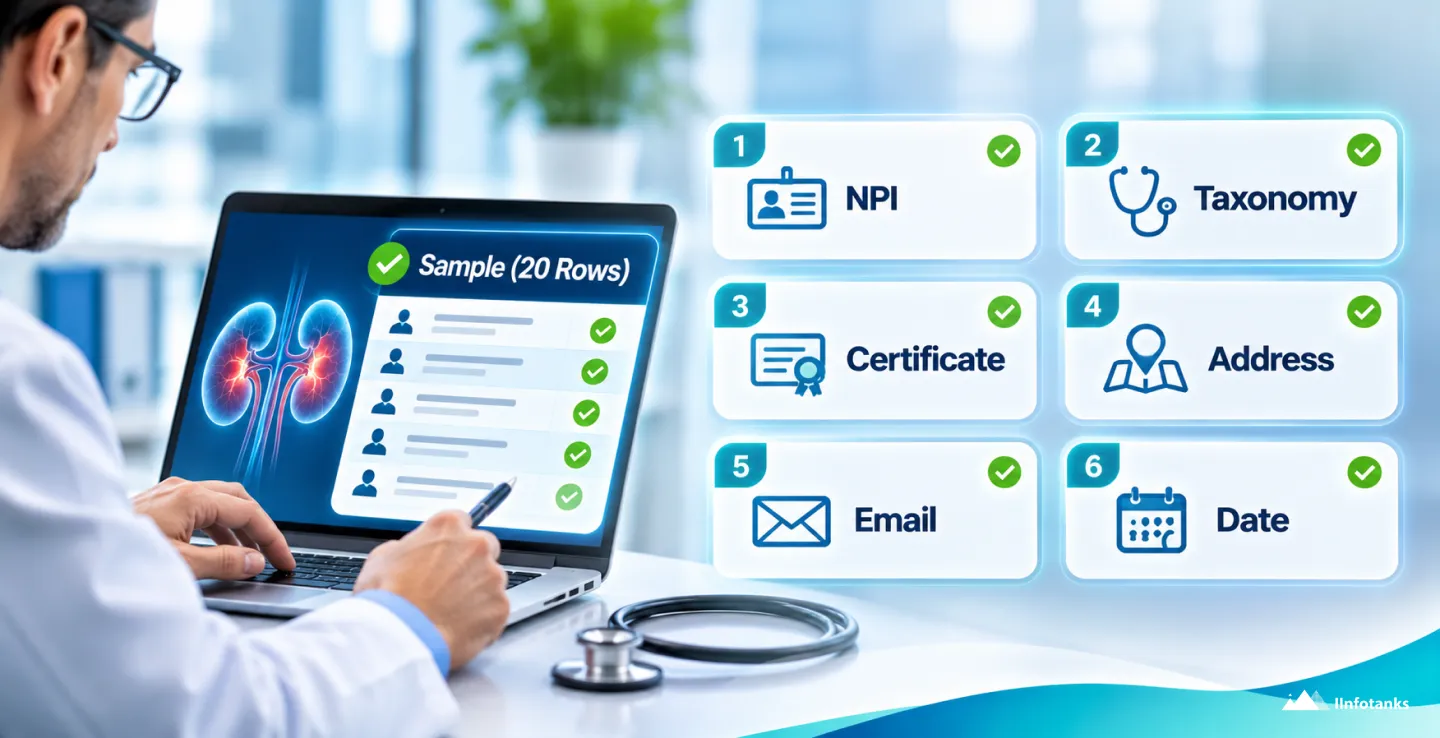
Short answer: Ask for a 20-row sample and run these 6 checks. You can finish them in an afternoon.
- NPI. Look up 5 NPIs in the NPI Registry. The name and primary taxonomy should match the row.
- Taxonomy. Count rows with a nephrology taxonomy code (207RN0300X) and rows with 2080P0210X. A row with neither needs another proof.
- Certificate. Check 3 names with ABIM’s public certification check to confirm each board-certified nephrologist claim.
- Address. Compare each nephrologist practice address with the registry, and flag any row that shows a mailing address only.
- Email. Look at the nephrologist email addresses in the sample, count named work addresses against shared inboxes, and check each domain against the practice website.
- Date. Ask for an as-of date on each field. A single “last updated” stamp hides which field is old.
Then count how many rows fill each field. Here’s what a result could look like (we invented these numbers to show the method):
|
Field |
Rows filled (of 20) |
Fill rate |
|---|---|---|
|
Name |
20 |
100% |
|
NPI |
20 |
100% |
|
Practice address |
19 |
95% |
|
Taxonomy code |
18 |
90% |
|
Practice phone |
17 |
85% |
|
Work email |
11 |
55% |
|
Certification |
8 |
40% |
|
As-of date |
5 |
25% |
In this example the email and certificate fields are the weak spots, so those are where you’d press the vendor. Apply the same grid to any sample of nephrologist contact information.
What to do: Write the 6 results at the top of the sheet and fix the weakest field first.
8 Questions to Ask Any Vendor
Short answer: These 8 questions separate a built file from a list of job titles.
- Which public sources feed the identity and location fields?
- Does every record carry an NPI and a nephrology taxonomy code?
- How do you define a nephrologist: taxonomy, certificate or job title?
- Are pediatric nephrologists included, and are they labeled?
- How was each email found, and when was it last verified?
- How do you handle a nephrologist who works at 2 or more sites?
- What is the as-of date on each field?
- What happens when an email bounces?
Put the same 8 questions to any file of nephrologist contact information, ours included. Our nephrologist email list page is the place to start with us.
What to do: Send the 8 questions to each vendor and compare the answers side by side.
Frequently Asked Questions
What is nephrologist contact information?
Nephrologist contact information is the professional record of a kidney specialist. It covers identity, credentials, practice, location, phone, email and an as-of date, and it leaves out all patient details.
What fields does nephrologist contact data usually include?
Expect name, credential, NPI, license state, taxonomy code, practice name, practice address and a phone number. Better files add board certification, group size, hospital affiliation, a work email and a date on each field.
Does nephrologist contact information include email addresses?
Public registries don’t. The CMS clinician data dictionary has no email field, and the NPPES layout we checked has none either. A vendor finds and verifies each email, so ask how and when.
Where does nephrologist contact information come from?
Mostly 4 places: NPPES, the CMS clinician file, board certification records and a vendor’s own research. Public records cover identity, taxonomy and practice location. Vendors add email, direct phones and context fields.
What is a nephrologist NPI number?
It’s the unique ID that NPPES assigns to a provider. It lets you match a file to the NPI Registry and to your CRM. None of the 5 public nephrologist file pages we read named an NPI field.
What is the taxonomy code for a nephrologist?
The NUCC code for Nephrology is 207RN0300X, filed under Internal Medicine. Pediatric Nephrology is 2080P0210X, filed under Pediatrics. The code finds candidates, and a certificate confirms them.
How can I check whether a nephrologist is board certified?
To confirm a board-certified nephrologist, use ABIM’s public certification check. ABIM requires a prior internal medicine certificate, at least 24 months of fellowship training and a passing exam score, so test a few names from any sample.
Are pediatric nephrologists included in a nephrologist file?
Not by default. They carry a separate taxonomy code, so a file built on 207RN0300X can miss them. Ask whether pediatric nephrologists are included, labeled or priced as their own segment.
How many nephrologists are there in the US?
No exact count exists. A Migration Policy Institute report, citing AAMC data, puts the US at about 12,600 nephrologists in 2024, up 67% from about 7,600 in 2008.
Why do nephrologist file counts differ between vendors?
They count different things. A page we read counts nephrologist job titles with a verified work email, and another counts every contact tied to nephrology practices, including nurses and fellows. Compare filled fields across vendors.
Can a nephrologist have 2 or more practice addresses?
Yes. NPPES carries a primary practice location, and CMS publishes a separate reference file for non-primary locations. Ask whether a vendor stores extra sites as extra addresses or as duplicate records.
Do public nephrologist phone numbers reach the physician directly?
Usually not. NPPES and the CMS file carry practice lines, and the CMS file lists a phone only when 1 number is available for the address. Direct dials and mobiles come from vendors.
Should nephrologist contact data include patient information?
No. It’s a professional record. Patient names, diagnoses, treatment details and lab results don’t belong in it, so put that in writing in your vendor brief.
How often should nephrologist contact information be refreshed?
We found no public standard. CMS publishes NPPES as a monthly file with weekly updates, but a vendor’s email and phone fields follow their own schedule. Ask for an as-of date on every field.
How do I test nephrologist contact data before buying?
Ask for 20 rows. Look up 5 NPIs, check 3 certificates, compare addresses with the registry, test the emails and count how many rows fill each field. Then compare the total with the 12,600 estimate.