
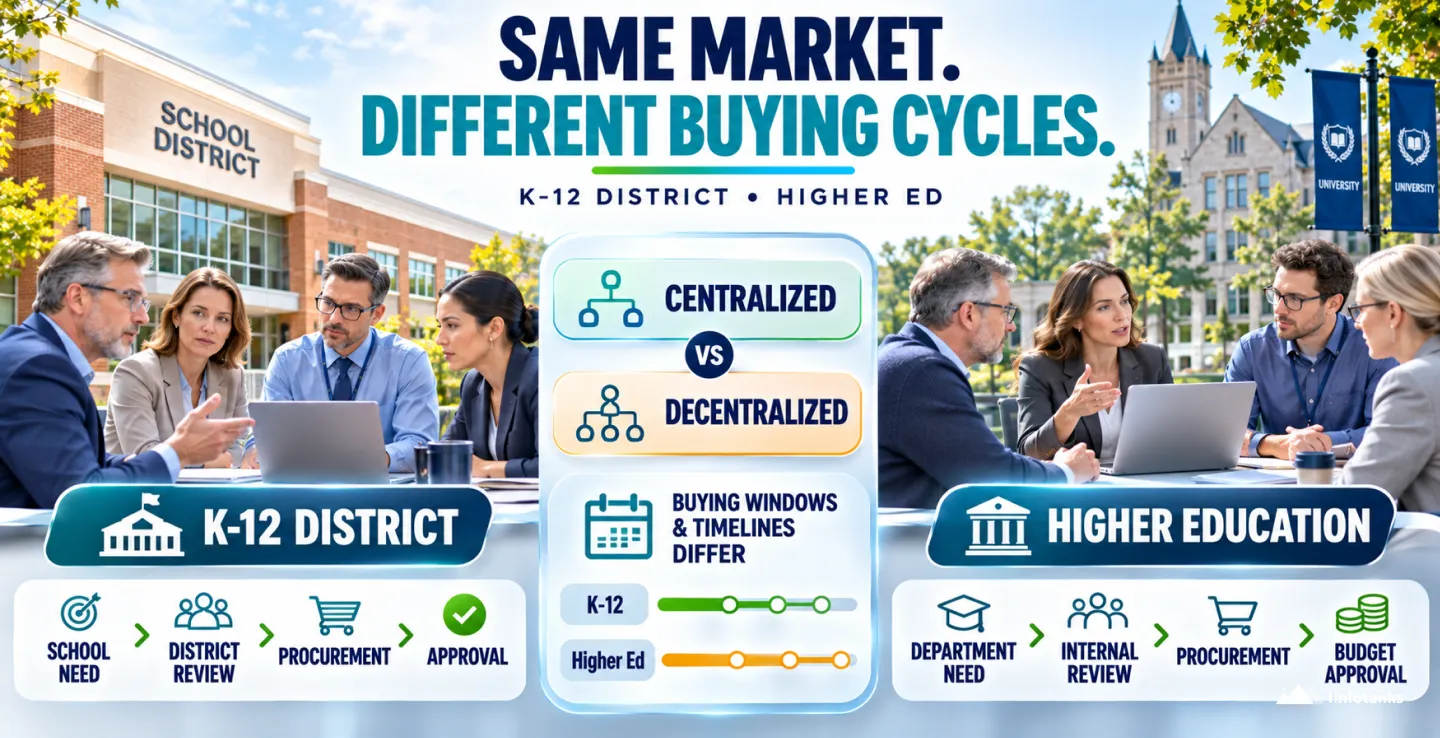
A district technology director can love your product and still be unable to buy it. A college dean can approve a pilot in a week and then watch it sit in procurement for months. Both are sales to a school, and they run on different clocks.
That’s the core problem if you want to sell to schools and colleges. K-12 districts and universities each have budgets, approvals and bid rules, but they use them in a different order. Once you know which buying path applies, an elementary and secondary schools email list filtered by school roles can help you reach relevant contacts. Check district and college coverage separately.
This guide shows how to sell to schools and colleges in three passes: who decides, when money moves and what paperwork clears the deal. I name the source for every number. Where sources disagree, I explain why. Where a figure comes from a vendor’s own data, I say that too.
TL;DR: how to sell to schools and colleges in four points
- Two buyers, two clocks. NCES counted 19,186 operating public school districts and agencies in 2023-24, plus roughly 5,600 to 5,800 Title IV colleges. To sell to schools well, pick the K-12 or higher-ed path first.
- Districts follow the board and the budget. Most budgets run July to June, larger purchases pass a bid threshold or a board vote, and new ARP ESSER obligations closed in September 2024, although some approved payments continued into 2026. Timing matters more than polish when you sell to schools.
- Colleges follow committees. Higher education procurement varies by institution type, size and funding, so map each campus before you write.
- Paperwork sets the speed. Cooperative contracts, student data privacy agreements and security reviews can speed a deal up or stop it cold.
Two markets that share a calendar and little else
Start with size, because it shapes how you build a list to sell to schools. In 2023-24, NCES counted 99,297 operating public schools, 19,186 operating districts and 49,404,386 students. Those totals cover the 50 states and DC.
You’ll also see “about 13,000 districts” quoted. Both numbers are right. Education Week’s summary of NCES data puts regular school districts at 13,318 for 2022-23, and that count leaves out regional service agencies, state-operated and federal agencies and other local education agencies. The larger count includes them. So a curriculum publisher selling to conventional districts may want the smaller figure, while a bus fleet vendor may want every agency that buys.
Enrollment adds pressure. NEA’s 2026 review of state data, as reported by NPR, shows fewer students in public schools. McKinsey notes that all 50 states use enrollment or attendance to set district funding, so fewer students means tighter budgets. That shapes every pitch you make when you sell to schools.
Higher education is smaller and less tidy. NCES counted 5,819 Title IV colleges in 2023-24 (the United States plus other jurisdictions) and 5,760 in 2024-25, with about 3,800 of the 2024-25 group degree-granting. A US-only tally of the same IPEDS data comes to 5,626. The gap comes from what each count includes, so confirm the basis before you size any list.
Counts tell you how many doors exist. The next question is who answers each one.
What each side buys, and who pays
Before you try to sell to schools, find out which budget your product draws on. NationGraph’s glossary lists what districts buy: technology, curriculum, professional development, facilities services, transportation, food services and administrative systems. Each category has a different owner. A food service director holds one budget, a transportation director holds another and a curriculum director holds a third.
Funding source matters just as much. Federal Title programs and state grants pay for many purchases, and each carries rules about what it can buy. Starbridge, a sales-intelligence vendor, treats each funding source as a buying signal, and Title III money for English learners is one of its examples. That’s a vendor’s reading, but the logic holds. Money with a label on it gets spent on the label.
Colleges split spending too. Central IT pays for enterprise systems and security tools, academic units often pay for instructional tools, and grants pay for research equipment. So the school decision makers who matter depend on whose budget your product touches. Learn that first, and the role table that follows gets much easier to use.
Who decides in a K-12 district
A district purchase involves several people, so a plan to sell to schools needs more than one contact. This table shows the usual roles when you sell to school districts.
|
Role |
What they own |
What they care about |
Best first message |
|---|---|---|---|
|
Superintendent or assistant superintendent |
District priorities and the budget proposal |
Student outcomes, cost, community reaction |
One outcome, with a nearby district as proof |
|
Curriculum or instruction director |
Learning programs and adoption cycles |
Standards fit and teacher use |
Alignment evidence and a small pilot |
|
Technology director or CTO |
Devices, network, software approvals |
Security, integration, support load |
Integration notes and privacy documents |
|
CFO or business manager |
Budget lines and funding sources |
Total cost, which fund pays, renewal price |
A cost sheet that names the funding source |
|
Purchasing officer |
Bids, quotes and contracts |
Compliance and clean paperwork |
Contract vehicle, W-9 and insurance |
|
Principal |
School-level needs and small purchases |
Staff time and fit with the school plan |
A quick win for teachers |
|
School board |
Approval of the budget and large contracts |
Public accountability |
A one-page summary ready for a meeting |
The school board may approve budgets and authorize major purchases, but an authorized district official can execute the contract. Board approval, procurement review and signing authority are separate steps, and local policies set spending limits within state law. For example, Pennsylvania’s 2026 public school purchasing threshold is $24,500 for formal competitive bids on applicable goods and supplies, with quotations generally required from $13,200. Certain services and items are exempt or follow different rules, and federal funding may add requirements. Before you try to sell to schools through a bid, ask each district for its current purchasing and signature policies.
Public view helps you here. Board agendas, budget documents and bid portals are public, which means a patient seller can see what a district plans to buy before anyone returns an email. Once you know who decides, the next question is how a college differs.
Who decides at a college or university
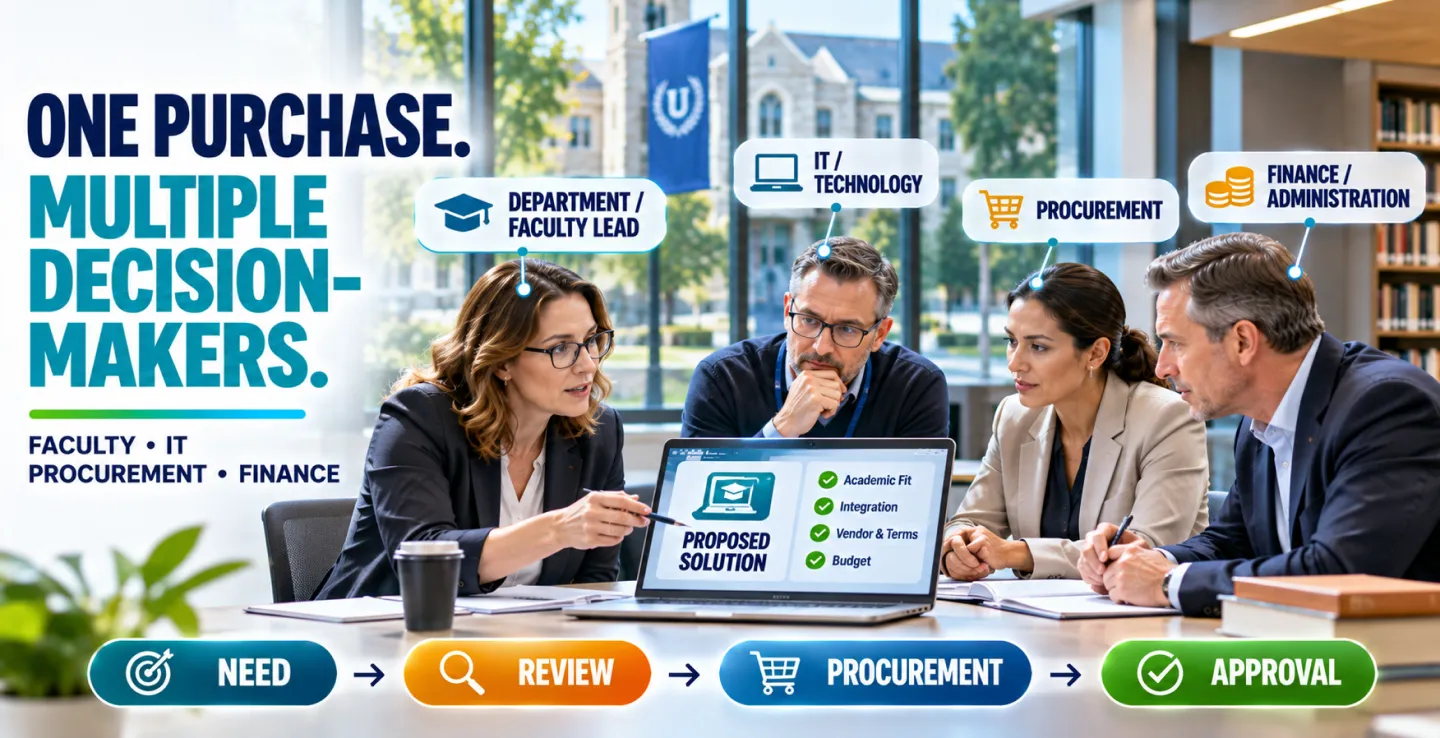
Higher education procurement has no single shape, which complicates any plan to sell to schools at the college level. EDUCAUSE says it varies significantly across institution types, sizes and structures, and that public and private institutions work under different regulatory frameworks. Public institutions generally follow applicable state purchasing rules, while private institutions use their own policies. For federal awards, grants and cooperative agreements generally follow Uniform Guidance; federal procurement contracts follow the Federal Acquisition Regulation (FAR), with some Uniform Guidance provisions also applying. Check the award type and its terms rather than treating every funding source alike.
Starbridge’s higher-ed guide sorts the people who start a purchase into four groups: department chairs and unit leaders (department budgets), deans and vice provosts (college or institution funds), CIOs (the central IT budget) and principal investigators (grant funds). Starting a purchase and approving it are different jobs, the guide adds, and final sign-off may sit with a vice president, the system office or a governing board. The weight each carries depends on what you sell. Instructional tools lean on faculty. Enterprise systems lean on the CIO.
A real example makes this clearer. El Camino College publishes a software purchasing flowchart (February 2024 version). The first gate is budget confirmation, meaning the expense was approved through a VP or the annual planning process. Instructional software goes to an academic technology committee, new software goes to a technology committee, and documentation follows. A seller trying to sell to schools through the dean alone skips the committee steps.
Neither market has one fixed approval sequence. El Camino College’s software process starts with budget confirmation and may then require committee review, contract review, board approval and procurement. K-12 districts also vary by purchase type, policy and funding. Use the table below as a checklist, not a mandatory order, when you sell to schools of either kind.
K-12 district vs higher-ed buying cycles, side by side
|
Factor |
K-12 district |
College or university |
|---|---|---|
|
Buying unit |
District office, with school-level buying for small items |
Campus, department or system office |
|
Potential buying organizations |
19,186 operating districts and agencies (NCES, 2023-24) |
About 5,600 to 5,800 Title IV institutions (NCES) |
|
Large purchase approval |
Board approval where required by policy or law |
Committee, leadership and procurement review as applicable; state rules at public institutions |
|
Technology vetting |
Technology director and privacy officer |
CIO’s office, security review and faculty committees |
|
Privacy paperwork |
Student data privacy agreement, often the National Data Privacy Agreement |
Security questionnaire such as the HECVAT from EDUCAUSE |
|
Shared contracts |
Sourcewell, state and regional co-ops |
Sourcewell, E&I Cooperative Services and consortia |
|
Money pressure |
ARP ESSER obligations ended in September 2024; some approved payments extended into 2026. Enrollment is falling (NEA, 2026) |
Varies by institution type and funding source |
Both columns share one trait. If you sell to schools of either kind, learning the process before the first call pays off. The rest of this guide covers the pieces that sit under these rows, beginning with timing.
How the school year and the budget line up
Timing drives the K-12 sales cycle more than any pitch does. When you sell to schools, the school district budget cycle is the one calendar that stays fixed. According to NCSL, 46 states start their state fiscal year on July 1, and the exceptions are New York (April 1), Texas (September 1) and Alabama and Michigan (October 1). Districts set their own fiscal year inside state law, and NationGraph says most follow July 1, so confirm each one.
One vendor, NationGraph, describes the school district budget cycle in three phases for July-to-June districts. Planning runs November to January. Approval runs February to April, and RFPs follow approvals. Execution runs May to August, when districts spend what’s left and start the new year.
The same vendor analyzed more than 7,000 Chromebook purchase orders from over 800 districts in 2024. Monthly orders averaged 342 in the planning phase, 529 in approval and 623 in execution. That’s a vendor’s own sample, and the article gives no selection method, so treat it as directional. NationGraph’s glossary page even shifts the windows (planning from October to February, spring procurement from March to June), which shows how loose these calendars are. Still, it fits the common warning from sellers: campaigns launched in April often meet decisions made in January.
Money is a second timer. Federal guidance shows that ESSER funds under the ARP program had to be obligated by September 30, 2024. Some previously approved liquidation extensions allowed payments through March 28, 2026, subject to later federal guidance and court orders. McKinsey’s survey found 53% of district decision makers expected a spending cliff, and its authors expect average school budgets to decline 5 to 8% after ESSER. In practice, districts now question renewals and favor tools that prove value on a tight budget, so anyone trying to sell to schools needs proof of value.
Higher ed runs on a different rhythm. EDUCAUSE’s budgeting guide says end-of-year spending patterns vary by institution, and that one-time funding pays for a single year only, so check whether your price recurs. El Camino’s flowchart shows the same discipline: budget confirmation comes first. So ask every college for its fiscal year end and its budget request deadline, and treat the answer as your calendar.
What clears a purchase: bids, co-ops and privacy paperwork
Three things stand between a yes and a purchase order when you sell to schools, and each one can add weeks.
Bid rules. State law and local policy set when a district or public college must collect quotes, run an RFP or award by sealed bid. Smaller purchases move faster. Larger ones follow the formal path, and public bodies publish the results.
Cooperative purchasing. A cooperative runs one competitive solicitation and lets many agencies buy from the winning contract. Sourcewell’s FAQ explains that to sell through its contracts, a company must respond to an RFP or IFB, and that whether an agency can use a cooperative contract depends on its state and local rules. E&I Cooperative Services plays a similar role for higher education. For a seller, a cooperative contract can replace months of separate bids. Demand still comes from your own marketing to each buyer.
Privacy and security review. If your product touches student data, expect a data privacy agreement. The National Data Privacy Agreement sits under the Student Data Privacy Consortium, a special interest group of the Access 4 Learning Community that reports 35 state alliances. Districts and vendors use it to settle privacy terms up front. Colleges often send a security questionnaire instead, and EDUCAUSE’s HECVAT is a common format. A vendor with these documents ready removes a frequent holdup before it starts.
No neutral source gives one number for the K-12 sales cycle. Vendor blogs quote cycles as long as 12 to 18 months and show no study behind the number. A small purchase on existing budget can close in weeks. A district-wide platform may pass a pilot, a bid and a board vote. Ask each buyer for their steps and dates, then build your plan to sell to schools around those.
Three sales, three paths
Tables only go so far, so here are three scenarios that show how to sell to schools at different scales. They’re illustrations only.
A classroom app for one grade. A principal or a teacher team may buy it from a school budget, often under a local spending limit. It can close in weeks, but it stays small. When you sell to schools this way, your goal is a pilot that grows into a district conversation.
A district-wide learning platform. This one meets the full K-12 sales cycle: curriculum and technology review, a privacy agreement, a budget line, a bid or cooperative contract and a board vote. Starting in planning season matters most here.
A campus-wide system at a university. Higher education procurement takes the lead: a committee, a security review, a budget request and often a state bid rule. The champion may be a dean, but the CIO’s office and procurement hold the gates.
Notice what stays constant. Every path has a person who feels the need, a gate that checks risk and a budget that pays. Name all three before you write a single email.
A 12-month plan to sell to schools and colleges
Put timing and process together and you get a calendar for anyone who wants to sell to schools all year. The windows below are typical, so confirm them with each buyer.
|
Window |
K-12 districts |
Colleges and universities |
|---|---|---|
|
August to October |
Learn the new year’s priorities and start pilots |
Meet deans and the CIO’s office early in the fall term |
|
November to January |
Planning window: meet technology and curriculum leads and share your results |
Ask when budget requests are due and what they need to include |
|
February to April |
Approval window: send board-ready one-pagers, quotes and your cooperative contract number |
Committee reviews: supply security documents and references |
|
May to August |
May-June: complete current-year purchasing; July-August: start new-budget orders and rollout |
Summer setup ahead of the fall term |
Here’s how I’d run it to sell to schools in practice:
- Choose a track. Decide whether you sell to school districts, to colleges or to both, and write separate messages for each.
- Map two or three school decision makers. In a district, that might be the technology director and the curriculum director. At a college, it might be a dean and the CIO’s office.
- Read the public record. Board agendas, budget documents and bid portals show what a buyer plans before anyone tells you.
- Ready the paperwork. Keep your privacy agreement, security answers, W-9, insurance and contract number in one folder.
- Offer a small pilot. A one-semester trial with agreed measures gives a committee something concrete to approve.
The same steps work whether you sell to schools with software, supplies, furniture or services. Swap the roles and the proof.
Mistakes that stall anyone trying to sell to schools
Even good lists fail when the approach is off. These patterns cost the most time when you sell to schools.
- Treating a champion as the buyer. A teacher or dean can open a door, but budget and approval sit elsewhere.
- Launching in April. Many districts have settled their plans by then, so start in planning season.
- Ignoring cooperative contracts. A buyer who can piggyback on an existing contract may prefer it to a new bid.
- Showing up without privacy documents. If student data is involved, the agreement is part of the sale.
- Treating every school as a district. An individual school buys small items, while the district office signs larger contracts, so match your offer to the level that can say yes.
- Using one message for both markets. If you sell to school districts and colleges, remember they decide in different orders, so write to each one separately.
Build the list before you sell to schools and colleges
All of this assumes you can reach the right people. A list that mixes districts, individual schools and colleges wastes your first month of trying to sell to schools.
Start broad, then narrow. The industry email lists hub shows how segments are organized, so you can see where education sits next to its neighbors. If you’re still comparing sources, this guide to B2B data providers shows what to ask before you buy. And once you have a file, the walk-through on how to reach decision makers with B2B data services covers the outreach side.
The cut that matters most is role plus staff-size band plus state. A file of technology directors at schools with 100 or more employees in two states reads very differently from a national list of every school. Confirm district-level coverage and pupil-enrollment figures separately. That cut lets you sell to schools by segment, with a message built for each one, and it keeps your first campaign small enough to learn from.
How IInfotanks builds school and college files
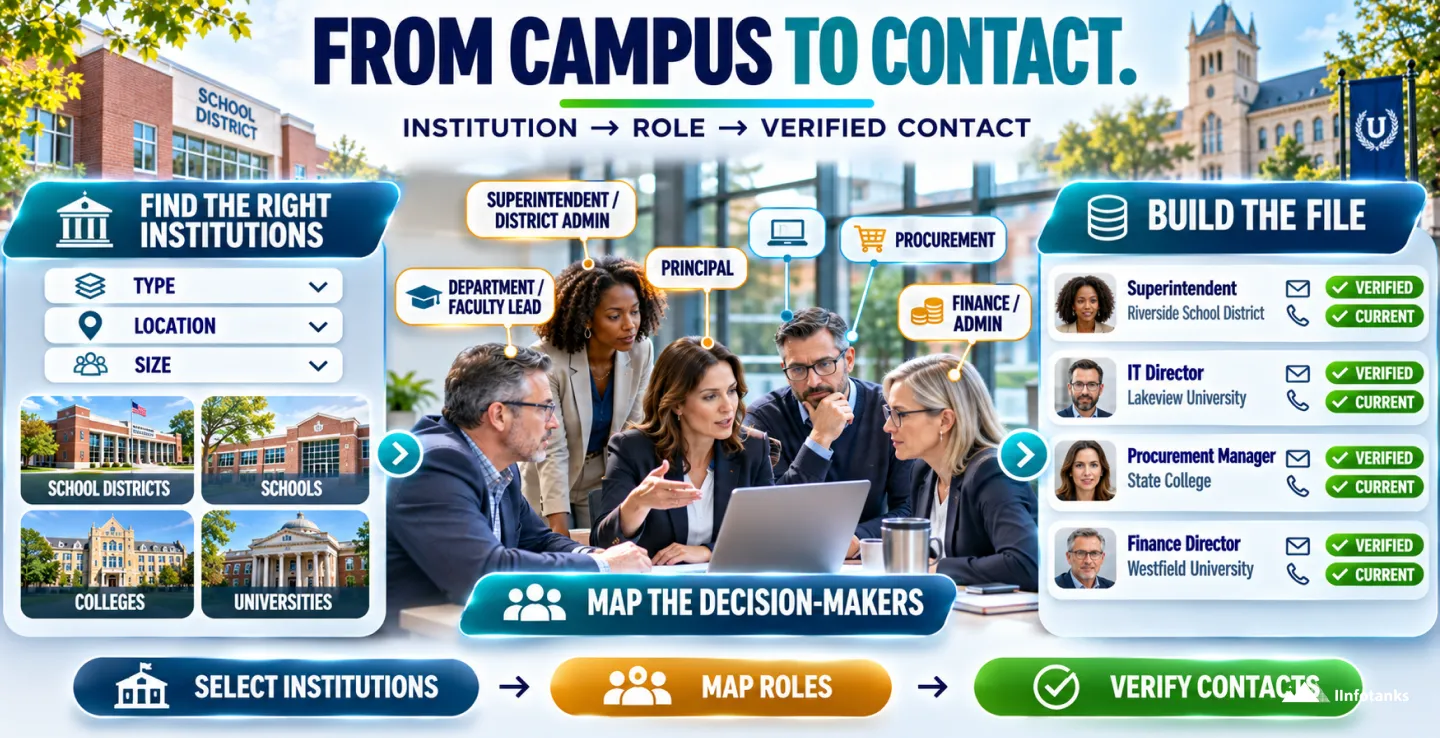
IInfotanks builds files around the segment and role you sell into. You can request school contacts by school type, employee size, job role, state and seniority. Pupil enrollment is not a standard field, so ask whether it can be sourced for your segment and confirm district or college coverage separately. You can start from a masked sample to check the format before you commit.
Share what you sell, the roles that buy it and the staff-size band that fits. The scoping team will map the cut with you, and a school-level contact list built that way helps you reach relevant staff. Confirm district and college coverage before targeting those groups.
Frequently asked questions
1. How do you sell to schools and colleges?
Decide first whether you’re selling to K-12 districts or to higher education, because their approval paths differ. Then reach two or three roles per account, learn the budget calendar and prepare your paperwork. Districts lean on budgets and boards, while colleges lean on committees and procurement. Keep privacy, security and contract documents ready for both.
2. How is selling to K-12 districts different from selling to higher education?
K-12 districts usually run July-to-June budgets, send larger purchases to a board vote or a bid, and often require a student data privacy agreement. Colleges decide through committees and procurement under campus or state rules, and many use security questionnaires. The structure differs, so each market needs its own message if you want to sell to schools well.
3. How long is the K-12 sales cycle?
No neutral source gives a single figure. Vendor guides quote 12 to 18 months for K-12 edtech and show no study behind the figure. A small purchase from existing budget can close in weeks. Ask the district for its steps, thresholds and dates on the first call.
4. When is the best time to sell to schools?
The best time to sell to schools is the planning window of the school district budget cycle. For July-to-June districts, vendor data points to planning in November to January and approvals in February to April. Execution follows from May to August. Colleges tend to plan budgets ahead of the academic year, so ask each one for its fiscal year end and request deadline.
5. Do I need a student data privacy agreement to sell to schools?
If your product collects or touches student data, expect to sign one. Districts and vendors use the National Data Privacy Agreement from the Student Data Privacy Consortium, and state rules may add terms. Colleges often ask for a security questionnaire as well, so keep both ready.
6. What is a cooperative purchasing contract and does it help me sell to schools?
A cooperative purchasing contract is one competitively solicited contract that many agencies can buy from. It can shorten the bid step for districts and colleges whose state and local rules allow it. You still have to win the contract and then market it to individual buyers.
7. Who approves a K-12 purchase and who signs the contract?
A board may approve the budget or authorize a large purchase, while a superintendent, purchasing officer or another designated official executes the contract. The exact path depends on district policy and state law. Ask who controls the budget, whether a board vote is required and who is authorized to sign.
8. How do I know whether a school district requires a competitive bid?
Check the district’s purchasing policy and state procurement rules before quoting. For example, in Pennsylvania in 2026, applicable school goods and supplies generally require quotations from $13,200 and formal bidding at $24,500. Certain services and other categories follow different rules, while federal funding may add requirements.
9. When did ARP ESSER funding end for school districts?
Districts generally had to obligate ARP ESSER funds by September 30, 2024. Some approved liquidation extensions allowed payments on eligible obligations through March 28, 2026, subject to subsequent federal guidance and court orders. The deadline to commit funds was therefore earlier than the final payment date for some projects.
10. Can I filter school contact lists by student enrollment?
Employee or staff size is a standard filter in IInfotanks’ primary and secondary education contact data. Pupil enrollment is not a standard field, so ask whether it can be sourced for your specific segment. Confirm district and college coverage separately rather than assuming that school-level records include those organizations.