
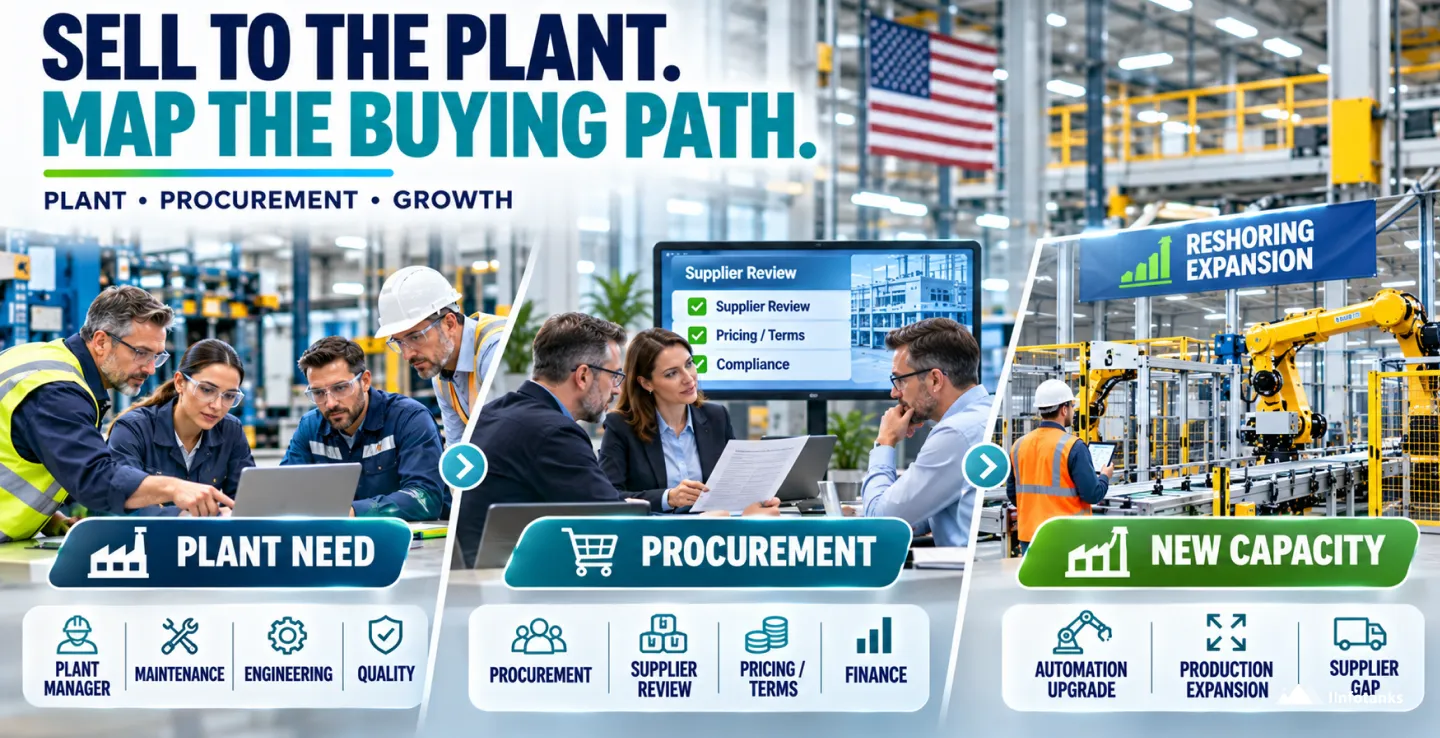
A box of replacement bearings and a new packaging line are both sales to a manufacturer. They have almost nothing else in common. One is a purchase order a buyer clears in a day. The other pulls in the plant, engineering, quality and finance.
That gap is the first thing to grasp if you want to sell to manufacturers. The deal depends on what you sell and on which building it lands in. Once you know both, a manufacturing email list cut by plant role and site size puts you in front of the right people.
This guide shows how to sell to manufacturers in three parts. You’ll see which roles sit inside a plant, how the manufacturing procurement process works, and what the reshoring wave means for your timing. I name the source for every number. Where sources disagree, I say so.
TL;DR: how to sell to manufacturers in four points
- The buyer is a site. The 2023 Census counted 284,452 US manufacturing establishments with paid employees, including 89,869 with at least 20 employees. To sell to manufacturers, pick plants by size, state and role.
- Roles split the work. Plant managers, maintenance and quality shape what gets bought. Procurement controls price, terms and the approved supplier list. Finance may approve major capital spending.
- Buyers research first. In a 2026 survey of 121 global professionals across manufacturing and related industries, 81% had a shortlist before contacting vendors, so your proof needs to exist before you try to sell to manufacturers.
- Reshoring helps, with caveats. Announced jobs hit 247,000 in 2025, yet imports from Asian low-cost countries still rose. The best openings are workforce, automation and supplier gaps.
Start with the plant when you sell to manufacturers
Selling to manufacturers means selling to a building with named roles inside it. The Census Bureau’s County Business Patterns counts employer establishments, meaning physical business locations with paid employees. A manufacturer with 6 staffed factories generally counts as 6 establishments. For 2023, the count was 284,452 manufacturing employer establishments employing 12,335,234 people; locations without paid employees are excluded.
Among employer establishments, manufacturing accounts for 3.4% of US locations and 8.8% of employees, so the average manufacturing establishment has about 43 employees against 17 across all industries. About 36% of manufacturing employer establishments have fewer than 5 employees, compared with 55% overall, while 89,869 (31.6%) have 20 or more.
Why does the unit matter? Plants buy differently from headquarters. A plant lives with the daily grind: uptime, scrap, safety, shift schedules and the parts on the shelf. Headquarters in a multi-plant group often owns contracts, standards and large capital projects. A founder-run shop with 60 people makes both kinds of decision in one building.
Your product decides which level to chase. Consumables, repair parts and shop-floor tools usually start at the plant. A company-wide software contract usually starts higher up. So before you build a list to sell to manufacturers, pick the level you’re after.
Once you’ve picked it, the next question is who inside the plant to write to.
The plant roles behind every deal
Titles vary from one factory to the next, but the same jobs show up among manufacturing decision makers again and again. This table is the map I’d use to sell to manufacturers at the plant level.
Role | What they own | What they care about | Best first message |
|---|---|---|---|
Plant manager or general manager | The site’s output, budget and headcount | Throughput, cost per unit, safety record | A result in their own numbers, such as downtime hours or scrap rate |
Production or operations manager | Daily schedule, lines and shifts | Hitting the plan with the crew on hand | How you cut changeovers or keep a line running |
Maintenance or reliability lead | Equipment uptime, spare parts, service contracts | Fewer breakdowns and fast parts | Specs, lead times and who answers the phone at 3 a.m. |
Quality manager | Inspection, audits, certifications | Passing audits and cutting defects | Certificates, documentation and traceability |
Manufacturing or process engineer | Process design, tooling, equipment specs | Fit, performance, integration | Technical data, drawings and trial offers |
EHS manager | Safety and environmental compliance | Injury rates and regulation | Proof your product meets the rule |
Purchasing manager or buyer | Suppliers, price, terms, the approved supplier list | Cost, supply security, clean vendor paperwork | Clear pricing, capacity and references |
Finance lead, owner or CFO | Capital approval | Payback and risk | Payback math in dollars |
The government counts two of these jobs. The Bureau of Labor Statistics reports 252,100 industrial production managers in 2025, with a median annual wage of $126,060. Employment is projected to grow 3% from 2025 to 2035, with about 17,000 openings a year.
Those projected openings include employment growth and replacement needs, such as workers transferring to other occupations or leaving the labor force. They do not show how often individual managers change jobs, so the figure should not be used as a contact-decay rate. Regular role checks still matter when you sell to manufacturers.
Purchasing roles show a similar pattern. BLS lists a $148,080 median annual wage for purchasing managers (May 2025) and $77,710 for buyers and purchasing agents, with about 53,600 projected annual openings across these occupations. Those buyers work in many industries, so the figure shows scale only.
Titles only show who works there. Deciding is a separate job, so let’s sort out who decides what.
Who decides when you sell to manufacturers
Who approves a purchase depends on what you sell. This table maps likely approvers across five categories; the authorized contract signer may be someone else.
What you sell | Who usually starts it | Who shapes the specs | Likely approver (not necessarily signer) |
|---|---|---|---|
Repair parts, consumables, safety gear | Maintenance, operators | Maintenance lead | Buyer or plant manager, often within a spending limit |
Raw materials and components | Engineering, planning | Engineering, quality | Procurement, after supplier qualification |
Production equipment and automation | Plant manager, engineering | Engineering, maintenance, quality, EHS | Plant manager plus finance or corporate |
Shop-floor software | Operations, engineering | Operations, IT, quality | Plant or corporate leadership with IT sign-off |
Outsourced services such as staffing or logistics | Plant manager, HR | Operations | Plant manager or corporate procurement |
Treat it as a starting map, not a signatory chart. Spending limits, final approval and contract-signing authority vary by company, so confirm all three early.
Across all five rows, manufacturing decision makers fall into three groups. One group feels the problem, usually maintenance and production. A second group vets you: quality, engineering, EHS and IT. A third group authorizes spending, often including procurement, plant leadership and finance. A deal that skips any group tends to stall.
The vetting group deserves extra attention. Quality, EHS and IT rarely sign anything, but each can stop a deal with one objection. A missing certificate or an unanswered security question can end your attempt to sell to manufacturers before it starts.
How big is the group? General B2B research from Gartner often puts a buying group at 6 to 10 people. Manufacturing-specific data is thin, but the 2026 Automation.com and RH Blake survey of 121 global industrial respondents found that 83% reported five or more evaluators. The two figures count different things, since one tallies decision makers and the other tallies everyone who evaluates. Either way, a manufacturing buying committee is rarely one person.
That’s why single-contact outreach stalls when you sell to manufacturers. You need two or three roles per site, each with a message built for their job.
How the manufacturing procurement process works
Procurement may join early or later, depending on the manufacturer and the type of purchase. Anyone who wants to sell to manufacturers at scale needs to understand the manufacturing procurement process. There is no universal order, so ask how each buyer handles qualification and approvals.
Komatsu’s public supplier guidance offers an example of how a manufacturer manages supplier relationships. It emphasizes quality, competitive pricing, compliance and supplier resources, but does not establish one mandatory sequence for every purchase. Depending on the buyer and category, qualification may involve capability reviews, documents, audits, negotiations or placement on an approved supplier list.
A common process to prepare for looks like this, although stages can overlap or change order:
- Need. A plant, engineering or maintenance raises a requirement.
- Qualification. The buyer collects certificates, financials, insurance and references, and may audit your site.
- Approved supplier list. You’re cleared for specific part families or categories only.
- Quote or proposal. Eligible or shortlisted suppliers compare price, lead time and terms; some buyers request quotes before final qualification.
- Order and review. The buyer places a purchase order and then tracks on-time delivery and quality.
Komatsu’s public supplier guidance emphasizes quality, competitive pricing and compliance; individual buyers may require additional evidence, including quality-system certification. IATF 16949 supplements ISO 9001 for automotive supply, while AS9100 adds aerospace-specific requirements to the ISO 9001 framework. ISO 13485 is a standalone quality-management standard for medical devices, not an automatic add-on to ISO 9001. Check which requirements apply to the product and customer.
Two practical points follow for anyone who wants to sell to manufacturers. First, assemble your paperwork before you start outreach: certificates, insurance, references and lead times. A buyer who says yes in message three will ask for them in message four.
Second, expect no single number for the manufacturing sales cycle. Vendor blogs quote anywhere from 6 to 18 months and rarely cite a study. A reorder of consumables can close in days. A qualification audit adds steps before your first order. Ask each buyer for their steps and dates, then plan around those.
How manufacturers research suppliers before they reply to you

Procurement starts late. Research starts much earlier, and your prospects do it without you. Those weeks decide whether you get the chance to sell to manufacturers at all.
The 2026 Automation.com and RH Blake survey covered 121 global professionals from manufacturing, industrial services, technology and engineering; 39% were US-based and 66% reported final decision-making authority. Among respondents, 81% had a shortlist before contacting vendors, and 25% first contacted a vendor within the opening 10% of the buying process. The findings describe this group of respondents, not all US manufacturers.
The sample is small, global and cross-industry, so treat its results as directional rather than representative of all US manufacturers. A 2019 Thomas survey of 266 industrial buyers, dated but still useful, found that 71% vetted fewer than five suppliers before deciding. Together the two studies point the same way: the list is short, and you want a spot on it before the first call. Selling to manufacturers starts weeks before anyone replies.
Three habits follow when you sell to manufacturers:
- Be findable. Spec sheets, certificates and role-specific pages should live on your site, because buyers check them before they answer you.
- Write to the roles that research. Engineers and maintenance leads read technical detail. Buyers scan for price logic and proof.
- Offer help first. A short note that names a real problem and offers data beats a request for 30 minutes.
AI is part of the picture now. The same study saw AI use for supplier research climb from 23% to 48%, yet buyers rated their trust in AI answers at 4.9 out of 10. Accurate, sourced pages on your own site give them something to verify against.
Research tells you how buyers behave. The next question is when they’ll spend, and that’s where the reshoring wave comes in.
The reshoring wave: what the numbers say
Reshoring headlines promise a lot to anyone who wants to sell to manufacturers. The data shows a more mixed picture, so I’ve lined up the main signals side by side.
Signal | Latest figure | Source | How to read it |
|---|---|---|---|
Announced reshoring and FDI jobs, 2025 | 247,000, essentially level with 2024 | Reshoring Initiative | Announced jobs; hires unconfirmed |
Projection for 2026 | About 309,000 announced jobs | Reshoring Initiative | A forecast tied to policy and skilled labor |
Announced jobs since 2010 | More than 2.3 million | Reshoring Initiative | Cumulative total through 2025 |
OEMs reshored or engaged in reshoring | 36%, up from 29%; 31% have no plans | Reshoring Initiative survey | OEM respondents only |
US manufacturing import ratio | 14.15% in 2025, up from 13.29% | Kearney 2026 Reshoring Index | Imports from 14 Asian low-cost countries still grew |
Kearney Reshoring Index | Negative 86, improved from negative 115 | Kearney | A negative number means net offshoring |
Manufacturing capacity | Up about 1.5% | Kearney | Investment ran 2 to 3 times pre-2020 levels |
Factory construction spending | Down 21.7% year over year in July 2026 | Census data via AGC and ACEC | Big projects are moving past peak build |
ISM Manufacturing PMI | 55.5 in October 2026, a 10th month of growth | ISM | Activity is expanding |
The jobs figures come from the Reshoring Initiative’s 2025 annual report, as covered by Manufacturing Dive. Note the wording. These are announced jobs. The report gives no count of filled jobs, and the 2026 projection depends on industrial policy, skilled labor and cost-based sourcing.
Kearney adds a second layer. China’s direct imports fell by $135 billion in 2025, but the other 13 Asian low-cost countries gained $194 billion, and Mexico’s imports rose 8%. Work that left China often landed in another low-cost country or in Mexico. Kearney’s own report gives the index as negative 86, though some press coverage printed negative 91, so check the report if you quote it.
So what should you make of this? Two things are true at once. Money is flowing into US plants, and the ISM index shows activity expanding, with a 10th straight month above 50 after 10 months of contraction. But capacity has grown only slightly, and construction on new factories has cooled from its peak. The reshoring wave is real, and it’s slower and patchier than the headlines suggest. Plan to sell to manufacturers on that slower timeline.
Where the reshoring wave opens doors
Which problems does this create for plants? Kearney’s survey of executives gives a clear list. 55% cite the availability of people on the line, and 61% report shortages of technical skills. 91% are raising wages and 87% are investing in training. Gaps among tier 2 and tier 3 suppliers ranked higher than in earlier years. Only 18% of CEOs were very confident of an acceptable return on reshoring, down from 47% the year before.
Read those numbers as a shopping list for anyone who plans to sell to manufacturers. Plants short on labor look at automation, training tools, safety systems and inspection. Plants short on suppliers look for new tier 2 and tier 3 sources, and those suppliers need buyers. Plants unsure about returns want proof of payback, which means your case studies matter more than your brochure when you sell to manufacturers.
Industry matters too. Kearney rates food, beverage and tobacco as the easiest sector to reshore, and it sees early signs in textiles, furniture and electrical equipment. If you sell to manufacturers in those groups, your timing is better than average.
Cost pressure adds urgency. Reuters reported the ISM Prices Index at 75.2 in October, which means input costs are high. When you sell to manufacturers in this climate, a pitch that cuts waste, energy or downtime lands better than one that adds a new line item.
Now put it into practice.
A first-contact plan to sell to manufacturers
Say you sell vibration sensors that warn of bearing failures on rotating equipment. Here’s how I’d set up outreach to sell to manufacturers in that case.
- Choose the segment. Fabricated metal (53,790 sites) and machinery (21,668 sites) are big NAICS groups with plenty of rotating equipment. Filter to sites with 20 or more employees in two or three states you can serve.
- Pick two roles per site. Start with the maintenance lead and the plant manager. Add a quality or engineering contact in a second wave.
- Stagger the messages. Send the plant manager a note about downtime cost. Send the maintenance lead specs and install details a few days later. Send purchasing your certificates and pricing logic only once someone shows interest.
- Show proof in one link. A single case study with before and after numbers beats a five-slide deck.
- Ask about the process. Close with a question such as “What does supplier qualification look like at your plant?” It shows you understand how they buy, which only 29% of buyers say vendors do.
The same order works for staffing, software, safety gear or raw materials. Swap the roles and the proof, and keep the sequence you use to sell to manufacturers.
Five mistakes that slow anyone trying to sell to manufacturers
Even a good list fails when the approach is off. These patterns cost the most time when you sell to manufacturers.
- Pitching corporate for a plant-level purchase. A VP at headquarters seldom approves repair parts for a site they’ve never visited.
- Writing to one contact per site. A manufacturing buying committee has several members, and one champion alone seldom carries a deal.
- Leaving certificates for later. Quality teams ask for them early, and delay looks like risk.
- Asking for a demo in message one. About a quarter of buyers want help understanding the problem first.
- Sending the same message to every role. A buyer wants price logic. An engineer wants specs.
Build the list before you sell to manufacturers
All of this assumes you can reach the right people. A list that mixes plants, offices and distributors wastes your first month of trying to sell to manufacturers.
Start broad, then narrow. The industry email lists hub shows how segments are organized, so you can see where manufacturing sits next to its neighbors. If you’re still comparing sources, this guide to B2B data providers shows what to ask before you buy. And once you have a file, the walk-through on how to reach decision makers with B2B data services covers the outreach side.
The cut that matters most is plant role plus site size plus region. A file of 20-plus-employee fabricators in Ohio, Indiana and Michigan reads very differently from a national list of every manufacturer.
How IInfotanks builds manufacturing files
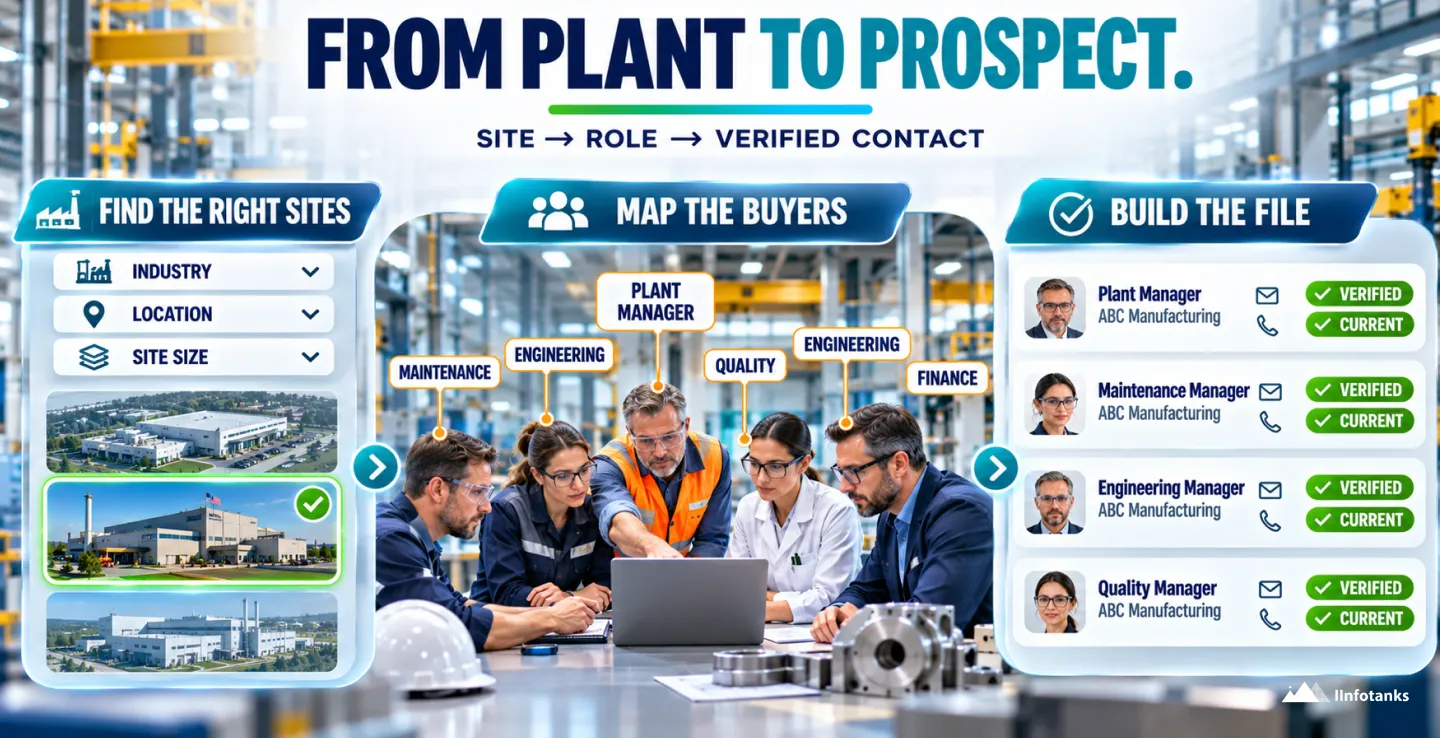
IInfotanks builds files around the segment and role you sell into. You can request records by industry segment, site size, job role, region and seniority, and you can start from a masked sample so you see the format before you commit.
Share what you sell, the plant roles that buy it and the size band that fits. The scoping team will map the cut with you, and a manufacturing email list built that way gives you a file to sell to manufacturers the way plants buy.
Frequently asked questions
1. How do you sell to manufacturers?
To sell to manufacturers, start by deciding whether your product is bought at the plant or at headquarters. Then write to two or three roles per site, such as the plant manager, maintenance lead or purchasing manager, with a message built for each job. Prepare your certificates and references early, because some buyers require qualification or supplier-list approval before an order.
2. Who are the manufacturing decision makers at a plant?
It depends on what you sell. Plant managers, operations managers, maintenance leads, quality managers and engineers shape the requirement. Purchasing managers and buyers run price, terms and supplier approval. Finance, the owner or corporate leadership may approve larger capital purchases; an authorized signatory executes the contract.
3. Should I sell to the plant or to corporate headquarters?
Match the level to the spend. Repair parts, consumables and shop-floor tools usually begin at the plant. Company-wide contracts, standards and large capital projects often begin at headquarters. In a single-site business, one team handles both, so you sell to manufacturers of that size through one set of roles.
4. What is an approved supplier list, and how do I get on one?
An approved supplier list is a manufacturer’s register of vendors cleared for certain parts or categories. Depending on the product and buyer, qualification may involve a capability review, quality certifications, financial records, references or a site audit. Some manufacturers seek quotes before final approval, while others qualify suppliers first. Ask about the company’s specific process before committing to a timeline.
5. How long is the manufacturing sales cycle?
No neutral source gives a single figure. A reorder of consumables can close in days, while equipment, software or a new material supplier can take much longer because of qualification and multi-role approval. Ask each prospect for their steps and dates on the first call.
6. Does reshoring make it easier to sell to manufacturers?
Probably, though the evidence is mixed. The Reshoring Initiative counted 247,000 announced jobs in 2025, but they are announcements, and Kearney found that US manufacturing imports from Asian low-cost countries still rose. The strongest openings are in workforce tools, automation, quality systems and supplier development.
7. What is the difference between a plant manager and a purchasing manager?
A plant manager focuses on output, uptime, staffing and site performance. A purchasing manager evaluates suppliers, pricing, availability and terms. Both may influence a purchase, but neither should be assumed to have final contract-signing authority. Match your first message to the problem each role handles.
8. How do manufacturers shortlist suppliers before contacting them?
Buyers may review specifications, certifications, case studies, lead times and supplier websites before inviting a conversation. Make these materials easy to find and specific to the industry you serve. A credible case study and clear technical details can help your offer reach the evaluation stage.
9. What should you say in your first email to a plant manager?
Lead with an operational issue such as downtime, scrap, changeovers or throughput. Explain the practical outcome your product could support, using a relevant example rather than a broad sales claim. Keep the message brief and ask whether the issue sits with the plant team or another buyer.
10. How do you build a targeted manufacturing prospect list?
Start with the industries that use your product, then filter by plant location, site size and relevant job roles. For a maintenance solution, begin with maintenance or reliability leads and plant managers. Keep corporate and plant contacts distinct, and check current titles before outreach.