
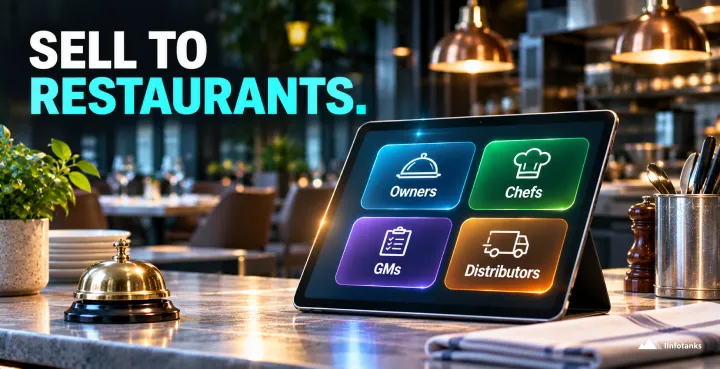
How to sell to restaurants? Start by finding who holds each decision. Owners set the budget, executive chefs shape the menu, general managers run daily ordering and foodservice distributors fill many of the orders. If you sell into this market, our restaurant owners email list reaches those roles, and the sections below show what each one wants.
This guide covers the main buyer roles, how operators react when costs rise, where restaurant technology money is going this year and which studies need a careful read. It ends with a simple plan for your first month. Most studies we found cover all operators or all restaurant software buyers, so we flag where a finding may not fit your product. When we assume something, we say so.
TL;DR
Buying is shared across roles
Knowing how to sell to restaurants starts with seeing who decides what. Owners hold the budget, chefs shape the menu, managers run the floor and distributor reps fill the order. A pitch to one role reaches one part of the decision, so plan for all of them.
Thin margins sharpen every purchase
Operators face higher ingredient prices, labor pressure and thin profits, so every new expense gets a hard look. Most operators paid more for food in 2025, according to the National Restaurant Association. A pitch that ignores that pressure may sit unread.
Lead with savings, then prove it
Open with the role that feels the pain and tie your offer to food costs the operator already tracks. Give every other role one short reason to agree, and show real numbers. The plan near the end tests one role at a time with a small send.
Who Makes Buying Decisions in a Restaurant
Restaurants split buying across a few roles, and the split shifts with size. A small neighborhood diner and a large group do not buy the same way. Here are the roles we found in the sources.
Owners and operators
In a small restaurant, the owner may hold the most influence, according to the TouchBistro buyer role guide, written by a restaurant software company on its own blog. It says group owners look at total costs, room to grow and expected return. Read that as a vendor’s view.
Executive chefs
TouchBistro’s list gives chefs menu planning, stock tracking and kitchen order screens as priorities. That fits what a chef handles every day. Our reading is that chefs weigh in on products that change a dish or a prep step, though the page gives no survey count.
General managers
The same list says managers want flexible management controls, staff scheduling, staff performance tools and stock tracking. These are daily needs. A manager may be the person who tests your tool on the floor, which is our assumption.
Distributor sales representatives
Distributor sales representatives call on operators, take orders and suggest products. In a distributor trade survey, more than half of operators wanted these reps to focus on ways to cut food costs. A seller who works through a rep needs a savings story the rep can repeat.
Margins Are Thin Before You Pitch
The National Restaurant Association’s restaurant industry report says about 4 in 10 operators were not profitable in 2025, though the report gives slightly different figures in different places. Typical profit before tax in 2024 was 2.8% of sales for sit-down restaurants and 4.0% for quick-service ones. We read the report through a copy hosted by a news station, so check the figures on the association’s own page. The association is a trade group that lobbies for operators, so read its framing with that in mind. Use the numbers to size the squeeze as you plan how to sell to restaurants, and avoid treating them as a full count.
How Operators Respond When Food Costs Rise
The same report says 82% of operators paid more for food in 2025 than in 2024, and average costs sit well above pre-pandemic levels. Many operators blamed tariffs. The table shows what operators did next.
| Step Taken After Costs Rose | Sit-Down Restaurants | Quick-Service Restaurants | What It Means for You (Our Reading) |
| Raised menu prices | 90% | 85% | Operators reach for price first, so a cost cut is easier to discuss than a new expense |
| Looked for other suppliers | 63% | 51% | Many operators will hear from a new source |
| Removed items from the menu | 60% | 43% | Menu changes pull chefs into the talk |
| Negotiated with current suppliers | 55% | 41% | Your quote may become a bargaining chip with the current supplier |
| Bought more from local sources | 19% | 13% | Local buying is a smaller trend |
Sit-down operators were more likely to look for other suppliers than quick-service ones, so they may be easier to reach with a new offer. A seller pitching group owners can use our senior executive email list to reach presidents and owners in one campaign.
How Foodservice Distributors Fill Orders
The International Foodservice Distributors Association, a trade group that speaks for distributors, ran a 2019 survey of 400 US restaurant operators, split evenly between independents and chains. You can read the IFDA operator survey results on its site. Most operators regularly use more than one distributor, nearly 3 on average. Online ordering was the most common method and the top choice for operators. Phone was used by many, but fewer operators preferred it. Because the sponsor’s members sell to restaurants, and the data is from 2019, treat the results as a dated view from the supplier side.
What Distributor Sales Representatives and Operators Discuss
The same survey found that help with analyzing food spending was the most useful added service, and about 9 in 10 operators called it useful. Most operators also buy distributor-brand products, mostly for price, and independents did so more often than chains. An older Restaurant Business piece on how distributors rank customers says distributors earn thin margins, often under 2%, and may rank customers as A, B or C. It has no byline or date, and clues in the text suggest it is quite old, so use it only to see how distributors think about service costs.
Pitch Slips With Restaurant Buyers
A few slips stall a restaurant sale, and they come up often when teams learn how to sell to restaurants:
- Pitching the wrong role: An owner may hold the budget while a chef or manager decides whether a product stays.
- Ignoring food costs: Most operators paid more for food in 2025, so a pitch with no saving gets a quick no.
- Skipping distributor sales representatives: Operators use several distributors, so a product that a rep cannot order may stall.
- Treating trade studies as neutral: The association, the distributor group and TouchBistro each have a stake in what operators buy.
If you want help turning buyer research into messages that each role reads, our team offers restaurant email campaign planning to build the sequence with you.
Where Restaurant Technology Money Goes Next
The report says about 6 in 10 operators plan to spend this year on technology that improves the guest experience. Roughly half plan to spend on tools that speed up the dining room and the kitchen, and fewer on online security. About 8 in 10 say technology gives them an edge. Most operators call their own technology average, and only a small share call it leading edge. Sit-down operators plan more spending than quick-service ones on both dining-room and kitchen tools. Sellers of restaurant technology can use that gap to choose a first segment.
Operators Research Before Reps Arrive
A September 2026 opinion piece in Nation’s Restaurant News on how operators research vendors says operators finish most of their research before a rep gets involved and often arrive with a shortlist. Its author runs a PR firm that sells the tactics she recommends. A couple of its headline statistics carry no source, and the one it does link comes from her own firm’s report. We use it as an informed opinion. Our reading is that your website, reviews and trade coverage should answer the questions an operator would otherwise ask a rep.
Key Facts to Remember
These facts shape most advice on how to sell to restaurants:
- Most operators (82%) paid more for food in 2025 than in 2024, per the National Restaurant Association’s 2026 report.
- Most operators use more than one distributor, nearly 3 on average, per a 2019 distributor trade survey.
- Typical profit before tax in 2024 was 2.8% of sales for sit-down restaurants and 4.0% for quick-service ones.
How Chain Buying Differs
A July 2013 article in Foodservice Equipment Reports shared a chain purchasing survey of chain subscribers on equipment and supplies. At smaller chains, corporate officers and operations executives decide first, followed by purchasing. Larger chains hand decisions to menu and culinary staff, equipment engineers and purchasing. The survey is old and covers equipment, so it may not fit your product. Product quality led the buying criteria, which suggests chain buyers will want proof at scale. Anyone working out how to sell to restaurants with many locations should ask who approves a test, since switching suppliers can affect every location.
Choosing the Right Contact for Your Offer
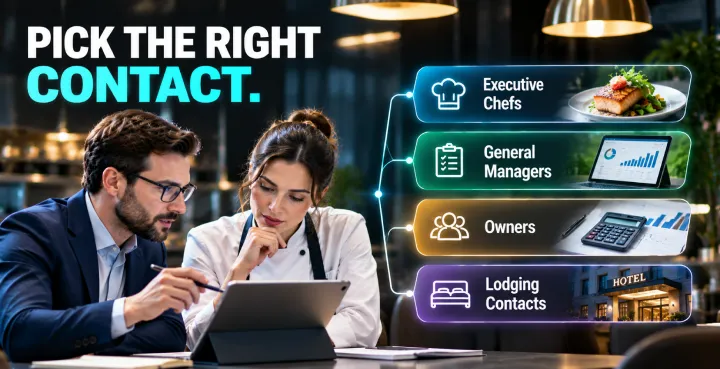
Different offers call for different first contacts. Pick the one that matches what you sell, since the best answer on how to sell to restaurants depends on your product.
Menu and ingredient products go to executive chefs
Lead with samples, specs and the cost per portion. A chef sees how a product changes a dish, and the result becomes your proof for the owner. Offer a tasting or a trial case, and write down what a good result looks like.
Daily-operations tools go to general managers
Show a manager how the tool saves time on scheduling, ordering or stock checks. Offer a short floor test, since a manager lives with the result. Ask who signs, because the owner may hold the budget.
Cost-saving offers go to owners
Give the owner a one-page summary with the price, the term, what the offer replaces and the saving. With thin profits, a clear saving carries weight. Keep the page short.
Hotel dining goes through lodging contacts
Restaurants inside hotels may be filed under lodging instead of restaurants, so a restaurant list can miss them. Our hotel and hospitality contacts list covers that segment, so pull it separately and keep it out of your restaurant tests.
What to Say in Your Opening Message
Anyone learning how to sell to restaurants should write each first message for one role. Busy buyers read between tasks, so keep it short and specific. A good first message has these parts:
- A subject line that names the role or the problem, such as rising ingredient prices or slow ordering.
- One sentence on what you sell, in plain words.
- One proof point, with its source and date.
- One easy next step, such as a sample, a quote or a short call.
Here is an example for a chef: “Hi Chef, we make [product]. Can we send a sample case this week so you can see how it works in your dishes and what it costs per portion?”
Common Pushbacks and How to Answer Them
Knowing how to sell to restaurants also means knowing what to say after the first no. These are common replies, what they usually mean and a simple way to respond.
| What You May Hear | What It Usually Means | How to Respond |
| “We already have a supplier.” | Switching feels risky, and the current supplier may lower the price to keep the account. | Offer a small test that runs beside the current supplier, and show the saving. |
| “Prices are too high right now.” | Rising ingredient prices are squeezing profit, so any new expense gets a hard look. | Lead with what you save, tied to a cost the operator already tracks. |
| “Send me some information.” | The buyer may be researching before talking to anyone. | Send a short summary, and make sure your website answers the usual questions. |
| “I need to ask the owner.” | You may be talking to someone who can test the product but cannot sign. | Ask who signs, and give your contact a one-page summary to pass along. |
| “Can my distributor order it?” | Distributors fill many orders, so a product they cannot supply may stall. | Check with the distributor first, and give the rep one clear savings point. |
These replies and answers are our reading of the sources above, not survey results.
A Simple Restaurant Budget Example
Here is a made-up example, so swap in your own figures. Say a sit-down restaurant keeps about 3 cents of profit from each sales dollar, in line with the typical figure above. A new tool that costs about half a cent per sales dollar would use about a fifth of that profit. Now say food takes about 30 cents of each sales dollar and a seller cuts that by 5%. That saves about 1.5 cents, which is about half of the profit. Every figure here is our assumption. A savings pitch can outweigh a feature pitch.
Source Dates and Quality
Source ages vary a lot. The restaurant industry report and the opinion piece are from 2026, the distributor survey is from 2019, the chain purchasing survey is from 2013 and the Restaurant Business piece has no date. TouchBistro’s page points to its own earlier report. Most of these sources have a stake. The association lobbies for operators, the distributor group speaks for distributors, TouchBistro sells restaurant software and the opinion piece’s author sells public relations. Write the date and sponsor beside each figure, and keep the older studies for context only.
What to Ask for in Restaurant Contact Data
- A role field that separates owners, executive chefs, general managers and purchasing leads.
- A restaurant type field for sit-down, quick-service, group and chain locations, so you can match offers to each.
- A location count and address, so you can split single restaurants from multi-location groups.
- Where your vendor holds them, technographic data fields that show which restaurant technology, such as ordering and payment systems, a restaurant already uses.
When to Approach Restaurant Buyers
Restaurant owners and managers are more likely to consider new products or suppliers when their business needs change. A new location, menu update, rising costs or upcoming contract review can create an opportunity to start a conversation.
The table below explains common buying signals, who to approach and how to make your message relevant.
| Buying Signal | Who to Contact | What to Focus On |
| New restaurant opening | Owner or general manager | Setup costs, equipment, supplies and delivery |
| Menu changes | Executive chef or kitchen manager | Ingredients, pricing and product consistency |
| Rising food costs | Owner or executive chef | Cost savings, portion sizes and supplier pricing |
| Supplier contract renewal | Owner or purchasing manager | Pricing, delivery terms and service quality |
| Restaurant expansion | Owner or operations director | Bulk purchasing and supply across locations |
| Technology upgrades | General manager or operations manager | Easier ordering, payment and daily operations |
These signals help suppliers approach restaurants with a clear reason for reaching out. Before making an offer, confirm the restaurant’s current needs, existing supplier arrangements and purchasing timeline. A relevant proposal supported by clear pricing and service details gives buyers more to evaluate than a general sales message.
Frequently Asked Questions
1. What is the first step in how to sell to restaurants?
Find out who decides. Owners usually control the budget, chefs choose menu items, managers run daily work and distributor reps handle orders. Pick one role, then write one message for that role.
2. Do executive chefs choose suppliers?
Often, for ingredients and kitchen items. In our reading, chefs step in when a product changes a dish or a prep step. The sources do not say how often chefs make the final call.
3. What do general managers buy?
Tools that help with daily work, such as scheduling, staff tracking and stock checks. They may not sign the deal, so ask who does.
4. How many distributors does a restaurant use?
Most use more than one, and the average is close to 3, according to a 2019 distributor trade survey.
5. What do foodservice distributors offer operators?
They deliver food and supplies and offer extras. Operators rated help with tracking food spending as the most useful extra. Many also buy the distributor’s own brands, mostly for price.
6. What do distributor sales representatives do?
They visit operators, take orders and suggest products. Many operators want them to help cut costs.
7. How have food costs changed?
They went up. Most operators paid more for food in 2025 than in 2024, and prices are well above where they were before the pandemic.
8. What are typical restaurant margins?
Thin. A typical sit-down restaurant keeps under 3% of sales as profit, and a quick-service one keeps about 4%. Many operators were not profitable in 2025.
9. Which restaurant technology will operators fund this year?
Mostly tools that improve the guest experience. Next come tools that speed up the dining room and kitchen, then online security.
10. Do chains and independents buy differently?
Yes. At chains, several teams often share the choice, such as corporate leaders, kitchen staff and purchasing. At a small restaurant, the owner may decide alone. The chain survey we found is from 2013, so use it as a guide only.
11. Do restaurants shop for new suppliers?
Many do when costs rise. After prices went up, about 6 in 10 sit-down operators and about half of quick-service operators looked for other suppliers.
12. Do operators prefer ordering online?
Yes. In the 2019 distributor survey, online ordering was the most common way to order and the top choice.
13. Should I pitch the owner or the chef first?
It depends on what you sell. Start with chefs for ingredients, managers for daily tools and owners for savings offers.
14. How reliable are these studies?
Use them as a guide, not a final count. Most come from trade groups or vendors with a stake, and some are old. Write the year and the sponsor beside each figure.
15. How often should I refresh restaurant buyer research?
Check every 3 months for new surveys and price changes, since costs and technology plans can change within a year.