
Say you sell a billing tool built for law firms (we invented this one). You email 200 managing partners, and half the replies say “talk to our administrator.” Before you rent a law firms mailing list and send another round, you need to know how to sell to law firms and who really signs.
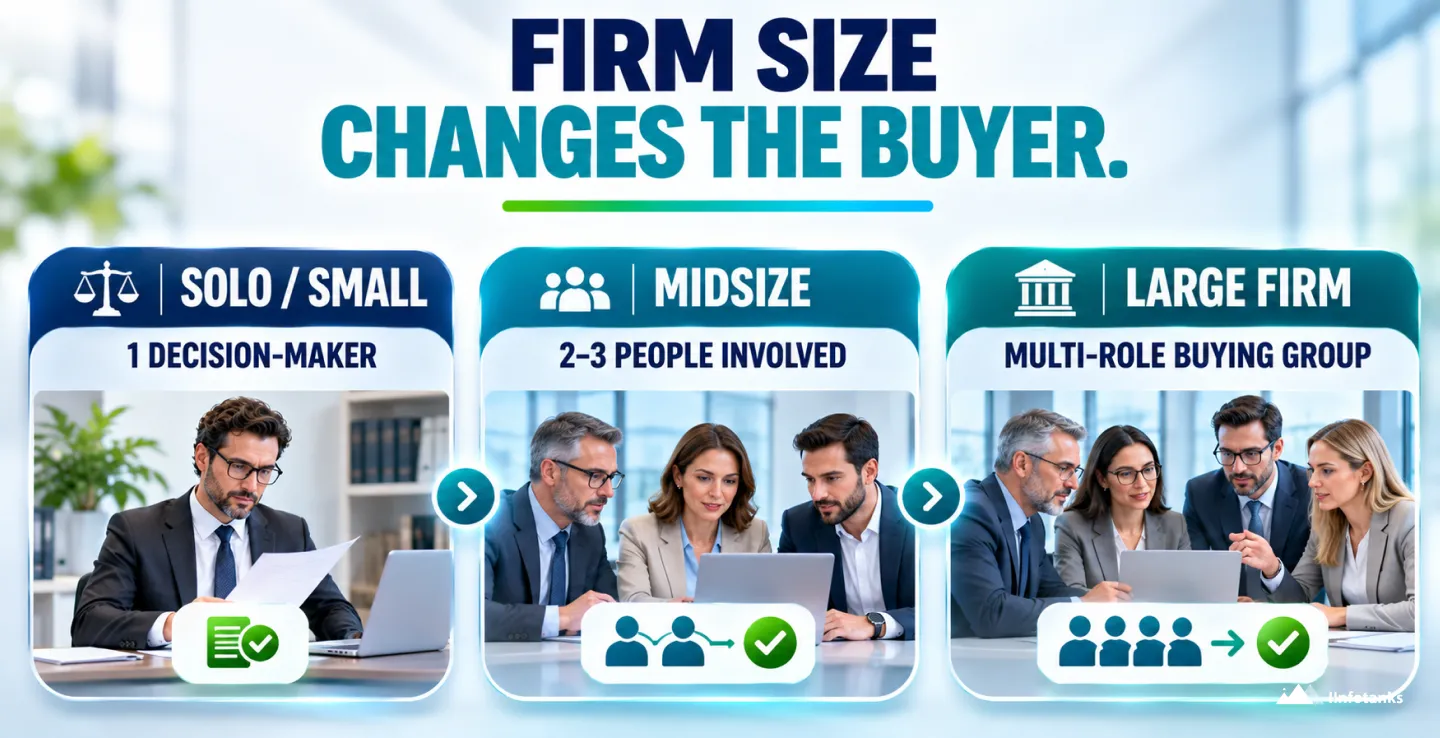
The answer changes with firm size. At a solo practice, the owner signs and often decides alone. At a 200-lawyer firm, a committee, an IT team and a few skeptical partners all get a vote.
This guide covers who signs, who influences and who can stall the deal at each firm size. Every number carries its source and date. Where nobody publishes data, we say so and mark our own read.
TL;DR
The buying group changes with firm size: At solo and small firms the owner decides, and 97% of solo attorneys make their own technology calls. Midsize firms bring in a managing partner or committee, and large firms add IT, finance and innovation leads. Selling to law firms starts with knowing which size you face.
A single yes is rarely enough: Once a firm grows past a handful of lawyers, partners, IT reviewers and staff can each slow a deal. Map every role before you pitch and give each person a reason to say yes. That’s how to sell to law firms without stalling at the first reply.
Match the title to what you sell: Billing tools go to administrators, security services go to IT and marketing services go to business development. Start with the role that feels the problem, then bring in the signer. No public source gives law firm sales cycle lengths, so track your own.
Who Signs the Deal at a Law Firm, and Who Just Gets a Vote?
The budget owner, purchase approver and authorized contract signer can be different people. At solo practices, the owner may fill all three roles. Midsize and large firms can involve partners, administrators, IT and committees, so confirm who approves the purchase and who can sign.
A law firm purchase can involve a budget owner who controls spending, a decision-maker who approves the choice, influencers who shape it and an authorized signatory who executes the contract. IT or security reviewers may identify risks without being blockers. One person can fill several roles.
Back to our billing-tool example. The managing partner who forwarded your email may champion the purchase, the administrator may coordinate vendor evaluation and onboarding, and the IT director may review integrations and security. Ask who controls the budget, who approves the purchase and who is authorized to sign (our read). Partners carry more weight than an org chart suggests. Stephen Embry argued in a 2023 column that lawyers in firms act like entrepreneurs, because firms run largely by consensus among people who each own a practice. So a managing partner who loves your tool can still lose a vote (our read).
The best survey data on purchasing roles is old, so read it as a pattern. The 2015 ILTA/InsideLegal Technology Purchasing Survey covered 184 member firms (a 14% response rate). It found that 81% of respondents either made the final purchasing decision or sat on the purchasing committee, and 42% sat on the final decision-making committee.The same survey shows where requests start. 80% of respondents said attorneys request purchases outside IT, and 46% said administration does.
Influence also comes from outside the firm. A Litera survey reported by Artificial Lawyer in May 2026 found that 51% of respondents said a client directly influenced an AI investment decision in the last 12 months, and only 15% called AI investment entirely internally driven. The article gives no sample size, so treat it as a signal about AI buying only.
How Does the Buying Group Change From Solo to Large Firms?
Short answer: It grows from 1 person to a committee. The ABA’s 2024 TechReports define small firms as 2 to 9 attorneys, midsize as 10 to 49 and large as 100 or more, and their data shows the shift from owner-decides to IT-reviews.
Firm size | Likely buying roles (our read) | What the ABA 2024 TechReport shows |
|---|---|---|
Solo | The owner | 97% of solo attorneys make their own technology decisions. 4% turn first to internal tech support |
Small (2 to 9) | The owner or managing partner | 90% of small-firm attorneys make their own technology decisions. 25% turn first to internal tech support |
Midsize (10 to 49) | Managing partner or a partner committee, with the administrator | 68% budget for technology. 56% turn first to internal tech support |
Large (100+) | A committee with IT, finance and innovation leads | 90% budget for technology. 96% turn first to internal tech support |
The pattern is plain. As a firm grows, more people sit between you and the signature. The ABA Solo and Small Firm TechReport gives the decision and budget figures, and the ABA’s Technology and Training TechReport gives the internal support figures.
The ABA data reports technology decisions and support, not contract signers. The middle column is our interpretation of likely buying roles, not an ABA finding. Its tables also skip firms with 50 to 99 lawyers, and we’d treat those as a blend of midsize and large . If you can filter a list by only 1 thing, filter by firm size first. It decides the title you email, the price you quote and the length of your pitch (our read). That tier shift is the core of how to sell to law firms, because the same pitch can’t go to an owner and a committee.
What to do: Put every account into a tier before you write copy, because the tier decides which person you contact first.
How Do You Sell to a Solo or Small Firm?
Short answer: Go straight to the owner with 1 price and 1 time saving. At solo and small firms, the owner may approve the purchase and control the budget, but signing authority should still be confirmed.
To sell to small law firms, start with the count. In 2023, 71.8% of US law offices with paid employees (118,754 of 165,491) had fewer than 5 employees, per Census County Business Patterns data as republished by industry data vendors. The BLS also puts 11% of lawyer jobs in self-employment. Price is the first filter. The ABA reports that 74% of solos spend less than $3,000 a year on legal software. A tool priced well above that needs a payback the owner can see in a sentence.
Outside consultants matter more than you’d expect. The ABA says solos most often turn to consultants (35%) for tech support, and small firms do too (31%). So an IT consultant can influence the owner’s choice, and a short note to the consultant can help (our read). With only 1 yes to win, the sales cycle should run shorter here than anywhere else, but no public source gives a number (our read).
Who Do You Pitch at a Midsize Firm?

Start with a partner who feels the problem, then bring in the managing partner and the firm administrator. For AI tools, IT staff and tech-savvy associates may also influence the decision; other types of purchases may follow different paths.
Writing about AI pitches to midsize firms, a New York partner in Attorney at Work (updated June 2026) described partners, senior IT staff and tech-savvy associates as participants in AI buying decisions. He also noted that his firm lacks a dedicated knowledge management team. Treat this as one practitioner’s view of AI purchasing, not a rule for every law firm product or service.
Selling to managing partners comes down to money and risk. The Thomson Reuters Institute’s report from the 2025 Marketing Partner Forum said firm leaders’ top worries are talent issues and potential revenue loss. Frame your offer around those 2 worries (our read).
The firm administrator, or COO, often runs the vendor process: references, contract terms and onboarding (our read). The ILTA survey groups these roles under “administration (e.g., executive director),” so expect titles to vary.IT shows up here too. The ABA says 56% of firms with 10 to 49 attorneys turn first to internal tech support, so ask early whether the firm has an IT person.
What Changes at a Large Firm?
Short answer: A committee decides, IT and security review the risk and individual partners can still say no. The ABA found that 96% of firms with 100 or more attorneys turn first to internal tech support, so IT is in the room.
Selling to large law firms adds specialist roles: CIO, innovation lead, knowledge management and procurement (our read). Together they form a law firm buying committee, each member checks a different risk, and any of them can delay a deal late in the process.
Pilots work better than pitches. Embry retold a former Bryan Cave partner’s experience in his 2023 column: pushing a single system on skeptical partners failed, while winning individual lawyers with small pilots worked and spread by word of mouth.
What Do Law Firms Check Before They Say Yes?
Short answer: They ask peers and search the web. In the 2015 ILTA survey, respondents said internet research (65%) and recommendations from peer firms (60%) influenced the prior year’s IT purchases most, ahead of ILTA conferences (57%) and consultants (48%). Recommendations from attorneys inside the firm came in at 21%, and analysts at 31%. Attorneys requested purchases at 80% of firms in that same survey, so the person who asks for a tool is rarely the main source of proof for it.
Firm size changes the mix. Large firms leaned on peers and conferences, and small firms leaned less on ILTA events and ranked consultants third. The survey counted small firms as those with 1 to 49 attorneys. The survey is from 2015, so habits have probably shifted (our read). Still, selling to large law firms rarely works without a peer firm that vouches for you, and how to sell to law firms becomes mostly a question of proof.
Which Job Title Matches What You Sell?
Short answer: Start with the role that feels the problem your product solves, then add the signer. No public source maps products to titles, so this table is our read.
What you sell | Start with | Bring in next |
|---|---|---|
Software lawyers use daily (research, drafting, case management) | A practice group leader or a partner who does that work | IT director, managing partner |
Billing, payments and accounting | Firm administrator or COO | Managing partner, finance lead |
Security, IT services and hardware | IT director or CIO (an outside consultant at small firms) | Firm administrator, managing partner |
Marketing, websites and client intake | Business development or marketing director (the owner at small firms) | Managing partner |
Recruiting, staffing and training | Hiring partner or firm administrator | Managing partner |
Titles shift from firm to firm. A law firm administrator at some firms is an executive director at others, and a managing partner at a 5-lawyer firm may also be the IT department. So treat the table as a starting guess and check it against each firm’s own website before you send. Selling to law firms works best when the first email lands with the person who feels the pain, and the signer joins second (our read).
What to do: Pick your starting title from the left column, then confirm that person exists at the firm.
How Long Does a Law Firm Sale Take?
Short answer: Nobody publishes a sourced number. Vendor guides quote anything from 60 days for solos to 18 months for the largest firms, and the ones we read cite no source for it.
Your own pipeline will tell you more. The law firm sales cycle depends on how many people must say yes and how long each takes (our read).Here’s an invented example. A midsize deal needs 3 yeses (partner, administrator, IT), and each takes about 2 weeks, so the deal runs near 6 weeks if nobody stalls. A single security questionnaire can double it.
That’s why a law firm buying process stalls at the same few points: a partner who wasn’t in the first meeting, an IT review that starts late and a budget cycle that closes (our read).
How Do You Find and Reach the Right Person?
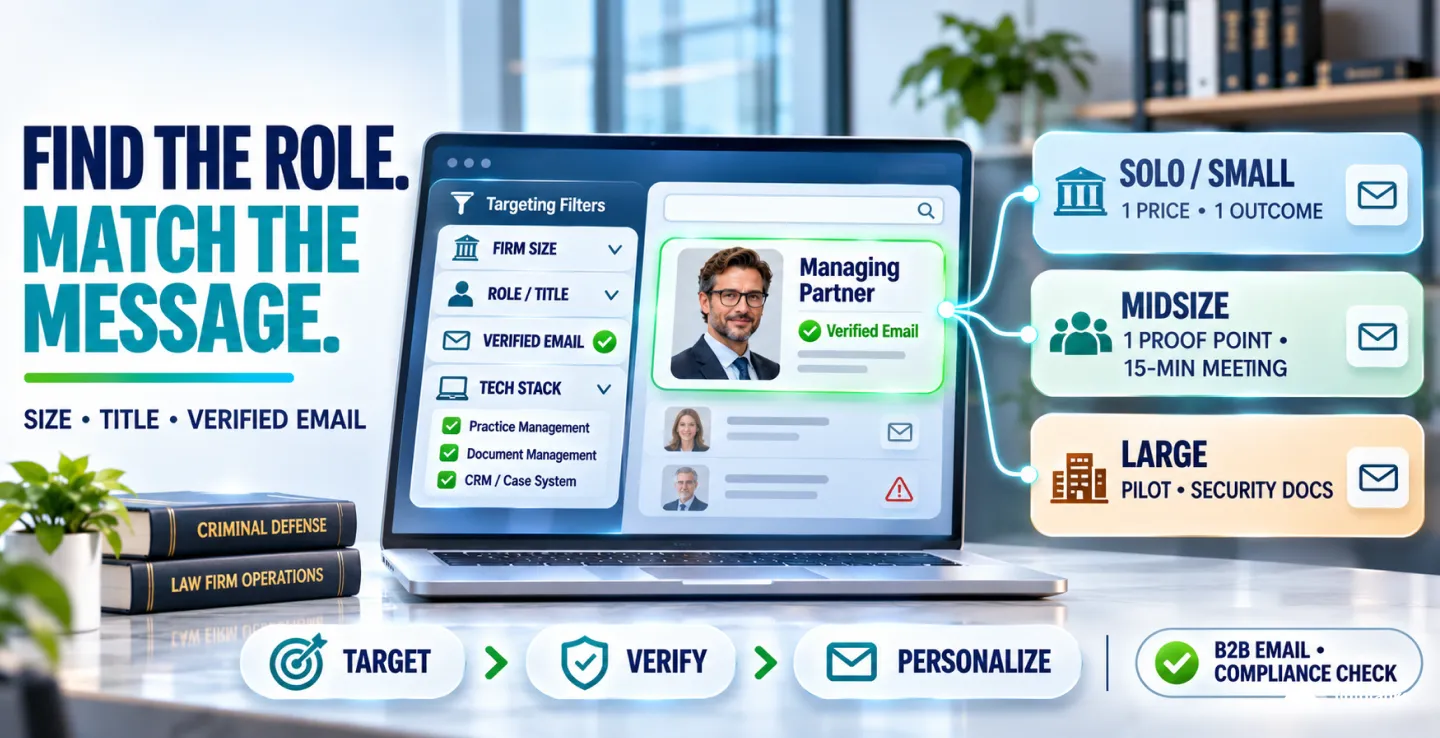
Build the list by firm size and title, then email the role you picked in the last section. A list with firm size, title and a verified email lets you test each tier on its own.
If you sell software, a technographics filter can show which firms already run a practice management or document system. That tells you whether IT will ask about integrations (our read). If your champion is a practicing partner, an attorney email list lets you reach lawyers by practice area.
Then match the first message to the tier:
- Solo and small: 1 price, 1 outcome, the owner’s name.
- Midsize: 1 page, 1 proof point from a peer firm, and a request for 15 minutes with the partner and the administrator.
- Large: An offer to pilot in 1 practice group, plus your security documents.
Business email is covered by the law too. The FTC’s CAN-SPAM guide says the law makes no exception for business-to-business email, and our guide to cold email under CAN-SPAM, GDPR and PECR covers what each message needs.
Contact Us
Looking to connect with the right people at law firms? At IInfotanks, we provide law firm contact lists tailored by firm size, location, practice area and job title. Whether you’re targeting attorneys, managing partners or firm administrators, we help you identify relevant contacts and support focused outreach. Contact us to discuss your targeting requirements and explore available contact options.
Frequently Asked Questions
How do you sell to law firms?
Start with the person who feels the problem, then identify the budget owner, approver and authorized signer. That’s the short version of how to sell to law firms: one owner may handle all three at a solo practice, while larger firms involve several stakeholders.
Who makes buying decisions at a law firm?
It depends on size. The ABA’s 2024 TechReport found 97% of solo attorneys and 90% of small-firm attorneys make their own technology decisions. At larger firms, partners, administrators and IT share the call.
Who is the decision maker at a small law firm?
Usually the owner or managing attorney. The ABA found 90% of attorneys at firms with 2 to 9 lawyers make their own technology decisions, and consultants often influence the choice.
Who decides at a midsize law firm?
A managing partner or partner committee may approve the purchase, while an administrator often coordinates vendor steps; the authorized signer may be someone else. For AI tools, partners, senior IT staff and tech-savvy associates may also weigh in (Attorney at Work, updated June 2026).
Who decides at a large law firm?
A law firm buying committee, usually with IT, finance, innovation and procurement input. The ABA found 96% of firms with 100 or more attorneys turn first to internal tech support, so IT reviews the purchase.
Do managing partners make every purchasing decision?
No. Managing partners may influence or approve midsize-firm purchases, but that does not always make them the authorized signer. Partners, administrators and IT can also shape the choice. The 2015 ILTA survey found 81% of respondents either made the final decision or served on the purchasing committee.
What does a law firm administrator do in a purchase?
Often the administrator runs the vendor process: references, contracts and onboarding (our read). The ILTA survey groups these roles under “administration,” and 46% of respondents said administration requests purchases outside IT.
How long is the law firm sales cycle?
No public source gives a sourced figure. Vendor guides quote ranges from 60 days to 18 months with no citation. The law firm sales cycle tracks how many people must say yes, so log your own dates.
How do you sell to small law firms?
Go to the owner with 1 price and 1 time saving. The ABA found 74% of solos spend under $3,000 a year on legal software, so show a payback fast. A short note to their IT consultant can help.
How do you sell to large law firms?
Offer a pilot in 1 practice group and bring security documents to the first meeting. A 2023 column by Stephen Embry describes pilots that spread by word of mouth, while pushing a single system on skeptical partners failed.
Do law firm IT departments block deals?
They can stall them. The ABA found 96% of firms with 100 or more attorneys turn first to internal tech support, and a security review that starts late can delay a deal (our read).
Do clients influence what a law firm buys?
Yes, for AI at least. A Litera survey reported in May 2026 found 51% of respondents said a client directly influenced an AI investment decision in the last 12 months.
What’s the best first email to a law firm?
Short, and written for the tier: 1 price and 1 outcome for an owner, 1 page and a peer proof point for a midsize firm, and a pilot offer plus security documents for a large firm.
What are the steps in the law firm buying process?
Our read: a lawyer or administrator feels a problem, a champion researches options, a demo follows, IT and finance review it and a partner or committee approves. Smaller firms skip steps, and large firms add them.
How many law firms are there to sell to?
IBISWorld estimates 412,253 US law firm businesses in 2026, while the Census counted 165,491 employer establishments classified as offices of lawyers in 2023. These figures use different measures and years, so they are not directly comparable. Of the Census establishments, 118,754 (about 72%) had fewer than 5 employees.