
Ask a few sources how many K-12 schools there are in the US and you’ll hear 99,073, 99,297, about 115,000 or about 129,000. Ask how many school districts there are and the answers get messier: 19,183, 13,289 or 12,535. Each of those numbers is right about something different. This guide sorts out which count answers which question, so you can size the K-12 market without quoting a figure that counts the wrong thing.
If you sell to this market, the count decides your list. An elementary and secondary schools email list cut by school level, employee-size band, state and job role puts your message in front of the person who buys, and the right count tells you how big that list should be.
This guide uses the latest available federal data reported through 2026: the 2024-25 Common Core of Data from the National Center for Education Statistics (NCES) for public schools, NCES’s 2023-24 Private School Universe Survey (PSS) for private K-12 schools, and the Census Bureau’s 2025 count of government school systems. I name the rule behind every number and flag the ones that come from estimates.
TL;DR: how many K-12 schools are in the US, in four points
- About 99,000 public K-12 schools operate in the US. NCES counts 99,073 for 2024-25, down 224 from 99,297 a year earlier.
- Private schools add about 30,550. Together that’s roughly 129,600 K-12 schools. That’s my arithmetic, and it mixes a 2024-25 public count with a 2023-24 private one.
- Districts have several counts. In 2024-25, NCES lists 19,183 education agencies, including 13,289 regular districts and 4,224 independent charter agencies. Census separately counts 12,535 independent school district governments in 2025. Agency totals do not represent separate purchasing authorities.
- The map is thinning. Enrollment fell in 40 states between 2019 and 2024, and preliminary NCES data show more than 1,000 public K-12 schools closed in 2025-26.
What counts as a K-12 school? Four definitions
The count depends on where you draw the line, and the sources draw it in four different places.
- Operating public school. The Common Core of Data lists schools that provided services at the start of the school year, from pre-K through grade 13. That range includes 1,483,492 pre-K students in 2024-25, so the count runs wider than kindergarten through 12th grade.
- Charter school. A public school that runs under a charter. NCES counts charters inside the public total, and it counts the groups that run them as agencies.
- Private school. The PSS covers private elementary and secondary schools. NCES notes that participation is voluntary and that some private K-12 schools skip the survey.
- School district. This one has three working definitions, and the district section below covers each.
Pick the definition first and the right number follows. The table below matches seven common counts to the rule behind each one.
Seven numbers for K-12 schools and districts, and what each one counts
Each row uses its own counting rule, and the rule matters more than the number.
Number | Source | What it counts | Best use |
|---|---|---|---|
99,073 | NCES, 2024-25 | Public-school count, pre-K to grade 13 | Sizing public K-12 schools today |
99,297 | NCES, 2023-24 | Public-school count, one year earlier | Trend comparisons |
30,553 | NCES PSS, 2023-24 | Private schools | Sizing private K-12 schools |
19,183 | NCES, 2024-25 | Operating education agencies of different types | Counting education agencies, not confirmed buyers |
13,303 | NCES, 2023-24 | Regular districts | Sizing traditional districts |
13,853 | Census Bureau, 2025 | School systems, independent and dependent | Government-level analysis |
12,535 | Census Bureau, 2025 | Independent school district governments | Counting districts that run on their own |
NCES publishes the 2024-25 table on its Common Core of Data site, and it’s the cleanest single source for public K-12 schools. The totals cover the 50 states and the District of Columbia. Year over year, the public count lost 224 schools and 3 districts and agencies (19,186 to 19,183). Student membership fell by 134,504, from 49,404,386 to 49,269,882. Those are my subtractions from NCES’s two tables.
Commercial school databases quote totals from about 115,000 to about 129,000 schools. The top of that range follows the federal logic. Education Week’s NCES-based sum for 2019-20 is 128,961 public and private schools, so the 129,000 you see online adds the two groups together, often from older years. I couldn’t confirm the rules behind the roughly 115,000 figure, so treat any vendor total as approximate until the provider names its definition and year.
Public schools: 99,073 and what sits inside them
The headline number hides a mix of school types. NCES’s 2023-24 release splits the public total into four.
School type | Schools (2023-24) | Share |
|---|---|---|
Regular | 90,461 | 91.1% |
Alternative education | 5,396 | 5.4% |
Special education | 1,865 | 1.9% |
Career and technical | 1,575 | 1.6% |
All public schools | 99,297 | 100% |
So 9 in 10 K-12 schools are regular schools. If you sell a product for general classrooms, that’s your core pool. If you sell job-training programs, the 1,575 career and technical schools are a much smaller and sharper target.
Level matters just as much. Education Week’s roundup of NCES 2022-23 data counts 52,474 elementary schools out of 99,388 public schools (53%). It lists 23,810 secondary schools (24%) and 16,298 middle schools (16%), with the rest pre-K or ungraded. That year’s total differs slightly from the 2023-24 and 2024-25 counts above, so treat the shares as a guide.
The elementary pool is more than double the high school pool. A reading program and a college-readiness tool address very different universes of K-12 schools.One more figure helps with sizing. Spread 49,269,882 students across 99,073 schools and you get about 497 students per school (my division). Averages hide a wide range, though, and the district size section below shows how wide.
Charter schools: 8,048 inside the 2024-25 public count
NCES counted 8,048 charter schools in 2024-25, about 8% of public schools. The prior-year count was 8,010 in 2023-24, following 7,998 in 2022-23. Those figures count charter schools, not separate charter agencies.
The National Alliance for Public Charter Schools uses its own method and reports about 8,150 schools, as K-12 Dive relays. Treat 8,000 to 8,150 as the working range. Education Week’s tally puts charter enrollment above 3.71 million students, or 7.6% of public school students.
Charters also appear in education-agency data, but a charter school and an independent charter agency are different units. NCES counted 4,224 independent charter agencies in 2024-25, compared with 4,212 in 2023-24. Some agencies operate one school and others operate multiple schools, so school and agency totals should not be treated as identical. The next section explains how those agencies differ from regular districts.
Private schools: 30,553 and what sits inside them
The other branch of K-12 schools is private. The latest PSS, published in 2026, counts 30,553 private schools for 2023-24. They enrolled 5,096,365 students and employed 517,780 full-time-equivalent teachers.
That’s up from about 29,730 in the 2021-22 survey, per Education Week’s summary of NCES data. The full results sit in NCES’s PSS First Look report.
Orientation | Schools | Share of schools | Students |
|---|---|---|---|
Other religious | 14,157 | 46.3% | 2,147,469 |
Nonsectarian | 10,169 | 33.3% | 1,233,162 |
Catholic | 6,228 | 20.4% | 1,715,733 |
All private schools | 30,553 | 100% | 5,096,365 |
Two-thirds of the total (20,385) are religious. Catholic schools are only 20% of the count, yet they enroll 34% of private students, so they run larger on average. Level tells a similar story. Elementary and middle schools make up 17,598 of the private total (57.6%) and secondary schools make up 3,677 (12.0%). Combined and other schools number 9,279, which is 30.4% of schools but 42.8% of students.
The takeaway for list builders: private-school buying authority varies. An independent school may make purchases through its head of school or business office, while a school network or religious organization may centralize approvals. Keep private schools and public districts in separate segments, and confirm the roles involved before outreach.
School districts: 19,183 agencies, 13,289 regular districts or 12,535 governments?
Here’s where the confusion peaks. Three official counts use three definitions, and each answers a different question.
NCES counts agencies, which it calls local education agencies. Its 2023-24 release lists six types.
Agency type | Count (2023-24) | Who they are |
|---|---|---|
Regular districts | 13,303 | Locally governed districts that run schools |
Independent charter agencies | 4,212 | Charter operators that act as their own agency |
Service agencies | 1,122 | Regional education service agencies |
Federal and other agencies | 250 | Federally operated and other agencies |
State agencies | 186 | State-operated education agencies |
Supervisory unions | 113 | Administrative centers that serve several districts |
All agencies | 19,186 |
The 2023-24 table shows 13,303 regular districts among 19,186 agencies. For 2024-25, NCES reports 13,289 regular districts among 19,183 education agencies, including 4,224 independent charter agencies. The wider count also includes service, state and other agencies, some of which do not operate schools or have separate purchasing authority.
The Census Bureau counts governments. Its 2025 report on government organization finds 13,853 school systems. Of those, 12,535 are independent school district governments and 1,318 are dependent systems that operate as agencies of another government. Dependent systems cluster in Connecticut, Maine, Massachusetts, North Carolina, Tennessee and Virginia, per the Census Bureau report.
The independent count slipped from 12,546 in 2022 to 12,535 in 2025, a loss of 11. Here’s a quick rule. For all NCES education agencies, use 19,183 in 2024-25, but do not assume each one is a separate buyer or contract signer. For independent district governments, use the Census count of 12,535. For regular school districts, use the NCES 2024-25 count of 13,289. Confirm each organization’s purchasing authority separately.
Why the number of school districts keeps falling
The long view helps you judge which number will hold next year. Education Week reports 15,944 regular districts in 1979-80 against 13,318 in the latest data, a drop of about 16%. The Census of Governments shows a far steeper slide from 108,579 independent districts in 1942 to 12,546 in 2022, per the St. Louis Fed’s reading of that data.
Consolidation has slowed, but the size mix keeps shifting. In 2021-22 the largest group of regular districts, 23.9%, enrolled between 1,000 and 2,499 students. Districts with fewer than 300 students fell from 26.5% of the total in 1979-80 to 19.2%. Districts with more than 25,000 students rose from 1.1% to 2%.
That makes the district universe a long tail of small systems plus a short head of giants. A rural district with 400 students and a large urban one with 400,000 sit in the same count, and they buy very differently. If you sell to districts, an enrollment band cut matters more than the raw district count.
State by state: five states hold a third of K-12 schools
National totals hide huge state gaps. NCES’s 2024-25 table shows five states holding 32,889 of the 99,073 public schools, which is about 33% (my math).
State | Schools | Districts and agencies |
|---|---|---|
California | 10,303 | 2,099 |
Texas | 9,192 | 1,233 |
New York | 4,810 | 1,077 |
Illinois | 4,398 | 1,029 |
Florida | 4,186 | 83 |
Top five combined | 32,889 | 5,521 |
Florida lists 4,186 schools and 83 districts and education agencies, about 50 schools per agency on average. Ohio lists 1,061 agencies and 3,543 schools, roughly 3 schools each. Michigan (882 agencies, 3,468 schools) and Pennsylvania (787 agencies, 2,932 schools) also have many more agencies relative to schools. These administrative counts do not establish who signs purchases.
At the low end, Hawaii has one statewide school district. NCES reports 20 districts and education agencies in Nevada, 25 in Maryland, 46 in Delaware and 53 in Alaska. Delaware has the fewest public schools of any state at 236, followed by Hawaii (296), Vermont (304), Rhode Island (313) and Wyoming (360). The District of Columbia lists 245 schools under 71 agencies.
Agency counts include independent charter agencies in states where charters operate separately. Read the right-hand column as NCES districts and education agencies, not a confirmed total of distinct purchasing authorities. Texas lists 1,233 agencies and Florida 83, but account targeting still requires checking who buys or signs. The school-level totals tell a different story: Texas has 9,192 schools and Florida 4,186.
Are K-12 schools disappearing? Enrollment and closures
The count of K-12 schools will keep drifting lower, and the reason is demographics. NCES reports that public enrollment fell 2.5% between fall 2019 and fall 2023. Pre-K through grade 8 dropped 4.5% while grades 9 to 12 rose about 2%. Eighteen states lost more than 4%. The outlook points the same way. Education Week cites a federal projection of 47.6 million public school students for fall 2026. Stateline reports that NCES projects about 46.9 million by 2031.
Closures follow enrollment with a lag. Preliminary NCES data, as reported by Stateline, show more than 1,000 public K-12 schools closed in 2025-26, the fourth straight yearly rise. A separate analysis by Big Local News at Stanford counted 1,156 closures in the last academic year, which shows how counting rules change totals even for closures.
Big districts feel it most. Cleveland closed or merged 29 schools in a district of almost 90, NPR reported. A net count hides this churn. Schools close, merge and open every year, so the 99,073 total sits on top of a lot of movement. For anyone building outreach lists, that movement is the real risk, since a school record from two years ago may point to a building that no longer exists.
Students, teachers and principals: the counts behind the contacts
Counts of K-12 schools and districts size your accounts. Staff counts size the people inside them.
- Students. Public school enrollment reached 49,269,882 students in 2024-25. Private K-12 schools enrolled 5,096,365 in 2023-24.
- Teachers. NCES counted 3,253,091 full-time-equivalent public school teachers in 2023-24, including 73,012 pre-K teachers. The 2024-25 teacher total is withheld because Tennessee’s data is missing. Private-school staff totaled 517,780 FTE teachers.
- Principals. Education Week cites 91,900 public school principals for 2020-21. That’s a little under one per school, since NCES counted 98,577 schools that year.
Those numbers give a sense of staffing scale, not a fixed ceiling on contacts. Schools commonly have a principal, but leadership arrangements differ, and a building may have several administrative decision-makers. Teacher full-time-equivalent counts also are not the same as unique contact records. Match the roles you request to the product and school type.
Which number should you use?
Match the count to the thing you sell, and quote the year and source next to it.
What you sell | Count to use | Why |
|---|---|---|
Software, curriculum or services bought through the district office | 13,289 regular districts, plus 4,224 independent charter agencies if in scope (2024-25) | Starting account count; confirm procurement and signing authority |
Products bought by each building, such as supplies, furniture or photography | 99,073 public and 30,553 private K-12 schools | Buying often happens at the school level |
Tools for private K-12 schools, such as admissions or tuition software | 30,553 (PSS) | Only the PSS counts them |
Charter-focused products | 8,048 charter schools and 4,224 independent charter agencies (2024-25) | Different units; an agency may operate several schools |
A statewide campaign | The state table above | NCES agency counts range from 1 in Hawaii to 2,099 in California |
Government or policy work | 12,535 independent districts | Follows the Census definition of a government |
Here’s a worked example. A reading-program vendor aiming at elementary buildings in Texas can’t use 99,073. Start from Texas’s 9,192 schools, then apply the national elementary share of about 53%, and you land near 4,900 buildings. That’s my estimate, since the state’s own level split may differ, but it beats quoting a national count for a state campaign.
For a market-size slide, 129,600 total K-12 schools works as a headline if you flag the year mix. For anything that drives a budget or a list order, use the narrower count.
Build a list of K-12 schools that matches your count
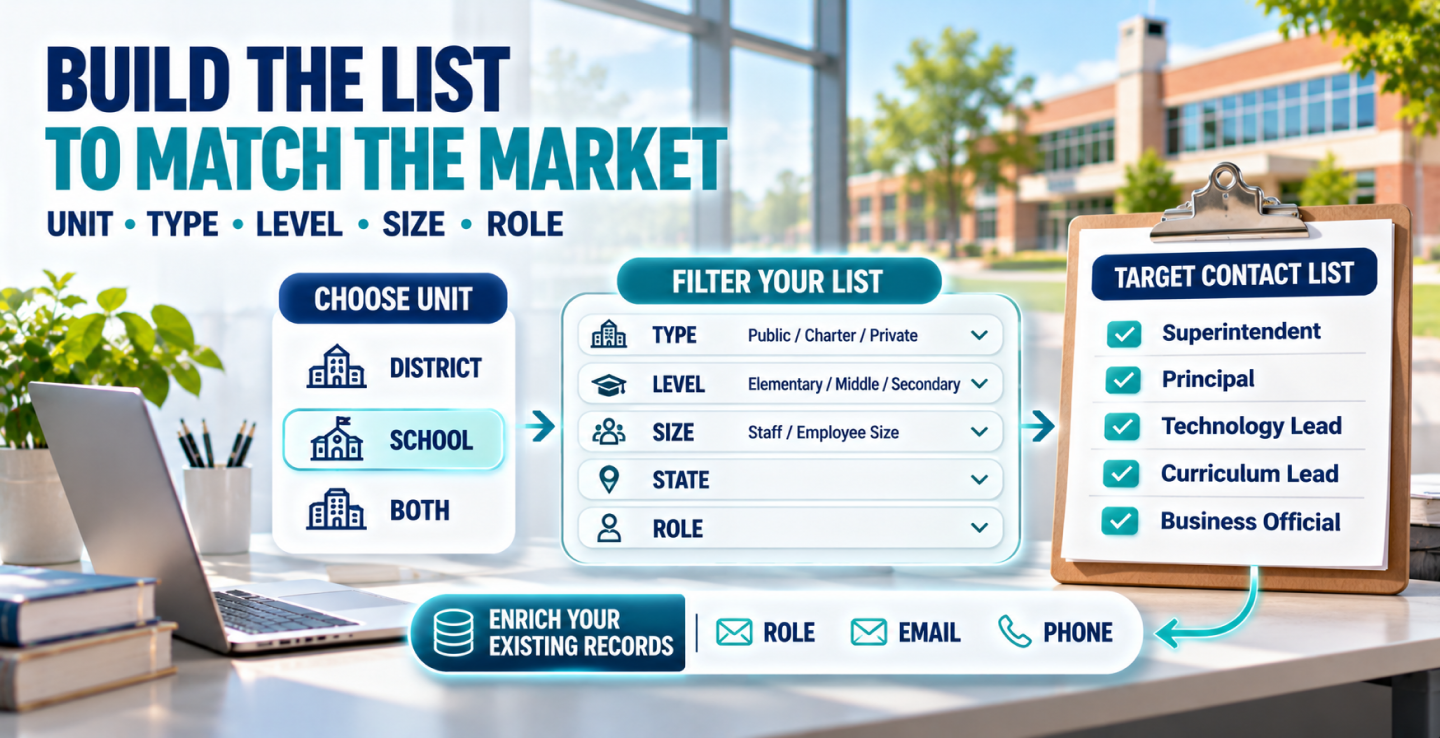
Once you’ve picked the right number for K-12 schools, build the list to match it. Choose the unit first (district, school or both), then cut by the traits that predict a sale.
Start with these cuts:
- School type. Public, charter or private, since each has its own buying path.
- Level. Elementary, middle, secondary or combined, which changes who owns the budget for your product.
- District size. Use employee or staff size as a standard contact-list filter; pupil enrollment can help when separately sourced and confirmed.
- State. Rules and funding differ, and so do the agency counts shown earlier.
- Role. Superintendent, principal, curriculum lead, technology lead or business official.
Already own school records? A data appending service can fill missing roles, emails and phone numbers so you skip rebuying what you already have.
Going after a short list of the largest districts? Account-based marketing services fit that play better than a broad blast, since you’re working named accounts with a coordinated sequence. And if your offer reaches past K-12, browse the other industry email lists to size the neighboring markets with the same discipline.
Mistakes that skew your count of K-12 schools
Most bad numbers come from six habits. Watch for them before you present a market size.
- Mixing years. A 2024-25 public count plus a 2023-24 private count is fine for a rough headline, but label it. Keep state tables from different years apart.
- Treating 19,183 agencies as separate school districts or confirmed buyers. The 2024-25 NCES total includes charter, service and other agencies; regular districts number 13,289. Verify purchasing authority before building an account list.
- Counting a charter twice. Charter-school and independent charter-agency totals cover different units, and one agency can oversee multiple schools. Pick one unit.
- Leaving out private K-12 schools. If your product sells to them, the real universe adds 30,553 schools to the public count.
- Ignoring pre-K. The public count runs through pre-K, and Education Week’s data lists 1,570 pre-K schools in 2022-23. Remove them if you sell to grades K to 12 only.
- Trusting a vendor total without its rule. Ask any provider how it defines a school and which year it covers before you accept its count.
How IInfotanks builds K-12 files
IInfotanks builds files around the unit you sell to, so your team starts from the right slice of K-12 schools. Standard filters include school type, level, employee or staff-size band, state and job role. Pupil enrollment is not a standard field, so ask whether it can be sourced for your segment. You can start from a masked sample to check the format before you commit.
Tell the scoping team what you sell, which buyer owns the budget and how many schools or districts you want to reach. They’ll map the cut with you, and an elementary and secondary schools email list built that way gives you a file that matches the count you chose.
Frequently asked questions
1. How many K-12 schools are in the US?
NCES counts 99,073 operating public schools for 2024-25, covering pre-K through grade 13. The 2023-24 PSS adds 30,553 private K-12 schools. Together that’s about 129,600, though the two counts come from different years.
2. How many school districts are in the US?
It depends on the definition. NCES reports 19,183 education agencies in 2024-25, including 13,289 regular districts and 4,224 independent charter agencies. Those agencies are not necessarily separate buyers. The Census Bureau separately counts 12,535 independent school district governments and 13,853 school systems in 2025.
3. How many private schools are in the US?
The 2023-24 PSS counts 30,553. About 20% are Catholic, 46% have another religious orientation and 33% are nonsectarian. Participation in the survey is voluntary, so treat the total as a close estimate.
4. How many charter schools are in the US?
NCES counted 8,048 charter schools in 2024-25, up from 8,010 in 2023-24. The National Alliance for Public Charter Schools reports about 8,150 using another method. NCES also counted 4,224 independent charter agencies in 2024-25; an agency may oversee several schools.
5. Which state has the most K-12 schools?
California, with 10,303 public K-12 schools and 2,099 districts and agencies in 2024-25. Texas is second with 9,192 schools. Florida runs 4,186 schools through only 83 districts.
6. Where can I find a list of K-12 schools?
NCES publishes school-level data for public K-12 schools through the Common Core of Data and for private K-12 schools through the PSS. They give school names, addresses and enrollment. They lack verified contacts for buyers, so a purchased file adds the roles and emails you need to reach them.
7. How many students attend public and private K-12 schools in the US?
NCES counted 49,269,882 students in public schools in 2024-25. Its latest Private School Universe Survey counted 5,096,365 students in private schools in 2023-24. These figures cover different school years and should be labeled separately instead of presented as a single-year enrollment total.
8. Are charter schools included in the public-school count?
Yes. NCES includes 8,048 charter schools within its 99,073 public schools for 2024-25. It also reports 4,224 independent charter agencies, but agencies and schools are different units. One agency may operate several schools, so do not add agency counts to the public-school total.
9. Why do NCES and Census report different school district counts?
NCES counted 19,183 education agencies in 2024-25, including regular districts, independent charter agencies and other agency types. The Census Bureau counted 12,535 independent school district governments and 13,853 total school systems in 2025. These figures measure different kinds of organizations, not the same set of purchasing authorities.
10. Can school contact lists be filtered by student enrollment?
Employee or staff size is a standard filtering option for IInfotanks school contact lists. Student or pupil enrollment is not a standard field, so ask whether it can be sourced for the selected schools or districts. Confirm the level of coverage and available fields before planning outreach.