

Here’s a gap that shows why law firm size tiers matter. Kirkland & Ellis billed $10.556 billion in fiscal 2025, more than a third of what the entire Am Law Second Hundred billed combined. At the other end, a solo practitioner picks every tool alone, and roughly 11% of US lawyers are self-employed, according to the Bureau of Labor Statistics.
Both are law firms. But they budget and buy so differently that treating them as one market wastes everyone’s time. Size tiers group firms that look and behave alike, so you can tell a partner committee from a one-person practice before you reach out to either. If you’ve ever filtered a law firm email list by headcount, you’ve already used a rough version of this idea.
The lines themselves don’t match from one source to the next: the ABA, NALP, ILTA, Thomson Reuters and the US Census Bureau each draw them in different places. At the top, the Am Law 100 takes in the large majority of Big Law’s revenue, while midsize firms are winning work and watching their margins tighten at the same time. Boutiques are sorted by practice focus more than by headcount, and solo and small practices make up most of the market by count. Census data shows that a tiny share of US law offices pays a third of the industry’s payroll. Buying follows the same lines, since who signs, how far a security review digs, what the tech budget looks like and how a pilot runs all change with headcount. And 2026 mergers, investor deals and AI rollouts keep moving firms from one tier to the next.
What Are Law Firm Size Tiers, and Who Defines Them?
Law firm size tiers are bands that group firms by lawyer headcount or by revenue rank, so you’re comparing firms that operate alike. Here’s the catch: no regulator sets them. Every survey picks its own cut-offs, which is why a 40-lawyer firm counts as “10-49” to the ABA, “under 50” to ILTA and “midsize” in this guide.
| Source | Smallest bands | Middle bands | Largest band | What it counts |
|---|---|---|---|---|
| ABA Legal Technology Survey (2024) | Solo; 2-9 | 10-49; 50-99; 100-499 | 500+ | Lawyers |
| NALP employment report (Class of 2024) | Solo; up to 10 | 11-25 through 251-500 | 501+ | Lawyers |
| ILTA Technology Survey (2026) | Under 50 | 50-149; 150-349; 350-699 | 700+ | Lawyers |
| Thomson Reuters Institute (2026) | Midsize (outside the Am Law 200) | Am Law Second Hundred | Am Law 100 | Revenue rank |
| US Census Bureau, County Business Patterns (2023) | Under 5; 5-9 | 10-19 through 500-999 | 1,000+ | All employees, per office |
| This guide (IInfotanks working tiers) | Solo (1); small (2-10) | Midsize (11-50); large regional (51-200) | Am Law and national (200+) | Lawyers |
This guide uses the last row from here on. One thing to keep in mind: the Am Law lists rank firms by gross revenue, never by headcount. Wachtell, Lipton, Rosen & Katz has about 272 lawyers, yet it sits in the 2026 Am Law 100 and leads that list in profits per equity partner, while the average Second Hundred firm has about 329 lawyers. So treat “200+ lawyers” as a rough stand-in for Big Law, and check the actual ranking before you label a firm. The same cut-offs work as firm size filters when you put together a custom attorney data order.
What Is the Am Law 200?
The Am Law 200 is The American Lawyer’s yearly list of the 200 US law firms with the highest gross revenue. It’s about as close as Big Law gets to an official roster. The 2026 editions came out in April and May 2026 and cover fiscal 2025. Four terms come up a lot:
- Am Law 100: firms ranked No. 1 to No. 100 by gross revenue.
- Second Hundred: firms ranked No. 101 to No. 200.
- RPL (revenue per lawyer): gross revenue divided by lawyer headcount.
- PEP (profits per equity partner): net income divided by the number of equity partners.
| Fiscal 2025 metric | Am Law 100 | Second Hundred |
|---|---|---|
| Gross revenue | $178.95 billion (up 13.0%) | $29.44 billion (up 6.0%) |
| Average revenue per lawyer | $1.39 million (up 8.7%) | $895,000 (up 5.2%) |
| Average profits per equity partner | $3.59 million (up 14.0%) | $1.21 million (up 9.5%) |
| Lawyers | 128,868 | 32,903 |
| Average lawyers per firm | About 1,289 | About 329 |
The gap between the two halves widened in 2025, and the top got more crowded: 62 Am Law 100 firms crossed $1 billion in revenue, up from 58 a year earlier. The per-firm averages in the table divide each group’s total headcount by its 100 firms, so individual firms sit well above and below them.
What Counts as a Midsize Law Firm?
In this guide, a midsize law firm has 11 to 50 lawyers, though the label stretches. The ABA’s survey band is 10-49. Thomson Reuters calls every US firm outside the Am Law 200 “midsize,” and that can include regional firms with a few hundred lawyers.
Right now, midsize firms are busy and squeezed at the same time. Thomson Reuters found that smaller firms picked up most of the market’s demand growth in 2025 as clients moved work away from the most expensive firms. The Q1 2026 Law Firm Financial Index shows how that growth is playing out, year over year:
- Worked rates: up 5.3% at midsize firms, against 6.9% in the Second Hundred and 9.8% in the Am Law 100
- Demand: up 2.6% at midsize firms, ahead of the Am Law 100’s 1.2%
- Direct expenses: up 5.4%, the fastest of the three segments
- Technology and knowledge management investment: up 6.2%, the slowest of any segment
Price explains a lot of that shift. In 2025, the average Am Law 100 lawyer’s standard rate topped $1,000, while lawyers at other firms averaged about $600, according to Thomson Reuters’ 2026 State of the US Legal Market report. In the second half of the year, midsize demand grew nearly 5% while the Am Law 100 stayed under 2%.
What Makes a Boutique Law Firm a Boutique?
A boutique law firm focuses on one practice area or a tight cluster of them, like patent and IP, tax, labor and employment, white collar defense or trial work. Most boutiques are small, but one can have eight lawyers or several hundred, because the label is about focus. Many start when Big Law partners leave together: Paul Clement and Erin Murphy left Kirkland & Ellis in 2022 to open their own appellate firm, and four Paul Weiss partners launched Dunn Isaacson Rhee in 2025.
Example: Susman Godfrey is a trial boutique with 226 lawyers. It’s also in the 2026 Am Law 100, with revenue per lawyer of $2.876 million, more than double the Am Law 100 average.
So with boutiques, practice area usually tells you more than headcount does. A 15-lawyer patent boutique has more in common with the IP group at a big firm than with a 15-lawyer general practice down the street, which is why sorting by practice area tends to fit them better. Client mix matters too: a boutique that represents large corporations inherits those clients’ security and outside counsel requirements, which can make its vendor reviews look more like a big firm’s than a small one’s.
Seven Facts About How Solo and Small Law Firms Buy
Solo and small firms (1 to 10 lawyers) are the biggest group by count, and they’re easy to underestimate. Here’s what the survey data says about how they decide.
- The lawyer is the whole buying committee. 97% of solos and 90% of small-firm lawyers make their own technology decisions, per the ABA’s 2024 Solo and Small Firm TechReport.
- Written rules are rare. 59% of solos have no technology policies at all, against 21% of small firms.
- IT consultants have a real say. Solos turn to outside consultants (35%) or online resources (28%) for tech help, and small firms to consultants (31%) or in-house staff (25%). That makes a firm’s IT provider a common voice when it compares tools.
- Hardware budgets stay small. 61% of solos spend under $2,999 a year on hardware, and 58% of small firms spend between $1,000 and $9,999 (ABA, 2024).
- AI tends to arrive inside tools they already pay for. In 8am’s 2026 Legal Industry Report, where 83% of respondents were solo or at 2-5 lawyer firms, 52% chose legal AI because it sat inside software they already trusted. So it helps to know which software a firm already runs, which is exactly what technographics data tracks.
- People move faster than their firms. 69% of those respondents use general-purpose AI themselves, but only 46% of their firms have rolled it out, and 43% have no AI policy and no plan to write one.
- Data security worries outrank price. 46% call data security a significant barrier to firm-wide AI, while 24% say the same about cost. Expect questions about where client data goes well before questions about price.
Where the Law Firms Are, and Where the Money Is
We ran the US Census Bureau’s 2023 County Business Patterns data for offices of lawyers (NAICS 541110), the latest year available: 165,491 offices, 1,093,331 employees and $137.3 billion in annual payroll. Split by office size, the picture is lopsided.
Source: US Census Bureau, County Business Patterns 2023, NAICS 541110; IInfotanks analysis
Offices with fewer than 10 employees make up 86.8% of the count and pay 22.2% of the payroll. The 1,150 offices with 100 or more employees are 0.7% of the total and pay 33.1%. Ranked by revenue, the top narrows further: the Am Law 200 firms employ about 161,771 lawyers, roughly 12% of the 1.37 million US lawyers the ABA counted in 2025, and billed $208.4 billion in fiscal 2025. That share is a rough comparison, since ALM counts firm headcount and the ABA counts licensed lawyers.
The 10 to 49 employee band is easy to overlook: it holds 11.4% of offices but 30.7% of payroll, more than all offices under 10 employees combined. One caveat on method: Census counts each office on its own and counts all staff, so a 1,000-lawyer firm with 20 offices shows up 20 times.
Why Firm Size Changes How a Law Firm Buys
That split between many small buyers and a few very large ones shapes everything that follows. Size also decides how many people stand between a first conversation and a signed contract, and what each of them will want to see. Here’s what shifts every time you move up a tier:
- Who signs: at a solo practice, the buyer, the user and the person paying the bill are one lawyer. In a partnership, decisions spread across partners and administrative leaders, so it helps to know how to email multiple attorneys at the same law firm without crossing wires. At an Am Law firm, a partner committee usually has the final say.
- What gets checked: corporate clients send their law firms security requirements, and firms pass that scrutiny on to their vendors. The bigger the firm, the more closely your security documents get read.
- Where the money sits: only 41% of solos budget for technology, against 90% of firms with 100 or more lawyers (ABA, 2024). A firm without a budget tends to buy when something breaks, while a firm with one buys on its budget calendar.
- How fast it moves: speed tracks the number of review steps. Thomas Kearns, a partner at Olshan Frome Wolosky, describes technology adoption at midsize firms as a much faster process than it is at Big Law.
How Each Law Firm Size Tier Buys, Side by Side
Here’s the whole picture in one table, from the one-lawyer shop to the Am Law firm. Read across a row to see how one part of the process changes with size.
| Buying factor | Solo and small (1-10) | Midsize (11-50) | Large regional (51-200) | Am Law and national (200+) |
|---|---|---|---|---|
| Who decides | The owning lawyer | Partners, senior IT staff and tech-savvy associates | Managing partner with the COO or firm administrator | Innovation, knowledge and IT leaders; a partner committee approves |
| Who else weighs in | IT consultant, paralegal or office manager | IT and cybersecurity leads | IT director, finance, practice group heads | CIO, security team, procurement, pilot users |
| What they check | Price, setup, client data storage | Hours saved, trial terms, security basics | Security questionnaire, contract terms | Security review, AI policy, structured pilot |
| Tech budget | Often none; 55% of 2-9 lawyer firms have one | About two-thirds of 10-49 lawyer firms have one | Most have one; the share rises with size | Formal annual budget |
| Where you’ll meet them | State bar events, ABA TECHSHOW | ABA TECHSHOW, Association of Legal Administrators (ALA) events | ALA events, Legalweek | ILTACON, Legalweek |
Blank Rome, an Am Law 100 firm, tested AI tools in 2024 through four large pilots involving more than 250 lawyers and business staff. At the midsize level, Kearns notes that most firms have no dedicated knowledge management team, so the evaluation lands on partners and IT. Past about 51 lawyers, you’re usually dealing with several people at once, and each of them tends to ask a different question.
How Security Reviews Change With Firm Size
A law firm’s security review mirrors what its own clients demand, and those demands rise with headcount. The ABA’s 2023 Cybersecurity TechReport, the latest edition with firm-size breakdowns, asked lawyers whether clients had sent them security requirements or questionnaires, and the answers climb steeply by firm size.
Source: ABA 2023 Legal Technology Survey, Cybersecurity TechReport
Firms’ own readiness follows the same curve. Incident response plans sit at 19% of solo and 2-9 lawyer firms, 34% at 10-49 lawyer firms and 78% at firms of 500 or more (ABA, 2023). And in ILTA’s 2026 Technology Survey, generative AI showed up on the list of top security challenges for the first time, in second place behind user behavior. If you work with firms above about 50 lawyers, it helps to have these ready before a questionnaire arrives:
- A completed standard security questionnaire, kept current, with one owner on your team
- Your SOC 2 report or equivalent audit, if you have one
- Plain answers on where client data lives, how long you keep it and who owns it
- Your breach notice timeline
- A written answer on whether client data trains any AI model
What Law Firms Spend on Technology, Tier by Tier
Law firm technology spending rose 9.7% in 2025, per Thomson Reuters’ 2026 State of the US Legal Market report. How much each firm spends, and on what, splits sharply by size.
| Firm size | What the spending data shows | Source |
|---|---|---|
| Solo | 74% spend under $3,000 a year on legal software | ABA, 2024 |
| All firm sizes | $13,991 average yearly tech spend, vs. $14,106 in 2022 | ABA, 2024 |
| Under 500 lawyers | Nearly 30% put over 5% of their 2025 budget into new tech | Bloomberg Law, 2026 |
| Under 500 lawyers | One in three spent over 8% on subscriptions and recurring costs | Bloomberg Law, 2026 |
| Large firms | About 67% spent under 2% on building or buying new tech | Bloomberg Law, 2026 |
| Kirkland & Ellis | Plans to put $500 million into its own AI model | Bloomberg Law, 2026 |
The large-firm row is easy to misread. A 2% share of a large firm’s budget can still be a big number, and Bloomberg Law’s survey found that at firms over 1,000 lawyers, subscriptions and recurring costs far outweighed new purchases, which suggests renewal dates carry a lot of weight at the top tier. Those big-firm figures come from 12 firms over 1,000 lawyers that shared extra data, so they show direction more than a precise benchmark.
How 2026 Mergers, MSOs and AI Are Changing the Tiers
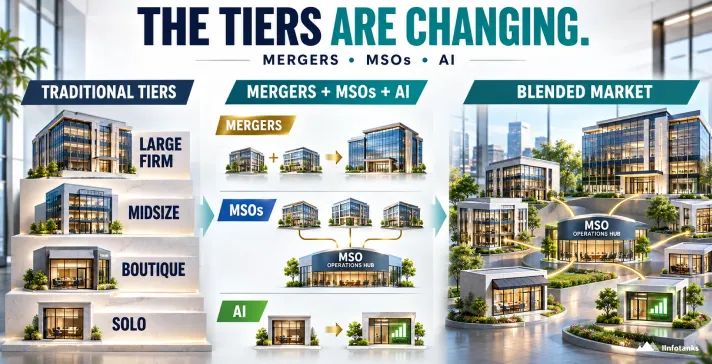
A firm’s tier can change overnight. Fairfax Associates counted 43 completed law firm mergers involving US firms in the first half of 2026, and most second-quarter deals saw larger firms absorb small and midsize ones. Each of those deals turns two firm records into one and changes the surviving firm’s domain, office list and headcount, which can push it up a tier. That’s why it pays to test attorney contact data against a sample before you rely on records for a recently merged firm.
| Effective date | Combination | What changed |
|---|---|---|
| July 1, 2026 | Hogan Lovells + Cadwalader, Wickersham & Taft | Launched with more than 3,200 lawyers |
| June 1, 2026 | Winston & Strawn + Taylor Wessing’s UK-led business | Became Winston Taylor, with more than 1,400 lawyers |
| Aug. 1, 2025 | McDermott Will & Emery + Schulte Roth & Zabel | Became McDermott Will & Schulte |
| June 2025 | Herbert Smith Freehills + Kramer Levin | Became Herbert Smith Freehills Kramer |
| Jan. 1, 2025 | Troutman Pepper + Locke Lord | Became Troutman Pepper Locke |
Outside money is redrawing who buys, too. In November 2025, McDermott Will & Schulte said it was fielding investor interest in a structure that splits a lawyer-run firm from an investor-funded management services organization (MSO) that runs the back office. The ABA Journal’s report on McDermott Will & Schulte’s private equity plan explains why that tests the profession’s limits on outside funding: ABA Model Rule 5.4 bars lawyers from sharing fees with nonlawyers, though ethics lawyer Lucian T. Pera argues that a properly structured MSO doesn’t trigger that rule. Where an MSO exists, the buyer for IT, marketing or finance tools may sit outside the law firm itself.
AI adds a third split. In ILTA’s 2026 Technology Survey, 94% of firms were using or exploring generative AI, up from 80% a year earlier, and the tools they pick differ sharply by firm size. Microsoft Copilot leads at both ends of the market, while specialist legal AI tools show up far more often at the largest firms.
A Checklist for Reaching Firms in Each Tier
Run through this list before you contact a firm in any tier. Each line ties a finding on this page to a step you can take.
- All tiers: tag every firm by lawyer headcount, then check Am Law status on its own, since that list ranks by revenue
- All tiers: re-check firm size after any merger before you rely on the record
- Solo and small: write to the owning lawyer by name and start with time saved and how client data is stored
- Solo and small: make it easy to try things without a contract, since many have no tech budget
- Solo and small: get to know the local IT consultants and state bar events these firms rely on
- Midsize: bring hours-saved math the partners can check for themselves
- Midsize: expect an early IT and security call, and keep trial seats and length flexible
- Large regional: reach the managing partner, the COO or firm administrator and the IT director in parallel
- Am Law and national: map innovation, knowledge management, CIO and practice group leaders, then tailor what each role hears to its own priorities
- Am Law and national: suggest a structured pilot with success criteria agreed up front
- Am Law and national: find out when the tools you’d replace come up for renewal and when next year’s budget gets set
Cosine Solutions: Finding Law Firms That Already Run Expense Software
Cosine Solutions wanted to reach law firms that already run expense management software, specifically Concur or Chrome River, which now trades as Emburse. IInfotanks treated Chrome River and Emburse as one platform so no firm was counted twice, admitted a firm only when its deployment could be confirmed and mapped named contacts at each one. The result was a database of 289 law firms and 1,223 contacts, just over four per firm, with the platform name on every record so the team could see why each firm qualified. The file was verified to a 90% email deliverability standard and delivered in five to seven business days.
Key takeaway: At law firms, where decisions are spread across partners and administrative leaders, several named contacts per firm and a confirmed reason to reach out matter more than a large record count.
Read the full case study: Cosine Solutions Legal Technographics Case Study
FAQs
1. What are law firm size tiers?
They’re bands that group firms by size so you’re comparing like with like. IInfotanks uses solo (1 lawyer), small (2-10), midsize (11-50), large regional (51-200) and Am Law and national (200+). Revenue rankings like the Am Law 200 sit on top of that headcount view.
2. What is the difference between the Am Law 100 and the Am Law 200?
The Am Law 100 is the 100 highest-grossing US law firms. The Am Law 200 adds the Second Hundred, firms No. 101 to No. 200. In fiscal 2025 the first group billed $178.95 billion and the second $29.44 billion.
3. How much revenue does a firm need to make the Am Law 200?
The bar moves every year, because The American Lawyer ranks firms by gross revenue alone. In the 2026 rankings, the average Second Hundred firm brought in about $294 million with about 329 lawyers, so the firms at the bottom of the list sit below that average on revenue.
4. How many lawyers are there in the US?
The ABA counted about 1.37 million US lawyers in 2025, the first real rise since 2020. The Bureau of Labor Statistics tracks jobs and counts 863,700 of them; 11% of those lawyers are self-employed.
5. How many law firms are there in the US?
The Census Bureau counted 165,491 offices of lawyers with paid staff in 2023. It counts each office separately and leaves out solos with no employees, so the number of firms differs from the number of offices.
6. What is considered a midsize law firm?
In this guide, a firm with 11 to 50 lawyers. The ABA’s band is 10-49, and Thomson Reuters labels every US firm outside the Am Law 200 as midsize, so check the definition behind any statistic.
7. What is a boutique law firm?
It’s a firm built around one practice area or a small group of them, such as patent, tax or trial work. Most are small, though Susman Godfrey, a 226-lawyer trial boutique, sits in the Am Law 100.
8. Is Big Law the same thing as the Am Law 200?
Close. Big Law has no official definition, and the term usually refers to the Am Law 100 or 200 by revenue, or the NLJ 500 by headcount. ALM publishes the NLJ 500, which ranks the 500 largest US firms by lawyer count.
9. Who makes technology buying decisions at a small law firm?
The owning lawyer, in almost every case: 97% of solos and 90% of small-firm lawyers decide for themselves (ABA, 2024). So at this size, the lawyer who tries a tool is usually the one who signs for it too.
10. How long does it take to sell software to a law firm?
It depends on how many review steps a firm runs. At a solo practice, the lawyer who evaluates a product usually approves it too, while an Am Law deal can clear a security review, an AI policy check, a pilot and a committee first. Knowing which tools a firm already runs gives you a sense of which steps you’ll face.
11. Do law firms send vendors security questionnaires?
Larger firms usually do, and the pressure starts with their own clients. In the ABA’s 2023 survey, 22% of lawyers overall said a client had asked them to complete a security questionnaire, rising to 50% at firms with more than 100 lawyers. Firms under that scrutiny tend to ask the same of their vendors.
12. How much do law firms spend on technology?
The ABA’s 2024 survey put average annual technology spend at $13,991. 65% of firms budget for technology, from 41% of solos up to 90% of 100+ lawyer firms, per the ABA’s 2024 Practice Management TechReport.
13. Which AI tools do law firms use at each size?
There’s a wide gap by size. According to the findings of ILTA’s 2026 Technology Survey, 59% of firms under 50 lawyers use or are exploring Microsoft Copilot and 22% Harvey, against 88% and 84% at firms of 700 or more.
14. What is an MSO in a law firm?
A management services organization is a separate company that runs a firm’s back office and can take outside investment. McDermott Will & Schulte said it was fielding investor interest in the model, which could move IT and marketing purchases outside the firm.
15. How do law firm mergers affect your contact data?
A merger can change domains, titles, office addresses and a firm’s tier all at once. With 43 mergers involving US firms completed in the first half of 2026, firm records go stale quickly, so it’s worth re-checking any record for a recently merged firm before you use it.