
How many criminal defense attorneys are in the US is harder to answer than it sounds, because no agency keeps one headcount for the whole defense bar. If you sell to this group, a criminal defense attorney email list sorted by state helps you reach working defense lawyers by practice type, so you can test each segment on its own.
This guide pulls together the best counts available for each part of the defense bar, from county defender offices to solo firms, and shows where the gaps sit. It ends with a four-week plan for sizing your market. Where we estimate, we label it.
TL;DR
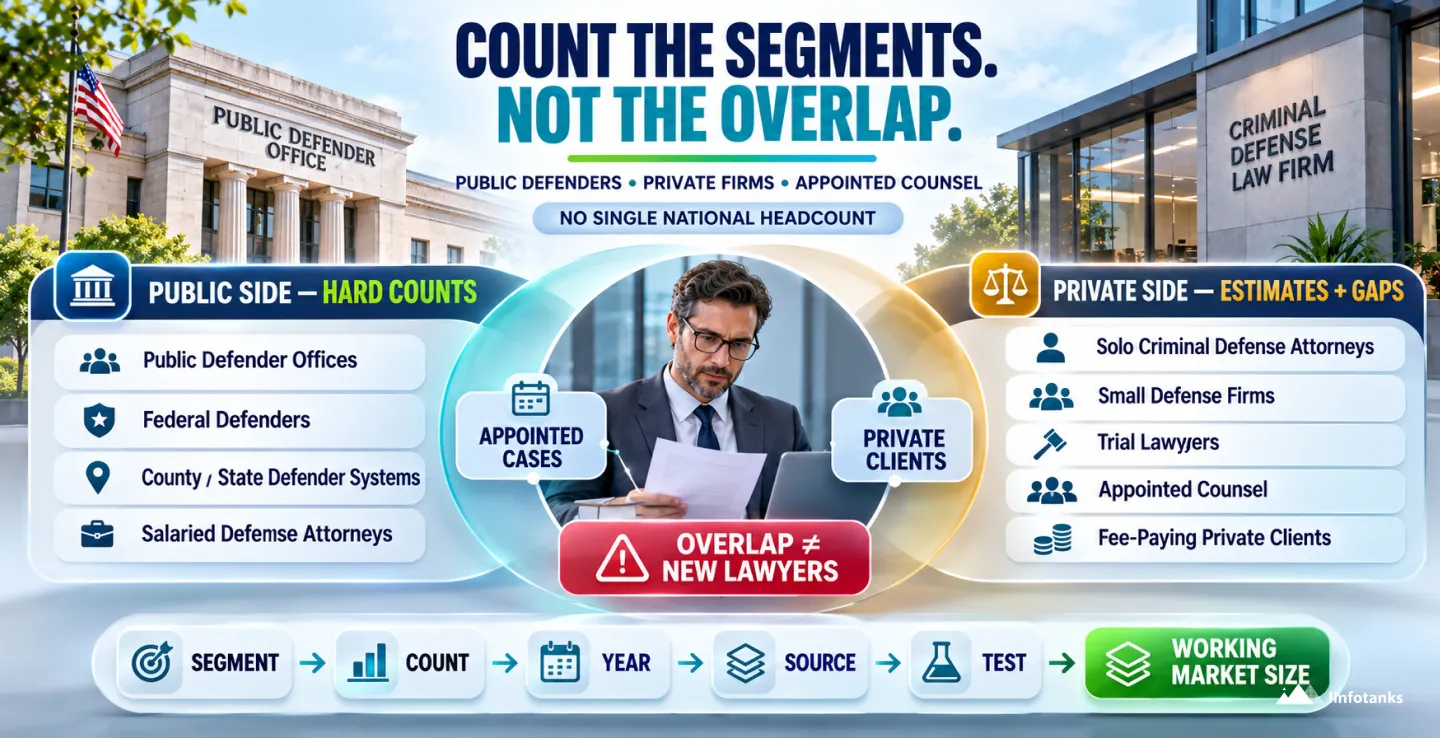
The public side has counts and the private side has gaps
Federal surveys counted public defender offices, and federal defenders publish yearly figures. Private firms never received a count of their own, so any answer to how many criminal defense attorneys are in the US blends hard data with estimates. Check the year and source on every number before you use it.
Overlap inflates every total you add up
Many lawyers take appointed counsel work and fee-paying clients at the same time, so stacking the two sides double counts people. Decide whether you’re targeting salaried defenders, panel lawyers or fee-paying firms, because each group buys through a different channel.
A simple routine turns the gaps into a working market size
The plan at the end sorts the segments, pins each count to a year and tests one segment first. A quarterly review then updates the numbers as new public data arrives and shows which part of the defense bar answers your messages.
What the Public Side Looks Like
Public defense is the part of the defense bar that got counted, so start there. The last published federal census covers 2007. It found 957 public defender offices with about 15,000 full-time equivalent litigating attorneys and 5.6 million cases. No newer count of offices has been published, so estimates still start from it. County-based offices numbered 530. They employed about 10,700 of those attorneys and received 73% of the cases. State programs cover the remainder. The same census counted 22 state public defender programs running 427 offices. Those offices employed 4,321 attorneys, about 29% of the total, and received roughly 1.49 million cases. Counties hold the largest share of public defense lawyers, and state programs hold most of what’s left.
Federal defenders form a separate group. In fiscal 2022 the federal courts listed 82 defender organizations, made up of 65 federal public defender organizations and 17 community defender organizations. They served 91 of the 94 federal districts and closed 89,521 representations. That count is separate from the county and state figures above, with its own year and source. Private lawyers take federal appointments too. That same year, 7,165 Criminal Justice Act panel attorneys were paid through the federal system, and they closed 59,985 representations. Each of them also counts as a private practitioner, and that matters when you total the two sides. Add panel attorneys to the defender count, then add private firms, and you count the same lawyers twice.
What the Federal Numbers Say About Demand
Federal appointed work looks steady. Representations opened under the Criminal Justice Act totaled 143,287 in fiscal 2022, down nearly 2% from the prior year. Defender organizations closed 2% more cases and panel attorneys closed 1% fewer, so demand moved little in either direction.
Why the Newest Public Defender Count Is So Dated
The 2007 census remains the latest published count of defender offices, so its 15,026 attorneys is a dated anchor for any estimate of how many criminal defense attorneys are in the US and not a current headcount. A November 2024 Federal Register notice from the Bureau of Justice Statistics asked for approval of a new Census of Public Defender Offices covering about 2,000 offices with a 2024 reference year. It gave no release date, so watch for it.
A Look Across the Courtroom
For scale on the other side of the courtroom, the Bureau of Justice Statistics’ 2020 National Survey of Prosecutors counted 35,120 attorneys in 2,347 state prosecutor offices that handle felony cases. The survey year and definitions differ from the 2007 defender census, so the ratio is a rough guide at best.
Where Private Practice Hides
The Bureau of Labor Statistics counted 863,700 lawyer jobs in 2025. Legal services employed 52% of them, 11% were self-employed and government held about 20%, but none of those categories isolates criminal defense. The 11% self-employed share is the closest proxy for solo practitioners, though it covers every practice area.
For scale, suppose 2% to 4% of those jobs sit in criminal defense, which would put the answer to how many criminal defense attorneys are in the US between about 17,300 and 34,500. The shares are our assumption for illustration, since no source publishes one. For comparison, the 2007 public defender count alone was 15,026.
A State-Level Snapshot From Michigan
The State Bar of Michigan publishes a practice-setting split for its Criminal Law Section. Of 2,213 Michigan residents in the section in 2025, 51.3% worked in private practice and 19.5% in government. Among the 1,136 private practitioners, 46.4% were full-time solo practitioners and 32.9% worked in firms of 2 to 10, though section members are self-selected, so treat the split as one state’s picture, and some state bars publish similar data.
How Often Defendants Rely on Publicly Financed Counsel
- In 1996, 82.0% of felony defendants in the 75 largest counties had publicly financed counsel, per a BJS study, split between public defenders at 68.3% and assigned counsel at 13.7%.
- In 1998, 66.4% of federal felony defendants had publicly financed counsel, with federal defender organizations at 30.1% and panel attorneys at 36.3%.
- In 1996, 68% of local jail inmates had publicly financed counsel, and about 3 in 4 state prison inmates did in 1997.
Private Firms and Public Defenders Compared
The table below pairs each segment with the best count we found and the gap that remains, so you can see which numbers to trust when you work out how many criminal defense attorneys are in the US.
Segment | Who they are | Best count found | Gap |
|---|---|---|---|
County defender offices | Salaried county staff | 530 offices, about 10,700 attorneys (2007) | Count is 18 years old |
State defender programs | Salaried statewide staff | 22 programs, 427 offices, 4,321 attorneys (2007) | Count is 18 years old |
Federal defender organizations | Salaried federal staff | 82 organizations (fiscal 2022) | No attorney headcount in the source |
CJA panel attorneys | Private lawyers paid per case | 7,165 paid (fiscal 2022) | Most also carry private clients |
County assigned or contract counsel | Private lawyers under local terms | No national count found | Rules vary by county |
Solo and small firms | Fee-paying clients plus some appointments | 11% of all lawyer jobs are self-employed | No criminal-specific count |
Private firms hold the biggest gap, and county contract counsel sit right behind them. Treat any vendor total that fills those blanks with one tidy number as an estimate and ask how it was built.
Why Any Single Total Misleads
A single national figure for how many criminal defense attorneys are in the US hides the differences that decide who answers you. A salaried defender in a county office, a federal panel lawyer and a solo firm owner have different budgets, workloads and buying habits, so size and test each group and keep the results separate. If bankruptcy is another practice area you sell to, size it separately with a mailing list of consumer bankruptcy lawyers.
What National Lawyer Totals Can and Can’t Tell You
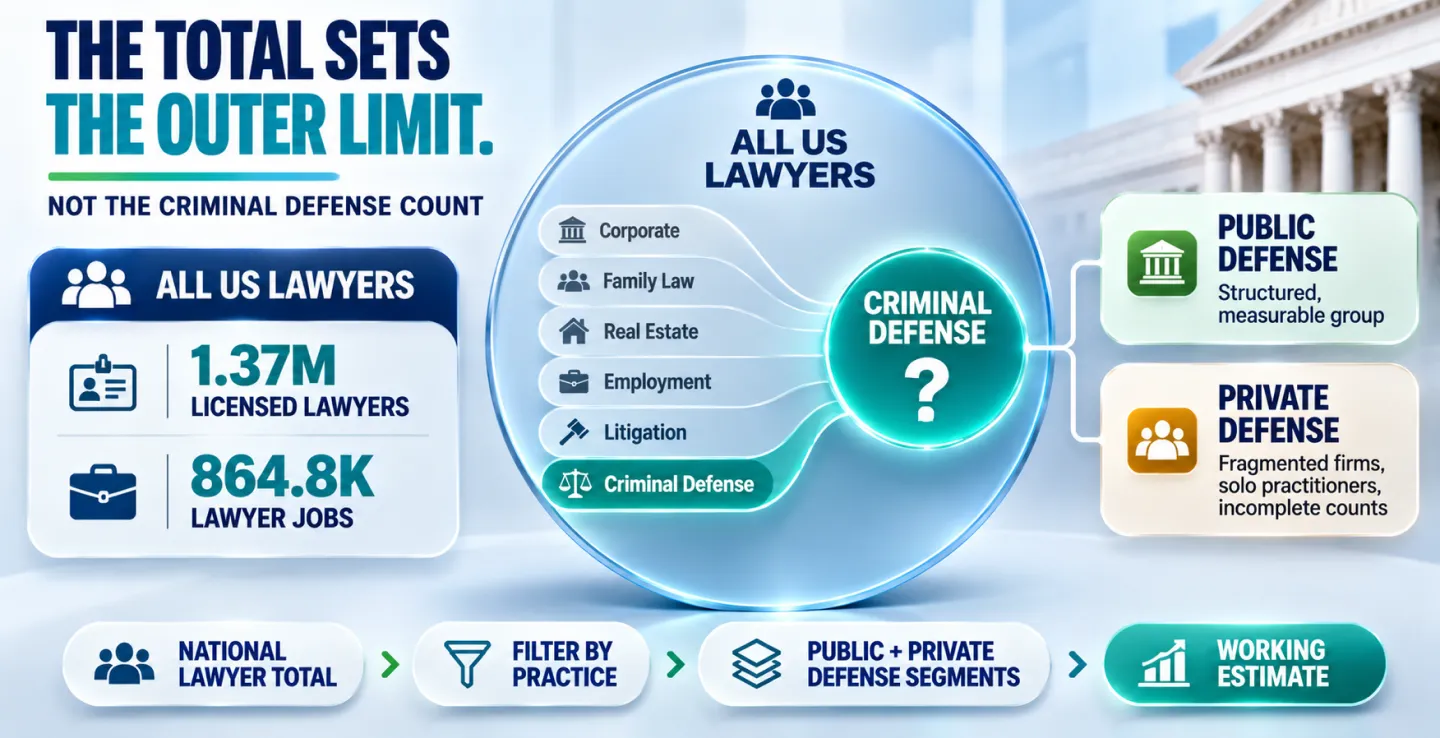
Start with the largest numbers you can find. The ABA’s 2025 Profile of the Legal Profession counts about 1.37 million lawyers in the US, up from roughly 1.36 million in 2024. The Bureau of Labor Statistics reports a smaller national figure, 864,800 lawyer jobs in 2024. The two differ because one counts licensed lawyers and the other counts jobs. Both cover every practice area. Neither separates criminal defense from other work, so you can’t read a defense headcount off either one. What you get is an outer limit. Any estimate of how many criminal defense attorneys are in the US has to land well inside these totals, and a number that doesn’t should make you ask where it came from.
Use the national totals for two jobs. First, they check a vendor’s claim. If a list says it holds more defense attorneys than the public counts and private estimates can support, compare it with the 1.37 million before you trust it. Second, they frame the gap you’re trying to close. The public side has a dated count of about 15,000 litigating attorneys in defender offices, and the private side has no matching count. That gap is where your own estimate comes from, built one segment at a time, with a year on every figure, in the sections below. National totals can’t do that part for you. They show the market’s outer edge, not which part of it answers your messages.
Choosing Where to Start Your Count
Work through four checks before you commit to one segment.
Decide who buys what you sell
Salaried defender offices buy through county or state budgets, so purchases move slowly and need approval. Solo practitioners buy with their own money and decide fast. Match your sales cycle to the segment before you size it.
Pin every number to a year
A 2007 office count and a fiscal 2022 federal count describe different worlds. Write the year beside each figure in your sizing sheet, and flag anything older than five years so nobody mistakes it for a current headcount.
Remove overlap before you add
Many CJA panel attorneys also run a private practice, and some solo lawyers take county appointments. Assign each lawyer to one segment and drop the repeat, or your count of how many criminal defense attorneys are in the US will run high.
Start with the segment that has a count
Federal defenders and county offices have published numbers, which gives you a check on your data. Test those first, then move to private firms once you trust how your source builds its totals.
State-Funded and County-Funded Systems Split the Map
Who pays for public defense decides who runs it, and that changes who you contact. The 2007 federal census found 22 states with a state public defender program. In the other 27 states, defender offices were county-based, run locally and paid mostly by the county or by a mix of county and state money. California shows the extreme case. Its 58 counties each set their own structure, funding and oversight, with no statewide standards. Washington leans the same way, with funding mostly local. In 2024 the state covered between 1.5% of public defense spending in King County and 15% in Garfield County. A statewide system gives you one office to approach. A county system gives you one buyer per county.
The map keeps moving, so check the current year before you plan outreach. Pennsylvania spent decades as one of two states that left public defense entirely to counties. Its legislature has created an Indigent Defense Advisory Committee to allocate state money and set statewide standards. Illinois and South Dakota also passed state funding laws recently, according to California’s Office of the State Public Defender. Each change can shift part of a budget from counties to the state. If you built a list around county chiefs in one of these states, a state office may now hold part of that budget. Pin the funding model to a year, the same way you pin every count. Then recheck it before each send.
Sizing Mistakes That Skew the Total
Four slips cause most of the bad answers to how many criminal defense attorneys are in the US:
- Treating 2007 as today: The newest published count is 18 years old.
- Counting panel lawyers twice: They appear in public data and in private practice.
- Counting every defender-office lawyer as a litigator: The census counted litigating attorneys, which is narrower than total staff.
- Ignoring county rules: Funding and contract terms differ across counties, so a state average hides the real buyers.
If you want a team to turn a rough count into a tested outreach plan, we offer lead generation services that map the segments with you.
How Funding Shapes Who Buys
The Sixth Amendment Center estimates state and local governments spent about $6.5 billion, or roughly $20 per resident, on indigent defense in 2023, and funding explains why the public side looks different from state to state when you ask how many criminal defense attorneys are in the US. Delivery models range from government defender offices to contracted nonprofits, private attorney systems and managed assigned counsel. Michigan had defender offices in 32 of 83 counties in 2023, up from 3 in 2013.
How Pay Rates Shape Appointed Counsel Work
Private lawyers take appointed counsel cases only when the pay and the rules make sense for them. The Sixth Amendment Center reported that in 2023 Iowa paid conflict counsel under $80 an hour, while Maine paid assigned counsel close to double that. A solo lawyer weighs numbers like those against fee-paying work. Indigent defense headcounts move with local budgets, so a lawyer who takes appointments this year may drop them next year when rates or contracts change. A count taken last year may already be off.
What Heavy Caseloads Mean for Outreach
A 2023 RAND national public defense workload study reviewed 17 state studies and used a panel of 33 expert defense lawyers to set new caseload standards. It put a low-severity felony at 35 hours and a high-severity misdemeanor at 22.3 hours, well above the old national guidelines, which were about 50 years old. Here is the arithmetic, assuming 1,800 case hours a year per attorney. Under the new caseload standards, a lawyer closing only low-severity felonies at 35 hours each could handle about 51 a year. A Missouri county office reported 350 felonies per lawyer in 2022, per an Arnold Ventures release, which is 12,250 hours or nearly 7 years of work.
How Caseload Standards Change Hiring
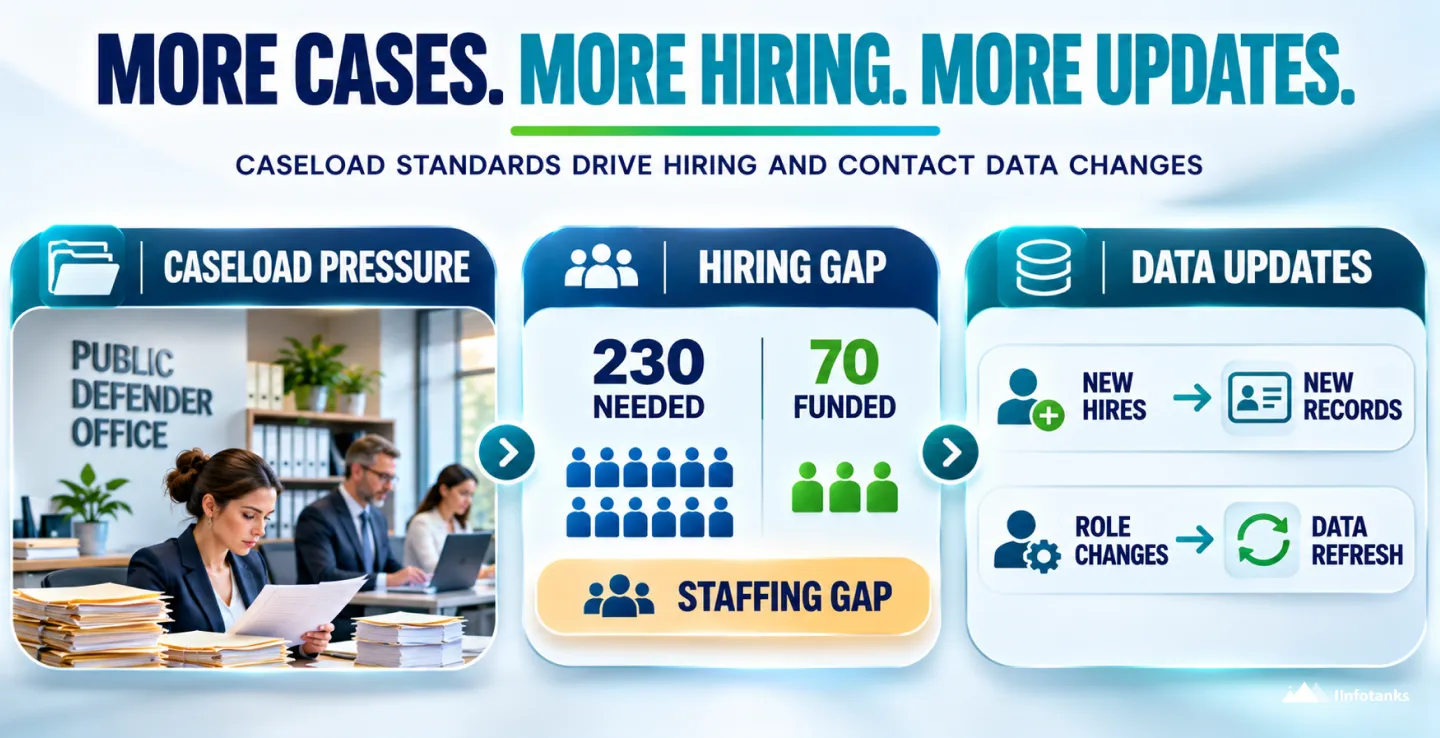
Moving toward RAND caseload standards could increase attorney hiring needs across public defender offices, creating new staffing demands and opportunities for updated legal contact data.
- RAND caseload standards suggest public defender offices may need significantly more attorneys to manage workloads.
- Meeting these standards could require additional hiring across offices with high attorney caseloads.
- A Colorado news report highlighted staffing shortages in a public defender budget request.
- The report cited a stated need for 230 additional attorneys to meet staffing requirements.
- However, the budget request sought funding for only 70 attorneys, leaving a significant gap.
- Increased hiring and staff turnover could create new contacts, making regular data updates essential.
Reaching Defense Lawyers Once You Have the Counts
After sizing, the message matters more than the total, and a short note naming one problem, such as time spent on discovery or intake, fits a lawyer doing indigent defense work with little spare time. A team offering email marketing services can handle sending, tracking and list hygiene while you refine the message for each segment. Test subject lines on a small group first, and note which segment opens and replies so the next round starts from evidence.
What to Ask for in Defense Contact Data
- An office-type flag that separates public defenders, appointed counsel and private firms.
- The state and county, since funding and delivery models change by place.
- Firm size, so solo lawyers and small firms can be tested apart from larger groups.
- An email list of law practices when your offer also reaches the firms that employ these lawyers.
A Practical Routine From Rough Count to First Send
Timing | Action |
|---|---|
Week 1 | List the segments you could sell to and pin each public count to its year. |
Week 2 | Remove overlap, pick one segment and request counts by state and office type. |
Week 3 | Write one short message for that segment and send a small test. |
Week 4 | Review replies, bounces and meetings by segment, then decide whether to widen the test. |
Every quarter | Recheck new public data and your reply rates, then rerun the sizing. To explore other buyer groups, browse the full set of industry email lists. |
Frequently Asked Questions
- How many criminal defense attorneys are in the US?
No source publishes one total. The public defender count was about 15,000 in 2007, and the private side has no direct count.
- How many public defenders are there?
The last published census counted 15,026 full-time equivalent litigating attorneys across 957 offices in 2007. A newer census was proposed in 2024.
- How many federal defender organizations exist?
The federal courts listed 82 in fiscal 2022, made up of 65 federal public defender organizations and 17 community defender organizations.
- What are CJA panel attorneys?
They are private lawyers paid by the federal courts to take appointed cases. 7,165 were paid in fiscal 2022.
- How many lawyers are in the US overall?
The ABA counted 1.37 million active lawyers in 2025, and the Bureau of Labor Statistics counted 863,700 lawyer jobs.
- What share of defendants use appointed counsel?
In 1996, 82.0% of felony defendants in the 75 largest counties did. The federal figure was 66.4% in 1998. Both are dated.
- Do private firms handle indigent defense?
Yes. Many private lawyers take county contracts or assigned cases, and panel attorneys take federal appointments, so the two sides overlap.
- How many solo practitioners handle criminal cases?
No national number exists. In Michigan’s Criminal Law Section, 46.4% of private practitioners were full-time solos in 2025.
- Why is the public defender count so old?
The Bureau of Justice Statistics last published a full census in 2007. A new one, covering about 2,000 offices, was proposed in November 2024.
- How much does indigent defense cost?
The Sixth Amendment Center estimates about $6.5 billion in state and local spending in 2023, or roughly $20 per resident.
- What do RAND’s caseload standards say?
A 2023 study set 35 hours for a low-severity felony and 22.3 hours for a high-severity misdemeanor, far above the old national guidelines.
- Can I add public and private counts together?
Not safely. Panel attorneys and county contract lawyers appear on both sides, so adding the counts double counts many people.
- Which segment should I target first?
Start with the segment that has the best published count and a buying path you understand, then test private firms after you validate the data.
- How often should I refresh defense contact data?
Recheck each quarter, since office assignments, firm sizes and county contracts change and old records lose accuracy.
- What is a good first step for sizing this market?
Write down each segment, pin each count to its year and remove overlap before you add anything together.