

Anyone planning outreach to cancer doctors eventually asks how many oncologists are there in the US, and the honest answer is a range. It runs from about 14,500 to more than 28,000 depending on who counts and how, and it shapes budgets, territories and expectations. A well-built oncology email list starts from the right count for your product, so it’s worth knowing where each number comes from.
This guide is for marketing, sales and market-access teams who need a number they can defend. It compares the main sources, splits the total by oncology type, shows where oncologists practice and explains how to turn a headcount into a reachable list. A four-week sizing plan near the end puts the steps in order.
TL;DR
A headcount with four different answers
So how many oncologists are there in the US? Counts range from about 14,500 to more than 28,000. The gap comes from definitions. Some sources count only physicians billing Medicare, some count physicians by specialty data, and others rely on self-reported specialty. Each one answers a slightly different question.
The risk is planning around the wrong total
Pick a number that’s too high and your territory plan promises reach you can’t deliver. Pick one that’s too low and a launch gets underfunded. Teams also mix oncology types, so a radiation device gets sized against figures for medical oncologists in the US that don’t apply.
A five-step way to size your audience
To answer how many oncologists are there in the US for your product, choose the oncology type that fits it, compare at least two sources, check the geography, turn the count into reachable contacts with public records, and test with a small send. The four-week plan near the end of this guide lays out each step.
Why the Number of Oncologists in the US Depends on Who You Ask
The answer to how many oncologists are there in the US changes because each source asks a different question. The AAMC’s 2022 specialty data report, as reported by Becker’s, listed 16,673 hematology and oncology physicians in 2021. A Medicare billing study found 14,547 in 2024, and a commercial physician database reported more than 28,000 in October 2025.
| Source | Year | What it counts | Figure |
|---|---|---|---|
| ASCO workforce report | 2020 | Oncologists engaged in patient care | 12,940 |
| Medicare billing study | 2024 | Hematologist and medical oncologists billing Medicare | 14,547 |
| AAMC specialty data | 2021 | Hematology and oncology physicians | 16,673 |
| Commercial physician database | Oct 2025 | Self-reported oncology specialties, all types | More than 28,000 |
The gaps are mostly definitions. Medicare billing leaves out oncologists who don’t bill Medicare, while self-reported specialty counts anyone who lists oncology, even partly. As a rule of thumb, the low end is likely closer to full-time clinicians and the high end closer to everyone who lists the field.
Oncology Workforce Data: Where the Numbers Come From
Most oncology workforce data comes from four places: professional society surveys, national physician files, insurance billing records and commercial databases. Each one has a blind spot. Surveys reach only the people who respond, physician files can lag behind moves and retirements, and billing records miss anyone outside the program.
Every source is usable once you know its blind spot. Name the source whenever you share an answer to how many oncologists are there in the US with colleagues, so nobody mistakes a billing count for a total.
What Counts as an Oncologist
Oncology covers six groups. Medical oncologists treat cancer with drugs, hematologist-oncologists add blood cancers, radiation oncologists use radiation, surgical oncologists operate, gynecologic oncologists treat cancers of the female reproductive system and pediatric hematology-oncologists treat children.
Each group buys different products, so a split by type helps more than a single total. A related hematologist email list covers blood specialists who may sit outside your oncology total.
Medical and Hematology Oncologists: The Largest Group
Most headcount questions are really about this group. The ASCO Post, reporting a study in JCO Oncology Practice, found 14,547 hematologist and medical oncologists billing Medicare in 2024, up from 12,267 in 2014. Growth was real, yet density per 100,000 people aged 55 and older fell from 15.9 to 14.9.
Medical oncologists in the US often appear under two labels in commercial data. One database listed 11,937 under hematology and oncology and 4,778 under medical oncology, so add the two before you compare with other sources.
Medical Oncologists in the US: What the Headcount Hides
A single count of medical oncologists in the US hides how the work splits. Many focus on a few tumor types, such as breast, lung or gastrointestinal cancers, and they follow very different product news. If you sell into one tumor type, treat the headline total as a ceiling. Your working group is the share of medical oncologists who see those patients, and your list should show that focus on each record.
Radiation Oncologists in the US: A Smaller, Equipment-Heavy Group
AAMC data counted 5,376 radiation oncologists in the US in 2021, and a commercial database listed 5,998 in October 2025. The two figures sit close together, which hints that this group is easier to count than medical oncology. Radiation treatment depends on expensive shared equipment, so purchase decisions often involve more than one person at a site. Radiation oncologists in the US are best segmented by treatment center as well as by individual.
Surgical Oncologists and Gynecologic Oncologists
Before you size surgical and gynecologic oncologists, keep these points in mind:
- One commercial database listed about 1,597 surgical oncologists and about 1,445 gynecologic oncologists, which makes them the smallest groups in this guide.
- Many cancer operations are also done by general, thoracic and urologic surgeons, so a surgeons email list can reach more of the people who operate on tumors.
- For this group, a total count means little until you pair it with hospital and state.
- A small group sized by title alone can leave out surgeons who treat cancer as part of a broader practice.
Pediatric Hematology-Oncology: Counted Differently Again
AAMC data listed 3,179 pediatric hematology and oncology physicians in 2021, and the commercial database listed 2,270 in 2025. The gap is wider than for radiation oncology. A pediatric count may include fellows and other physicians in training, depending on the source. Check whether a figure covers only attending physicians before you rely on it.
How Many Patients Does Each Oncologist Serve

The American Cancer Society projects 2,114,850 new cancer cases in the US in 2026 and 626,140 deaths. About 18.6 million Americans had a history of invasive cancer as of January 1, 2025. Divide new cases by 14,547 Medicare-billing hematologist and medical oncologists and you get roughly 145 new cases for each one. That’s a rough illustration, since the years and counting rules differ, but it shows why oncologists guard their time and why short, specific emails tend to land better.
Where Oncologists Practice: Geography and Retirement
ASCO’s 2020 report on oncology workforce data, as summarized by Becker’s Oncology, counted 12,940 oncologists in 1,698 practices. About 34% were women, about 11% practiced in rural areas and about 20% were 64 or older.
The 2025 study adds the map. Only 45% of US counties had an oncologist, 1,724 counties had none and 942 counties had more than a quarter of their oncologists nearing retirement age. Density fell in 38 states, so your reachable audience may shift faster than a yearly headcount suggests.
Reading the Number of Oncologists in the US Over Time
Growth in the number of oncologists in the US has been steady but slow. Medicare billing counts rose by about 2,280 between 2014 and 2024, a gain of roughly 19%. Retirements push the other way. With about 20% of oncologists aged 64 or older in 2020, a count taken a few years ago may already overstate who’s still seeing patients, so date every figure you use.
Picking the Right Count for Your Product
Match the count to what you sell, then check it against a second source:
- Cancer drug or biologic: Start with hematology and medical oncology, then narrow by the tumor types your drug treats.
- Radiation or imaging device: Start with radiation oncologists in the US and group them by treatment site.
- Surgical product: Start with the surgical oncology group, then add the general and specialty surgeons who operate on your tumor type.
- Diagnostics or genetic testing: Use medical oncology and hematology together, since both groups may order tests.
- Pediatric product: Use pediatric hematology-oncology alone, and confirm whether trainees are in the count.
Whichever count you choose, write the source and year next to it. Our guide on healthcare data enrichment with NPI and specialty fields shows how specialty labels get added to a record and where they can go wrong.
From Headcount to Reachable Audience
A headcount and a contact list are different things. Every physician has a National Provider Identifier, and the public NPPES registry lets you search by taxonomy code. These are the codes for each oncology type:
| Oncology type | Taxonomy code |
|---|---|
| Medical oncology | 207RX0202X |
| Hematology and oncology | 207RH0003X |
| Radiation oncology | 2085R0001X |
| Surgical oncology | 2086X0206X |
| Gynecologic oncology | 207VX0201X |
| Pediatric hematology-oncology | 2080P0207X |
The registry gives names, addresses and codes but no verified emails. Expect your oncologist audience size to shrink at each step, from everyone with a code, to active clinicians, to the ones you can reach by a verified address.
Why Counts Overlap and Double Up
Many oncologists list more than one specialty, and some databases give each listing its own record. That’s how the number of oncologists in the US can drift upward on paper without a single new hire. Hematology and oncology versus medical oncology is the usual trouble spot.
Ask any source how it handles dual labels, whether it counts people or records and how often it refreshes. Those three questions explain most differences between data sets.
A Worked Example: Sizing a Radiation Device Launch
Say a company launching a treatment-planning tool asks how many oncologists are there in the US. It starts with radiation oncologists, a group of roughly 5,400 to 6,000 across two sources, and keeps the whole range. It then narrows to the 10 states where it has sales coverage, removes records without a verified email and sets a first-wave target from what’s left. The final oncologist audience size is smaller, and it’s the one the sales team can plan around.
Setting an Oncologist Audience Size Target
Once you have a count, decide how much of it you want to reach in the first wave. One practical approach is to start with a slice you can follow up on personally, since replies from a small, well-chosen group teach you more than silence from a large one. Write the target down with its source, its year and its filters. If the figure changes later, you’ll know whether the market moved or your definition did.
Sharing the Number Inside Your Company
Sales, medical and finance teams all answer how many oncologists are there in the US, and they rarely give the same answer. Agree on a single line everyone can repeat, such as the group, the source and the year. A short note on what the figure leaves out saves hours of debate later. If a colleague finds a bigger number, you can show which definition produced it and decide together whether to adopt it.
Turning the Count Into a Campaign Plan
Reach drives budget in two ways: how many contacts you buy and how many times you send to them. Sizing first keeps you from buying more data than a product can use in a year. A smaller, verified group that gets three well-timed messages usually gives you cleaner results than a large group that gets one. Plan the number of sends before you plan the size of the list.
Keeping Outreach Compliant
The FTC’s CAN-SPAM guide applies to every commercial send, with honest sender details, a postal address and an opt-out honored within 10 business days. Count only the contacts you can sensibly email, and keep a suppression list for each campaign. If a message mentions a drug, send it through your medical and legal reviewers before it goes out.
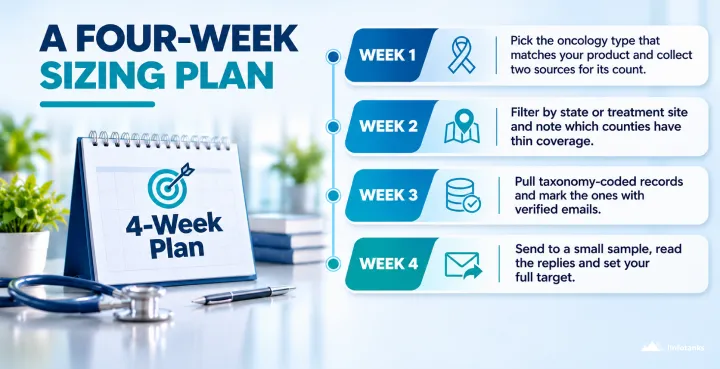
A Four-Week Sizing Plan
| Week | What to do |
|---|---|
| Week 1 | Pick the oncology type that matches your product and collect two sources for its count. |
| Week 2 | Filter by state or treatment site and note which counties have thin coverage. |
| Week 3 | Pull taxonomy-coded records and mark the ones with verified emails. |
| Week 4 | Send to a small sample, read the replies and set your full target. |
Review the count twice a year, since retirements and moves change it. If your product also touches referring doctors, a physicians email list adds that audience.
Frequently Asked Questions
1. How many oncologists are there in the US?
The answer to how many oncologists are there in the US depends on the source. Medicare billing data shows 14,547 hematologist and medical oncologists in 2024, AAMC data shows 16,673 hematology and oncology physicians in 2021, and one commercial database lists more than 28,000 across all oncology types.
2. Why do sources give different counts?
Each one defines an oncologist differently. Some count only Medicare billers, some count by specialty data and some rely on self-reported specialty.
3. How many medical oncologists are there in the US?
A commercial database listed 4,778 under medical oncology and 11,937 under hematology and oncology in October 2025. Add the two for a fair comparison.
4. How many radiation oncologists are in the US?
AAMC data counted 5,376 in 2021, and a commercial database listed 5,998 in October 2025.
5. How many surgical oncologists are there?
One commercial database listed about 1,597 in October 2025. Other surgeons also operate on cancer, so the practical audience may be larger.
6. How many pediatric hematologist-oncologists are there?
AAMC data listed 3,179 in 2021, and a commercial database listed 2,270 in 2025. Check whether the figure includes trainees.
7. What is oncology workforce data?
It’s counts and details about practicing oncologists, such as number, age, location and practice type. ASCO, the AAMC and Medicare billing records are common sources.
8. Is the number of oncologists growing?
Medicare billing counts rose from 12,267 in 2014 to 14,547 in 2024. Density per 100,000 people aged 55 and older still fell from 15.9 to 14.9.
9. How many new cancer cases are expected in the US?
The American Cancer Society projects 2,114,850 new cases in 2026.
10. How do I find oncologists by taxonomy code?
Search the public NPPES registry by taxonomy code. Medical oncology uses 207RX0202X and radiation oncology uses 2085R0001X.
11. Where do oncologists practice?
Only 45% of US counties had an oncologist in the 2025 study, and about 11% of oncologists practiced in rural areas in ASCO’s 2020 report.
12. How do I estimate my oncologist audience size?
Pick the oncology type that fits your product, compare two sources, narrow by state or site and remove records without a verified email.
13. Can I email every oncologist in the registry?
No. The registry doesn’t carry emails, so your reachable group is smaller than the headcount.
14. Does CAN-SPAM apply to oncologist emails?
Yes. Every commercial send needs honest sender details, a postal address and an opt-out honored within 10 business days.
15. How often should I refresh my count?
Twice a year is a workable rhythm, since retirements and moves change the numbers.