
Ask what software law firms use, and you’ll usually find a list of vendors. That list rarely explains how the tools fit together or who approves a purchase. A solo attorney may select software directly, while a larger firm might involve IT, security, and several partners. If you sell legal technology, understanding those differences matters before choosing an attorney email list or planning outreach.
The legal tech stack also changes with firm size, budget, and day-to-day work. Solo and small firms often rely on cloud practice management, billing, online payments, and e-signature tools. Mid-sized firms may combine several separate systems, while larger practices often maintain enterprise document management, financial platforms, research products, and AI pilots. None of these categories is universal, and adoption varies across firms.
This guide compares the legal tech stack across four firm-size groups, using survey findings published between 2024 and 2026. It breaks down the software categories firms use, the budget signals available, and the people who typically influence purchasing decisions. You’ll also see where AI adoption figures need careful interpretation and how vendors can tailor their messaging without treating every law firm as the same buyer.
TL;DR: the legal tech stack in 4 lines
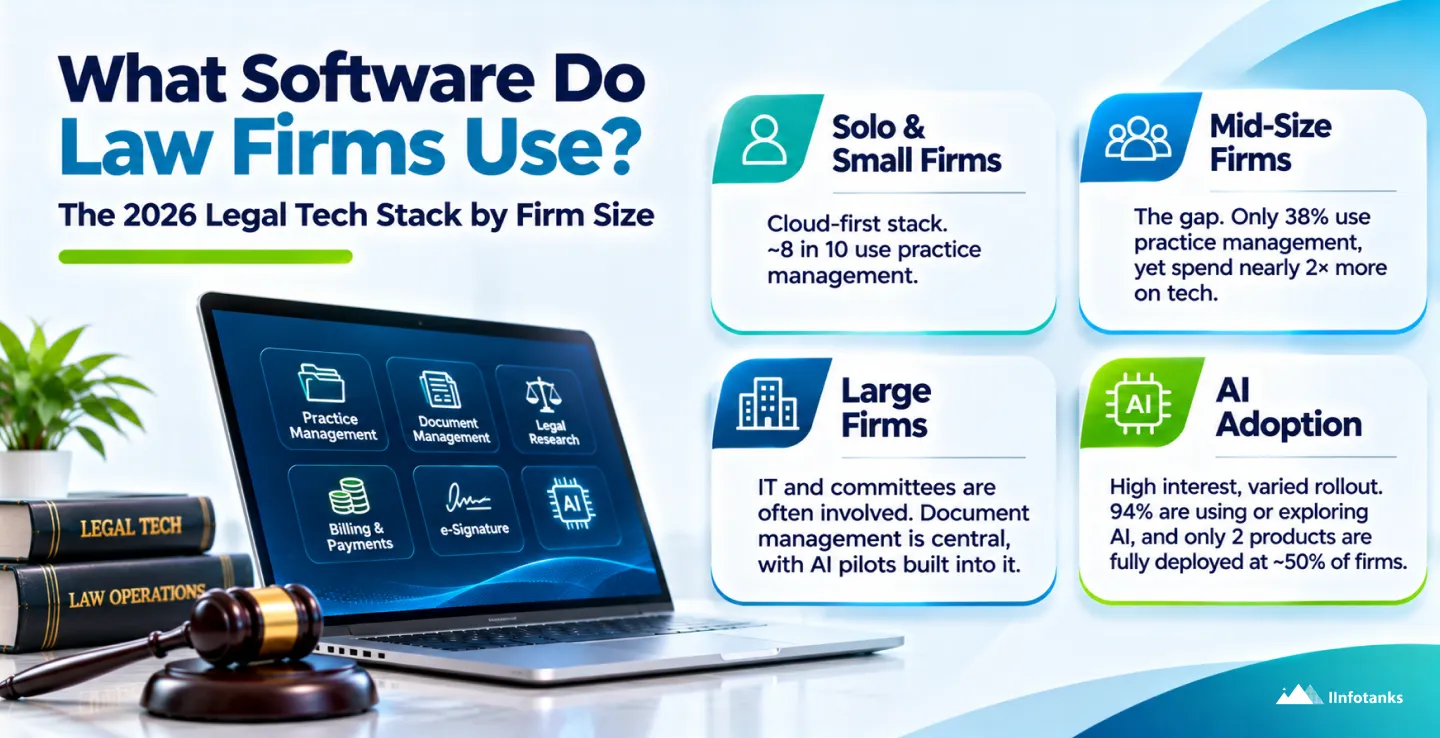
- Solo and small firms run a lean, cloud-first legal tech stack. About 8 in 10 use cloud practice management software, and the lawyer often makes the buying call.
- Mid-size firms are the gap. Clio found only 38% use legal practice management software, even though they spend nearly double the industry average on technology.
- Large firms often involve IT and committees in purchases. Document management sits at the center, and the AI pilots plug into it.
- AI interest is widespread, but rollout varies. In ILTA’s 2026 survey, 94% of firms were using or exploring generative AI, and only 2 products reached full deployment at half of firms.
So, what software do law firms use?
Law firms commonly use software from 6 categories, but not every firm uses every layer. The products and spending change by size.
Layer | What it does | Example products |
|---|---|---|
Practice management | Matters, contacts, tasks, deadlines | Clio, 8am MyCase, Smokeball |
Billing and accounting | Time capture, invoices, trust accounting | TimeSolv, Bill4Time, Aderant |
Document management | Stores, versions and secures files | iManage, NetDocuments |
Research | Case law and statutes | Westlaw, Lexis+, Fastcase |
Intake and CRM | Leads, consults, follow-up | Lawmatics, PracticePanther |
AI and automation | Drafting, summaries, review | Microsoft Copilot, CoCounsel, Harvey, Claude |
Those examples come from the surveys below and from vendor guides. They show what exists in law firm software and don’t rank market share. Together they make up the law firm technology a firm owns.
Here’s the same legal tech stack by firm size.
Firm size | Core stack | Typical buyer |
|---|---|---|
Solo | Cloud practice management, cloud storage, e-signature, online payments | The lawyer |
Small (2 to 9) | Practice management plus CRM, billing and a consultant | Managing partner |
Mid-size | Mixed tools, a document system, patchy practice management | Partner plus an administrator |
Large | Financial system, document management, research suites, AI pilots | IT and a committee |
Firm size labels differ by survey. Clio, the ABA and ILTA each cut their samples differently, so I’ll name the source and the bracket every time.
What belongs in a legal tech stack
A legal tech stack is every tool a firm pays for to run matters, bill clients and protect data. It splits into 2 groups. Core tools hold the firm’s records: practice management, billing and document management. Add-ons speed up the work: e-signature, intake, research and AI.
Core tools are hard to rip out. Add-ons get swapped often. For a vendor, that’s the gap between a 3-year relationship and a 6-month trial. The everyday parts count too. Cloud storage and video conferencing show up in Clio’s adoption figures because nearly every firm has them, so they set the floor of the legal tech stack.
The solo legal tech stack
A solo’s legal tech stack is built around one person’s time. Clio’s 2025 report for solo and small firms found 81% of solos use cloud storage and 80% use video conferencing. 79% run cloud practice management software, 76% take online payments and 72% use e-signature. Money is tight. The ABA’s 2024 solo and small firm TechReport says 74% of solos spend under $3,000 a year on legal software. Only 41% of solo respondents budget for technology at all.
Research follows the same pattern. 45% of solos use fee-based research tools, against 78% of larger firms. And 37% of solos name Fastcase as their most-used free research site. Support is thin. Solos most often turn to consultants (35%), then online resources (28%). 59% of solos have no technology policies.
At solo practices, the lawyer is usually the main buyer. The ABA reports that 97% of solo respondents make technology decisions in-house, although some may still consult outside advisers.
The small firm legal tech stack
Small firms look like solos with a second layer on the legal tech stack. Clio’s numbers for them run slightly higher: 85% on cloud storage, 80% on video conferencing and 81% on cloud practice management software. E-signature use climbs to 78%. The extra layer is client management. The ABA found 39% of small firms use a CRM, against 31% across all firm sizes. Access to litigation support software rises from 27% for solos to 38%.
Research habits shift too. Government websites are the most-used free source at small firms (29%), and Fastcase drops to 23%. Small firms also start to buy help. 31% rely on consultants for technology support and 25% on internal staff. 55% of firms with 2 to 9 attorneys keep a technology budget.
Decisions often stay close to the partners. The ABA reports that 90% of small-firm respondents make technology choices in-house, but approval may involve a managing partner, other partners or an administrator. Only 21% of small firms lack technology policies.
The mid-size legal tech stack
Mid-size firms are where the legal tech stack gets messy. Clio’s 2025 mid-sized report found only 38% of mid-sized firms use legal practice management software, against 71% of smaller firms. Yet these firms spend about 2% of expenses on technology, nearly double the U.S. Census industry estimate. So the money is there and the central platform often isn’t. My read is that these firms buy point tools (document automation, AI research, e-signature) before they settle on one system to tie them together.
AI use increased in Clio’s mid-size research. Its 2025 survey found that 93% of surveyed legal professionals at mid-sized firms reported some AI use, compared with 19% in an earlier, differently scoped survey. In 2025, 51% reported wide or universal adoption. Popular tools included AI-powered legal research (66%), general AI tools (65%) and document automation (60%).
For a vendor, this is the opening. A mid-size firm already has the budget and has felt the gap. Ownership may be split across roles, so the pitch may need to reach both a partner who approves spending and an administrator who runs the day-to-day.
The large-firm legal tech stack
Large firms often involve IT in software purchases. The ABA reports 90% of firms with 100 or more attorneys keep a technology budget, and access to litigation support software reaches 73%, against 27% of solos. Fee-based research use sits at 78%.
The core of a large firm’s legal tech stack is heavier. Document management (iManage or NetDocuments) holds the work product, and this layer of the legal tech stack is where large firms spend the most care. Enterprise billing and financial systems (Elite 3E or Aderant) sit beside it. Research suites and e-discovery platforms plug into both.
Document management for law firms matters most for AI. In ILTA’s 2026 survey, iManage AI Enrichment, Ask iManage and NetDocuments’ ndMAX App Builder stood out in its testing and pilot results. The public summary does not establish a clear denominator for the product-specific pilot percentages, so they should not be read as shares of all responding firms. The AI layer sits on top of document management, so a firm’s document system shapes what it can adopt.
Large firms may use buying committees. Depending on the tool, vendors may need input from IT, security, knowledge management and partners. Security questionnaires and pilot plans are common, but approval paths vary.
The AI layer by firm size

AI is an emerging layer across firm sizes, though adoption and rollout vary. ILTA’s 2026 survey covers over 500 member firms and about 140,000 lawyers. It found 94% of firms using or exploring generative AI, up from 80% a year earlier.
The product mix changes with size.
Product (using or exploring) | Under 50 lawyers | 700+ lawyers |
|---|---|---|
Microsoft 365 Copilot | 59% | 88% |
Claude | 42% | 64% |
CoCounsel | 40% | 43% |
Harvey | 22% | 84% |
Legora | 6% | 47% |
Large firms reported more interest in Harvey and Legora, while smaller firms leaned toward general tools such as Microsoft 365 Copilot and Claude. The cited summary does not give figures for the middle bands.
“Using or exploring” does not mean a firm-wide rollout. In ILTA’s deployment results, 52% of respondent firms reported full deployment of “Microsoft Copilot (formerly Bing Chat)” and 50% reported Westlaw Advantage. That Copilot label differs from the paid Microsoft 365 Copilot product in the usage table.
The top uses were initial drafts, meeting notes, legal research and summarizing long documents, each in the 73% to 79% range.
The ABA’s 2024 survey asked 512 attorneys whether their offices were using AI-based tools. Overall, 30.2% said yes. Reported office use was higher at firms of 100 or more lawyers (about 46%) than among solo respondents (about 18%).
What a legal tech stack costs by tier
At the low end, 74% of solos spend under $3,000 a year on law firm software, per the ABA. That buys a practice management plan, e-signature and a research subscription at best.
Small firms add a CRM and billing tools, and 55% keep a technology budget. At mid-size firms, Clio puts technology spend at about 2% of expenses. For a firm with $10 million in expenses (a made-up round number), that’s roughly $200,000 a year.
Large firms are budgeted and committee-run. 90% of firms with 100 or more attorneys keep a technology budget, and document management for law firms at that size is a platform decision that runs through IT. For a vendor, price tolerance follows the tier. A solo compares your price to a monthly plan. A large firm compares it to a department’s annual line item.
Where the legal tech stack is heading in 2026
Reported interest and use rose, but the surveys measure different things. ILTA’s member-firm share using or exploring generative AI rose from 80% to 94%. Clio found 93% of surveyed mid-sized-firm legal professionals reported some AI use, compared with 19% in an earlier, differently scoped sample. In the ABA’s 2024 survey, 30.2% of attorney respondents said their offices used AI-based tools, up from roughly 11% in 2023.
Yet the deployment leaders reported by ILTA were Microsoft Copilot (formerly Bing Chat) and Westlaw Advantage, not evidence that all AI tools were broadly rolled out. Much of the legal tech stack is still being tested at the edges while core systems remain.
That has a practical effect on sales cycles. A firm that is piloting 5 AI tools won’t sign 5 contracts. It will keep 1 or 2 and drop the rest. The document layer is the other shift. iManage and NetDocuments sit at the top of ILTA’s pilot list, so the next wave of AI tools will be judged by how well they plug into the firm’s document system. If your product doesn’t connect to the document layer of the legal tech stack, expect that question in the first call.
Why the surveys disagree
Read every legal tech stack number with its source in mind. Clio’s solo and small firm report draws on a survey of 1,028 legal professionals and another of 1,437 Clio customers. A customer survey skews toward firms already on cloud software, and Clio sells that software.
ILTA surveys its member firms. Its sample runs 27% under 50 lawyers and 12% at 700 or more, so it speaks for firms big enough to join a trade body. The ABA’s 2024 online-research survey drew 512 attorney respondents. Its AI question asked whether their offices were using AI-based technology tools, rather than whether each lawyer personally used them.
The 94% ILTA figure covers responding member firms using or exploring generative AI. Clio’s 93% reflects surveyed legal professionals at mid-sized firms reporting some AI use. The ABA’s 30.2% reflects attorney respondents saying their offices used AI-based tools. These are different questions and populations, not competing estimates of one adoption rate. Use each figure only for the survey population and question it measures. None is a directly comparable national adoption rate.
Who buys each layer of the legal tech stack
Firm size helps identify likely buyers, budget constraints and approval steps, but responsibilities vary by firm and product.
Firm size | Likely buyer | Budget signal | Gatekeeper |
|---|---|---|---|
Solo | The lawyer | 74% spend under $3,000 a year on software | None |
Small | Managing partner | 55% keep a technology budget | A consultant, sometimes |
Mid-size | Partner plus administrator | About 2% of expenses on technology | Office administrator |
Large | IT, knowledge management, partners | 90% keep a budget, plus security review | A committee and an IT gateway |
Picture a made-up e-signature vendor with one email template and one list. It would reach solos who can say yes in a day and large-firm IT teams who need a security packet. Both get the same message, and both ignore it.
A solo wants a short pitch and a price. A large firm wants evidence it can show a committee.
How to sell into each tier
Build the file around firm size first. Then add practice area and seniority. A buyer of an attorney email list from IInfotanks can request records by practice setting, practice area, seniority, region and firm size, so the segmentation above maps straight onto how the file gets cut.
Here’s how I’d shape outreach for each tier.
Tier | Lead with | Call to action |
|---|---|---|
Solo | Time saved and a clear price | Free trial or a short call |
Small | Fit with their practice management tool | A demo for the managing partner |
Mid-size | Fixing the gap between tools | A scoped pilot, with the administrator copied |
Large | Security, integration with iManage or NetDocuments | A pilot plan and a security packet |
What each tier needs from a vendor
Solo lawyers often decide directly. Lead with price, setup time and a trial when those details fit the offer. Small-firm buyers often prioritize software that connects to their practice management tools. If a firm uses Clio or MyCase, relevant integrations can be a useful starting point. Check the firm’s existing setup before leading with a specific integration claim.
Mid-size buying groups often focus on a specific gap, such as intake, document automation or AI research. A partner may sponsor the purchase while an administrator coordinates evaluation. Large-firm buying groups often request integration evidence, security documentation and a pilot plan. Lead with the requirements relevant to that firm’s existing systems.
Large firms also filter vendor mail hard. Our guide to fixing the law firm email gateway covers what to check before you send. And if you’re writing to several people at one firm, our post on emailing multiple attorneys at the same firm covers how to sequence it. That matters most at mid-size and large firms, where the buying group has more than one voice.
Security and policy in the legal tech stack
Security is where firm size shows most. 59% of solos have no technology policies, against 21% of small firms. Solos also voice less concern about data privacy and security (24%) than firms of 10 to 49 attorneys (56%), according to LawSites’ write-up of the ABA survey.
Lawyers carry a duty here. Model Rule 1.1 Comment 8 asks them to keep up with the benefits and risks of relevant technology. ABA Formal Opinion 512 (2024) applies the same duty to generative AI, including competence and confidentiality.
So a security answer is part of the sale at every tier of the legal tech stack. A solo may only ask “where is my data stored?” A large firm will send a full questionnaire. Have a one-page answer ready for the first and a packet ready for the second.
How to build your own law firm technology stack
If you run a firm, work in this order. Each step builds on the one before.
- Start with practice management. Pick the system that holds your matters, contacts and deadlines.
- Add billing and trust accounting that syncs to it.
- Add document management and e-signature.
- Layer in research and intake as volume grows.
- Add AI last, and write an AI policy first.
- Review security. Check for two-factor sign-in, encryption and an incident plan.
Don’t buy a tool for each gap in your legal tech stack. Check how each piece connects to the first one.
A stack review is part of the job (see the security section above), so schedule it once a year.
Common mistakes in building a legal tech stack
Most legal tech stack problems come from the same few habits.
- Buying AI before the base. An AI tool needs clean documents and matters to read. If practice management is patchy, the AI inherits the mess.
- Skipping the policy. 59% of solos have no technology policies, and the gap closes slowly as firms grow.
- Ignoring connections. Five tools that don’t talk to each other cost more than three that do.
- Copying a bigger firm. A 700-lawyer firm’s stack needs IT staff to run it. A 5-lawyer firm will drown in it.
How IInfotanks builds attorney files by firm siz

IInfotanks builds attorney files around the segment you sell into. You can request records by practice setting, practice area, seniority, region and firm size. Our guide to placing a custom attorney data order walks through the filters and fields.
You can start with a masked sample before you commit. Share your product, the firm size you want and the region, and the scoping team will work through the cut with you.
Frequently asked questions
1. What software do law firms use?
Law firms use practice management, billing and accounting, document management, research, intake and AI tools. Solo and small firms lean on cloud practice management, while large firms add enterprise document and financial systems.
2. What is a legal tech stack?
A legal tech stack is the set of software a firm uses to run its work, from practice management to AI. The legal tech stack changes with firm size and budget.
3. What practice management software do law firms use?
Common examples include Clio, 8am MyCase and Smokeball. Clio’s 2025 report found 79% of solos and 81% of small firms use cloud practice management software.
4. What software do large law firms use?
Large firms typically run document management such as iManage or NetDocuments, enterprise financial systems and research suites, plus AI pilots. The ABA found 73% of large firms have access to litigation support software.
5. How much do law firms spend on software?
74% of solos spend under $3,000 a year on legal software, according to the ABA’s 2024 report. Clio found mid-sized firms spend about 2% of expenses on technology.
6. How many law firms use AI?
It depends on the measure. ILTA’s 2026 survey found 94% of responding member firms using or exploring generative AI. In the ABA’s 2024 survey, 30.2% of attorney respondents said their offices were using AI-based tools. Neither figure represents all US law firms.
7. Do small law firms use cloud software?
Yes. Clio’s 2025 report found 85% of small firms use cloud storage and 81% use cloud practice management software.
8. Who buys software at a law firm?
It depends on size and the product. Solo lawyers often decide directly; small firms may involve a managing partner or administrator; larger firms commonly involve IT, security and partners. The ABA reports that 97% of solo respondents make technology decisions in-house.
9. How do you sell software to law firms?
Segment by firm size first, because the buyer, budget and gatekeeper change with it. Then match the message to the practice area and seniority.
10. Where can you find an attorney email list by firm size?
IInfotanks can build an attorney email list filtered by firm size, practice setting, practice area, seniority and region. Request a masked sample before you buy.