

Most vendors selling to legal departments type “general counsel” into a filter and call it a day. Then the deal stalls, because the person who owns the process has a different title. That’s the first lesson of selling to legal departments. A targeted in-house counsel email list exists for exactly this reason: the lawyers below the top seat are often the ones who evaluate your product.
Picture a made-up contract software vendor that emails 4,000 general counsel and gets 6 replies. The pitch was fine. It went to the signer, and the person who would have championed it never saw it.
This guide breaks down in-house counsel vs general counsel vs outside counsel as buyers, and compares in-house counsel vs outside counsel on budget and influence. It covers who decides, who influences, who pays, and how that changes selling to legal departments in 2026. It also shows how to spot the legal department decision makers who matter.
TL;DR: who to target and why
- The general counsel often sponsors or approves major legal tech purchases, but approval authority varies by company. In-house counsel below them often evaluate and use the product.
- Legal operations professionals often start the purchase, and many vendors never write to them.
- Outside counsel is a separate market. Law firms buy software and services too, but through a different chain.
- Selling to legal departments works best with 2 or 3 contacts per account, each with a message built for the role.
- Selling to legal departments in a tight-budget year means leading with efficiency and leaving growth language out.
Three titles, three different jobs
The terms get mixed up constantly, and the mix-up wrecks targeting. Here’s the clean split.
Role | Who employs them | What they own | What they usually buy or influence |
|---|---|---|---|
General counsel (GC) | The company | The legal function, risk and the board relationship | Strategic platforms, legal AI, budget approval |
In-house counsel | The company | Day-to-day legal work inside one business | Tools they use daily, vendor recommendations |
Outside counsel | A law firm | One matter or a panel relationship | Their own firm’s software and services |
A general counsel is an in-house lawyer, but most in-house lawyers aren’t general counsel. Titles also stretch. At a small company, the “general counsel” can be the only lawyer on payroll.
So a filter on one title will miss most of the legal department. In selling to legal departments, that’s the costliest mistake. That’s the core problem with selling to legal departments through a single-title list.
How to read a legal department org chart
Before you build a list, it helps to know what the chart looks like. Titles vary by company, but a mid-size or large department often runs in layers.
The general counsel or CLO sits on top. Deputy and assistant general counsel manage groups of lawyers. Senior counsel and counsel handle matters, often with a specialty. Legal operations sits beside the lawyers, and paralegals support them.
For selling to legal departments, each layer matters for a different reason. The top layer approves, the middle layer champions, the specialists test, and operations runs the process.
A small company flattens all of that. One lawyer may hold every role, so a legal department decision makers list for a small account has 1 name on it, not 5.
What the general counsel decides in selling to legal departments
The general counsel is often an important approval stakeholder. BrightFlag’s guide on buying legal tech emphasizes GC buy-in, but approval routes and spending authority vary by organization.
Approval and discovery are different. Legal operations or another team member often researches tools and frames the need, but the GC can also initiate a search for new technology.
The GC also faces a credibility gap. Thomson Reuters Institute’s 2026 State of the Corporate Law Department report found 86% of GCs say their department is a significant contributor to the business, while 17% of other C-suite executives agree.
That gap shapes the GC’s buying logic. A tool that helps them show value to the CEO and CFO lands better than one that only saves lawyers time.
The same report says the share of GCs naming technology as a strategic priority doubled entering 2026. For vendors, that’s a real opening, and it’s one reason the GC remains a target in any plan for selling to legal departments. If you’re after the top seat across industries, our CLO email list covers the chief legal officer and general counsel level.
Who buys legal technology: the full committee
If you ask who buys legal technology, “the GC” is only part of the answer. BrightFlag’s 2024 guide identifies 7 potential stakeholder groups: legal operations, procurement, the general counsel, finance, IT, attorneys and paralegals, and business partners outside legal such as sales or FP&A. Not every purchase involves all 7 groups.
Each group asks a different question. Legal operations asks whether it saves time. Procurement asks about price, and it runs the RFP when one is required. Finance asks whether it controls cost. IT asks whether it’s secure and integrates with current systems.
For AI tools, the guide says IT reviews how the AI handles and stores legal data. So a deal for an AI product can stall at a security review after the lawyers have already said yes.
You won’t email all 7 groups, and you shouldn’t. But knowing who buys legal technology tells you which objections to answer in your first message. A GC who has to take your product to IT and procurement wants help doing that.
The in-house counsel layer below the GC
Below the general counsel sit deputy general counsel, assistant general counsel, senior counsel and specialty counsel for privacy, employment, IP and contracts. This is where in-house counsel vs general counsel stops being a question of seniority and becomes a question of job.
These lawyers are the daily users. BrightFlag’s guide puts attorneys and paralegals in that seat and notes that their support can sway whether a tool gets bought.
They also do the first filtering that shapes selling to legal departments from the inside. A specialty counsel who handles privacy will test a privacy tool long before the GC hears its name.
At companies without a legal operations team, the same guide says another in-house team member, such as an assistant general counsel, builds the business case. So the AGC is often your real champion.
This is also where the volume sits. The general counsel is one seat per company, while the layer below can be many seats. A list that stops at the top title leaves the champions out.
The legal operations seat many vendors skip
Legal operations professionals often aren’t “counsel” at all, which makes them easy to miss when selling to legal departments. They run budgets, vendors and technology for the department, so they rarely show up in a title search for lawyers. BrightFlag’s guide says legal operations typically starts the buying process, identifies pain points and builds the business case. That makes them the most useful first contact for process tools.
CLOC’s 2026 State of the Industry Report backs up the scope. It lists technology strategy (80%), financial management (72%) and outside counsel and vendor management (62%) as the main focus areas for legal operations.
In CLOC’s survey of 135 departments at companies with median revenue of $13 billion, 85% reported dedicated AI oversight or resources. This finding reflects a large-company-skewed sample, not all legal departments. If you sell AI tools, legal operations may be involved early.
CLOC’s report draws on the 2025 Harbor Law Department Survey of 135 departments with median revenue of $13 billion, so it describes large departments best. Smaller companies often have no legal operations role, and the work falls to the GC or an AGC.
Where outside counsel fits in selling to legal departments
Outside counsel plays 2 roles for a vendor. They’re a target when you sell to law firms, and they’re a gatekeeper when your product touches matters a firm handles. On the target side, firms buy research, e-discovery, document management, insurance and training. Firm size sets the buyer: a solo decides alone, while a large firm routes through IT and committees. If law firms are your market, our law firms email list segments by firm.
On the gatekeeper side, panels are shrinking. The 2025 ACC and Major, Lindsey & Africa benchmarking report, drawn from nearly 400 legal departments, found the median number of law firms used fell from 14 to 10 in a year.
Fewer firms means each panel firm carries more weight with the department, which matters in selling to legal departments through outside counsel. A vendor whose tool saves a panel firm time may get a referral into the client. That said, don’t treat outside counsel as a shortcut. Outside lawyers are paid by the matter, and the department decides what software it adopts.
What each legal department decision maker cares about
Messages land when they match the role. Here’s what the sources above suggest each legal department decision maker wants to hear.
Role | What they worry about | Proof they want | Angle for the first email |
|---|---|---|---|
General counsel | Showing value to the C-suite, risk | Business impact, peer references | Risk reduction and visible results |
Deputy or assistant GC | Team capacity, building the case | Time saved, adoption plan | A short business case they can forward |
Specialty in-house counsel | Accuracy, fit with their work | A demo on their own use case | How it handles one task they do weekly |
Legal operations | Cost, process, vendor sprawl | Metrics, integrations | Efficiency and spend control |
Outside counsel | Client service, firm economics | Fit with firm systems | Time saved on matters they bill |
The first 4 rows draw on the buyer roles and CLOC and TRI data covered above. The outside counsel row is my own judgment.
What AI adoption means for selling to legal departments

AI changes who gets involved in a purchase. The 2025 ACC and MLA benchmarking report found the share of companies implementing AI tools rose from 34% to 52% year over year.
Thomson Reuters Institute’s 2026 report says almost half of corporate legal departments have some type of enterprise-wide GenAI tool, and the share of GCs calling AI a strategic imperative doubled.
CLOC adds the structure: in its survey of 135 departments at companies with median revenue of $13 billion, 85% reported dedicated AI oversight or resources. That finding reflects the surveyed departments, not a universal rate for corporate legal teams.
For selling to legal departments, that cuts both ways. Interest is high, but so is scrutiny. Expect questions on data handling, accuracy and governance in the first call, and put the answers in your outreach.
Where the money sits: in-house counsel vs outside counsel spend
Budget tells you who has leverage when selling to legal departments. According to the 2026 ACC benchmarking report, as covered by Global Legal Post, outside counsel rose to 47% of overall legal spend, from 45% a year earlier.
The same coverage shows median legal spend at 0.43% of revenue, down from 0.53%, the lowest in six years. Technology made up 5% of legal spend and alternative legal service providers 3%.
Measure (ACC 2026 benchmarking) | Figure |
|---|---|
Outside counsel share of legal spend | 47%, up from 45% |
Median legal spend as share of revenue | 0.43%, down from 0.53% |
Technology share of legal spend | 5% |
Alternative legal service providers share | 3% |
Employees supported per lawyer (median) | 367, up from 300 in 2021 |
Those numbers come from 576 legal departments in 45 countries. Read them as a pressure gauge: spend is tight, and each lawyer covers more of the company.
In selling to legal departments, tight budgets favor sellers who can show hours saved or outside spend avoided. Nice-to-have pitches stall.
Why the spending numbers disagree
Spend sentiment comes from several surveys, and they don’t match, which complicates selling to legal departments. CLOC found 37% of departments expect outside counsel spend to rise, down from 58% the prior year.
Thomson Reuters Institute found 36% of GCs expected to increase outside counsel spend as of Q4 2025, while 20% planned to decrease. And as Legal Dive reported in January 2025, almost 45% of CLOs in ACC’s survey were increasing outside counsel spend.
About 4 in 10 respondents expected an increase, but the surveys cover different years, samples and questions. These are expectations, not actual spending growth. CLOC’s share expecting higher outside counsel spend also fell from 58% to 37%, suggesting more caution about future budgets rather than proof that spending is growing slowly.
That’s useful for selling to legal departments. Lead with efficiency and outside-spend control, and keep growth language out of the first email.
Trigger events for selling to legal departments
Timing matters as much as title. Legal Dive’s January 2025 coverage of ACC’s CLO survey names several pressures behind rising outside spend.
More complex litigation and investigations push costs up, and ACC’s own summary says more complexity results in higher costs. The same article says being understaffed is the biggest barrier legal departments face.
Almost a quarter of CLOs said their company faced an investigation in the prior year. More than 40% reported more lawsuits, and almost 40% said those suits were more complex.
Those are trigger events. A department that just opened an investigation or lost headcount has a live problem and a reason to listen. Outreach tied to one of those events beats a generic pitch.
Also watch hiring. Half of CLOs at companies with $1 billion or more in revenue, and about a third at smaller companies, were increasing lawyer hires. New hires bring new tool needs and new budget conversations.
Which title to target for what you sell
The best first contact for selling to legal departments depends on the product. This table is my judgment based on the buyer roles above, so test it against your own pipeline.
What you sell | Start with | Then add | Likely blocker |
|---|---|---|---|
Contract management | Legal operations or AGC | GC | IT and procurement |
E-billing and spend tools | Legal operations | GC and finance | CFO or procurement |
Legal research and AI tools | Specialty in-house counsel | GC and legal operations | IT security review |
Compliance and privacy software | Privacy or compliance counsel | GC | IT |
E-discovery and litigation support | Litigation counsel | GC and outside counsel | Panel firm preference |
Training and CLE | Deputy or assistant GC | GC | Budget owner |
Software for law firms | Managing or practice-group partner | IT at large firms | Committee |
BrightFlag’s guide adds finance to the picture of selling to legal departments. The CFO decides whether legal gets budget, and favors tools that cut spend, such as e-billing tools that flag billing violations.
IT assesses integration and security, and procurement runs any RFP. Each is a blocker you can plan around.
How company type changes selling to legal departments
Legal teams don’t scale evenly, and that changes how you approach selling to legal departments. The 2025 ACC and MLA report found lawyers per $1 billion in revenue run at 10.2 in information companies, 9.7 in professional services, 7.8 in pharmaceuticals and medical devices, and 7.7 in finance.
By 2026, the median had fallen to 3 lawyers per $1 billion, down from a range of 3.6 to 4.2 over the previous five years. Departments are leaner overall.
For targeting, that means 2 things. First, a regulated, lawyer-heavy sector like finance or pharma gives you more in-house counsel per account. Second, a lean department means fewer seats, so the right 2 contacts matter more than 10.
If you need a segment cut by industry, company size and seniority, our guide to placing a custom attorney data order covers the filters.
How to sequence outreach when selling to legal departments
Selling to legal departments works best as a small, staged campaign. A single blast stalls.
- Start with the role closest to the problem. For process tools that’s legal operations, and for subject tools it’s the specialty counsel.
- Add the AGC or deputy GC a few days later with a business-case angle.
- Bring in the GC with a short note on risk reduction or proof of value for the C-suite.
- Send each person a different message. Don’t forward the same email up the chain.
Each message in selling to legal departments needs a different promise. Operations wants time and cost. Specialty counsel wants accuracy and fit. The GC wants risk reduction and something to show the CEO.
Keep the sequence short when selling to legal departments. A legal department sees dozens of vendor emails, and a tight 3-step sequence reads better than 8 touches.
Common mistakes in selling to legal departments
- Filtering on “general counsel” only. You reach the signer and miss the champion.
- Skipping legal operations. The person who starts the process never hears from you.
- Treating outside counsel as the buyer. A law firm lawyer doesn’t pick the department’s software.
- Sending one message to every title. A GC and a privacy counsel care about different things.
- Ignoring company size. Small companies may have 1 lawyer and no legal operations team.
- Pitching growth in a tight-budget year. The numbers above favor efficiency.
How IInfotanks builds legal department files
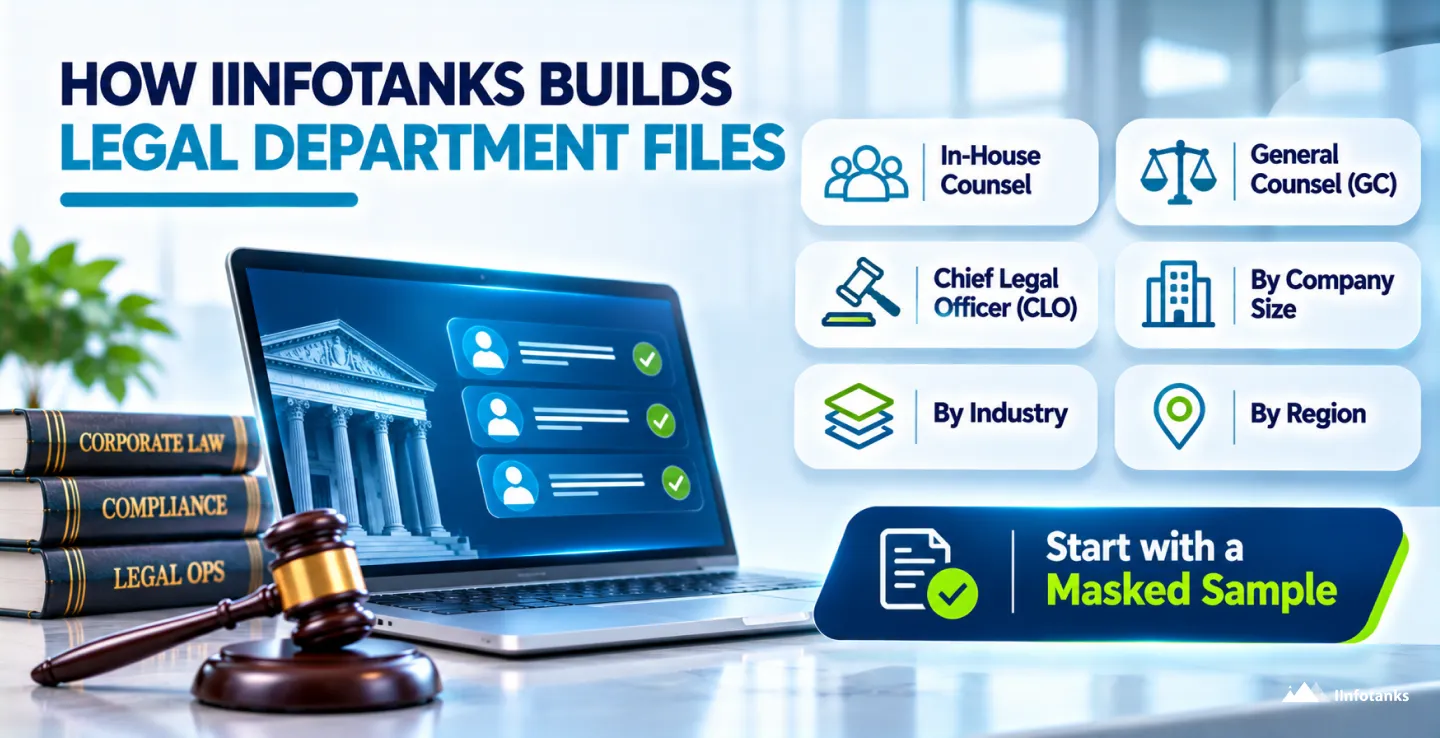
IInfotanks builds legal department files around the segment you sell into, which suits selling to legal departments by role. You can request in-house counsel contacts by title, seniority, company size, industry and region, and you can add general counsel and CLO records when you need the top seat as well.
Start with a masked sample so you can check field depth before you commit. Tell the scoping team your product, the roles you want and the industries you serve, and they’ll map the cut with you.
Frequently asked questions about selling to legal departments
1. What is the difference between in-house counsel and general counsel?
In-house counsel is any lawyer employed by a company. The general counsel is the most senior one, who leads the legal department and often sits on the executive team.
2. What is the difference between in-house counsel and outside counsel?
In-house counsel works for one company as an employee. Outside counsel works for a law firm and takes on matters for clients, including that company.
3. Who buys legal technology at a company?
Legal operations may initiate an evaluation, while the GC may sponsor or approve a purchase. Finance, IT, procurement and end users may also be involved. BrightFlag’s guide describes potential stakeholders, not a required approval sequence.
4. Who should I target when selling to legal departments?
For selling to legal departments, start with the role closest to the problem, usually legal operations or specialty in-house counsel. Add the GC with a message about risk reduction or business value.
5. Is the general counsel the decision maker?
The GC is often an important sponsor or approver, but not always the sole decision-maker. Legal operations or other counsel may initiate the search, while finance, IT and procurement may share review or approval responsibilities.
6. Do outside counsel choose the software a legal department uses?
No. The department owns the purchase. Outside counsel can influence it when a tool affects matters they handle.
7. How many law firms does a legal department use?
The 2025 ACC and MLA benchmarking report found the median number of firms used fell from 14 to 10 in a year.
8. How much of legal spend goes to outside counsel?
ACC’s 2026 benchmarking report, as covered by Global Legal Post, puts outside counsel at 47% of overall legal spend, up from 45%.
9. Do small companies have legal operations teams?
Many don’t. CLOC’s 2026 data comes from large departments with median revenue of $13 billion, so at smaller companies the GC or an assistant general counsel often runs the work.
10. Where can I find an in-house counsel email list?
IInfotanks builds in-house counsel email lists by title, company size, industry and seniority. Ask for a masked sample before you buy.